Manila: Pasig River Cruise with Ambeth Ocampo
29 January 2007
"Manila took a long time to make. What is now its ground used to be sea. The sea reached as far as the present towns of Mandaluyong (‘a place of waves’) and Makati (‘a place of tides’). No one knows how long it took to turn sea into land. But we do know who built a site for Manila. The builder was the Pasig River."
Such were the words National Artist for Literature Nick Joaquin wrote in his book Manila, My Manila.
It was, and is, the Pasig river who built, and continuously building, Manila. Technically a tidal estuary, the direction of flow is determined by the water level difference between Laguna de Bay and Manila bay.
I happened to read a posting in one of my yahoogroups I'm lurking in about the Ayala Museum-Pasig River Rehabilitation Council sponsored Historic Tour of the Pasig River as part of their Ode to the Pasig River painting exhibit at the Ayala Museum I blogged about here plus the post about the upcoming Pasig River Ferry system Pasig River Ferry terminals and schedules.
Sensing the urgency and limited slots available for the tour, I made a quick call to the posted number and reserved me a seat and paid promptly since Ayala Museum is very near my place.
On the day of the cruise, the organizers and participants met up at the Ayala Museum then boarded vans that took us to Isla de Convalencia occupied by Hospicio de San Jose where a ferry is waiting for us to cruise the historic river who built Manila.
 The Tour, with about 20 people, including media people and a Coast guard personnel, was enlivened by Prof. Ambeth Ocampo, the current chair of the National Historical Commission, with his authoritative information spiced up with historical gossips and trivia.
We set sail westward heading towards the mouth of the once beautiful river passing Ayala Bridge, Quiapo, Arroceros Park, Quezon Bridge, Sta Cruz, Intramuros, MacArthur bridge, Binondo, Parola and Baseco before turning around going the opposite direction retracing the water to Isla de Convalencia, our "anchorage", passing through the once millionaire's district of San Miguel, the regal Goldenberg Mansion and picture-perfect yet picture-censored Malacanang Palace, Mabini Shrine, Nagtahan bridge (where our Coast Guard escort left us), Pandacan, Sta Ana, Makati, Mandaluyong, Pasig and Marikina before turning around again to Guadalupe where waiting vans took us to see the exhibits of paintings and artists’ rendition of their dreams for the beauty that was Pasig
Join me as I take you with me in my tour of the once pristine river

the Baluarte de Santa Barbara, named after the patron saint of artillery men. Storage cells and powder magazine used as dungeons. Ambeth narrated prisoners often drowned when the tides are high

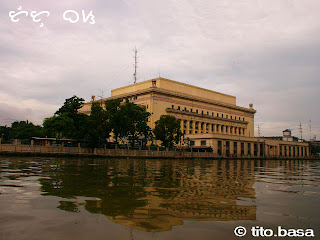
the post office building: a Juan Arellano masterpiece along with the nearby Jones Bridge, Metropolitan Theater and Executive house (now the National Museum)

closer view of the river-facing facade (alright I cheated here. I replaced the grey sky with blue one)
To be continued...
Related Posts:
Pasig River Lighthouse,
Pasig River Structures,
People of Pasig,
Bridges of Pasig River.
Such were the words National Artist for Literature Nick Joaquin wrote in his book Manila, My Manila.
It was, and is, the Pasig river who built, and continuously building, Manila. Technically a tidal estuary, the direction of flow is determined by the water level difference between Laguna de Bay and Manila bay.
I happened to read a posting in one of my yahoogroups I'm lurking in about the Ayala Museum-Pasig River Rehabilitation Council sponsored Historic Tour of the Pasig River as part of their Ode to the Pasig River painting exhibit at the Ayala Museum I blogged about here plus the post about the upcoming Pasig River Ferry system Pasig River Ferry terminals and schedules.
Sensing the urgency and limited slots available for the tour, I made a quick call to the posted number and reserved me a seat and paid promptly since Ayala Museum is very near my place.
On the day of the cruise, the organizers and participants met up at the Ayala Museum then boarded vans that took us to Isla de Convalencia occupied by Hospicio de San Jose where a ferry is waiting for us to cruise the historic river who built Manila.
 The Tour, with about 20 people, including media people and a Coast guard personnel, was enlivened by Prof. Ambeth Ocampo, the current chair of the National Historical Commission, with his authoritative information spiced up with historical gossips and trivia.
We set sail westward heading towards the mouth of the once beautiful river passing Ayala Bridge, Quiapo, Arroceros Park, Quezon Bridge, Sta Cruz, Intramuros, MacArthur bridge, Binondo, Parola and Baseco before turning around going the opposite direction retracing the water to Isla de Convalencia, our "anchorage", passing through the once millionaire's district of San Miguel, the regal Goldenberg Mansion and picture-perfect yet picture-censored Malacanang Palace, Mabini Shrine, Nagtahan bridge (where our Coast Guard escort left us), Pandacan, Sta Ana, Makati, Mandaluyong, Pasig and Marikina before turning around again to Guadalupe where waiting vans took us to see the exhibits of paintings and artists’ rendition of their dreams for the beauty that was Pasig
Join me as I take you with me in my tour of the once pristine river

the Baluarte de Santa Barbara, named after the patron saint of artillery men. Storage cells and powder magazine used as dungeons. Ambeth narrated prisoners often drowned when the tides are high


the post office building: a Juan Arellano masterpiece along with the nearby Jones Bridge, Metropolitan Theater and Executive house (now the National Museum)

closer view of the river-facing facade (alright I cheated here. I replaced the grey sky with blue one)
To be continued...
Related Posts:
Pasig River Lighthouse,
Pasig River Structures,
People of Pasig,
Bridges of Pasig River.
Labels: History, Manila, Metro Manila, National Capital Region, Rivers
posted by GingGoy @ 9:02 PM,
,


History and Legend of Ati-atihan Festival in Kalibo, Aklan
24 January 2007
It's the Sto Nino month once again this time of year so I'm sharing pictures of the Ati-atihan festival in Kalibo in 2004 (using a borrowed Pentax digital camera from an officemate. 'twas only a few months later when I bought my first digicam: the Canon Ixus IIs)
The Ati-atihan Festival is a centuries old tradition of Aklanons commemorating the arrival of the 10 datus from Borneo.
What was once a legendary celebration whose story, handed down through oral tradition, was later turned by the Spanish colonizers into a religious festival honoring the Sto Nino. It's present form is a mixture of religious celebration, hedonistic revelries and bacchanalian festivities. What sets apart this festival from the Sinulog of Cebu is that people can be part of the grand parade of colors and not merely spectators and kibitzers.
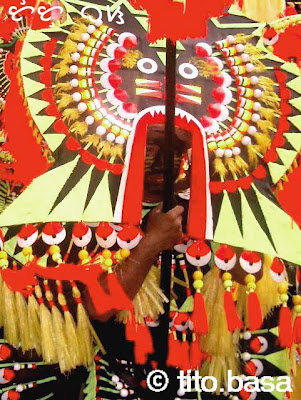

The legend of the Ten Datus from Borneo is generally accepted by modern historians but the story of the barter of Panay with Datu Puti, leader of the ten Bornean datus on board balanghays, gave Marikudo, the local chieftain, a golden salakot in exchange for occupying the land, is now debunked due to claims that the Ati people, up to this time, are basically gatherers of the land and do not engage in land possession.
Modern historians also argue that if the indeed the golden salakot was really given, it would have been just a gift and not a barter in exchange for "land titles."
So many things I learned about history taught me by my teachers that are no longer accepted yet I still see many of them being passed around like the hoaxes of Kalantiaw, Maragtas and so many others. I wish to find the time to post them here.
By the way, if you don't have the time and money to catch a plane for the upcoming Dinagyang in Iloilo, why not set out on a journey to my hometown, Paete, to witness another celebration in honor of the Sto Nino where people douse each other with water particularly those wearing red.
The festivity, called Salibanda, held on the last Sunday of January, ends with a fluvial procession on the shores of Laguna de Bay. This celebration, like almost everything else, reeks with fanaticism bordering on idolatry having lost the true spirit of celebration.
Also Recommend protecting your expensive cameras from water or better bring waterproof ones :)
The Ati-atihan Festival is a centuries old tradition of Aklanons commemorating the arrival of the 10 datus from Borneo.
What was once a legendary celebration whose story, handed down through oral tradition, was later turned by the Spanish colonizers into a religious festival honoring the Sto Nino. It's present form is a mixture of religious celebration, hedonistic revelries and bacchanalian festivities. What sets apart this festival from the Sinulog of Cebu is that people can be part of the grand parade of colors and not merely spectators and kibitzers.


The legend of the Ten Datus from Borneo is generally accepted by modern historians but the story of the barter of Panay with Datu Puti, leader of the ten Bornean datus on board balanghays, gave Marikudo, the local chieftain, a golden salakot in exchange for occupying the land, is now debunked due to claims that the Ati people, up to this time, are basically gatherers of the land and do not engage in land possession.
Modern historians also argue that if the indeed the golden salakot was really given, it would have been just a gift and not a barter in exchange for "land titles."
So many things I learned about history taught me by my teachers that are no longer accepted yet I still see many of them being passed around like the hoaxes of Kalantiaw, Maragtas and so many others. I wish to find the time to post them here.
By the way, if you don't have the time and money to catch a plane for the upcoming Dinagyang in Iloilo, why not set out on a journey to my hometown, Paete, to witness another celebration in honor of the Sto Nino where people douse each other with water particularly those wearing red.
The festivity, called Salibanda, held on the last Sunday of January, ends with a fluvial procession on the shores of Laguna de Bay. This celebration, like almost everything else, reeks with fanaticism bordering on idolatry having lost the true spirit of celebration.
Also Recommend protecting your expensive cameras from water or better bring waterproof ones :)
Labels: Aklan, Festivals, History, Western Visayas
posted by GingGoy @ 7:50 PM,
,
Fireworks Photos of 2nd World Pyro Olympics
17 January 2007
Photos from the 2nd day of the World Pyro Olympics at the Esplanade, SM Mall of Asia where we braved humongous traffic going and getting out of :(
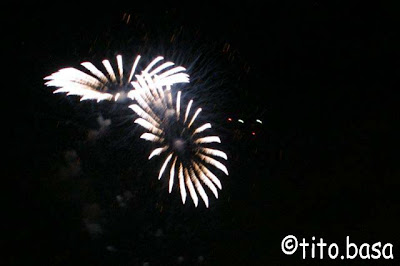


I have a really good view with my tripod perched on top of a huge rock as you can see from the picture before a cameraman, might be from a tv network blocked my view without even saying sorry or excuse me. Instead of thinking something nasty, I just included him in my composition that turned our quite well.
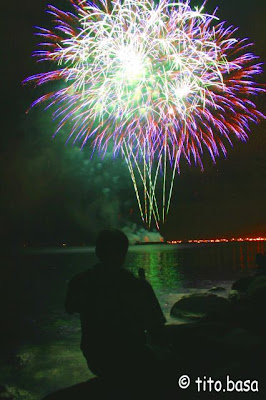
My first time actually to take fireworks pictures where I got washed out pictures of the first ones I took but I found out my optimum settings for use that night:
Manual Mode
Manual Focus
F8
ISO100
Bulb
tripod in use
that's not all, the biggest hurray for me was my DIY remote control for my 300D with details in my other blog here.

(i really need to study lighting also but more on DIY lighting setup to save on my hard-earned pesos)
Check out my other pictures in my Multiply accout that goes by the same name:
Tutubi Patrol
lastly, Lady Luck abandoned me when my eyeglasses fell off deep into the crevices of the large rocks of Manila Bay.
time to visit Quiapo again to buy me a new pair as well as numerous other stuff.
Looking forward to World Pyro Olympics 2008 :)


I have a really good view with my tripod perched on top of a huge rock as you can see from the picture before a cameraman, might be from a tv network blocked my view without even saying sorry or excuse me. Instead of thinking something nasty, I just included him in my composition that turned our quite well.

My first time actually to take fireworks pictures where I got washed out pictures of the first ones I took but I found out my optimum settings for use that night:
Manual Mode
Manual Focus
F8
ISO100
Bulb
tripod in use
that's not all, the biggest hurray for me was my DIY remote control for my 300D with details in my other blog here.

(i really need to study lighting also but more on DIY lighting setup to save on my hard-earned pesos)
Check out my other pictures in my Multiply accout that goes by the same name:
Tutubi Patrol
lastly, Lady Luck abandoned me when my eyeglasses fell off deep into the crevices of the large rocks of Manila Bay.
time to visit Quiapo again to buy me a new pair as well as numerous other stuff.
Looking forward to World Pyro Olympics 2008 :)
Labels: Events, Festivals, Metro Manila, National Capital Region
posted by GingGoy @ 9:08 PM,
,
The Philippine International Hot Air Balloon Fiesta
12 January 2007
Do check this out on Feb 8-11, 2007 530am - 730pm:
"The Philippine International Hot Air Balloon Fiesta never fails to bring its audience exciting surprises. Topping the list is our new-found home at the Armed Forces of the Philippines (AFP) grounds. Though it entails more work for the organizing committee, this promises to make the events for spectacular to the audience. Still within the vicinity of Clark Airfield Pampanga, more space will allow better view from the crowd area, perfect for kite-flying, bigger area for our picnics and bazaars. The partnership with the AFP also assures better security not just for our guests but for our flying machines as well."
quite a long post if I put all info I got here. leave a comment if you want to receive info of the event.
I'm having finacial constraints plus limited time but I'm inviting my photo-buddy friends to visit this one. Hope I make it this time :)
"The Philippine International Hot Air Balloon Fiesta never fails to bring its audience exciting surprises. Topping the list is our new-found home at the Armed Forces of the Philippines (AFP) grounds. Though it entails more work for the organizing committee, this promises to make the events for spectacular to the audience. Still within the vicinity of Clark Airfield Pampanga, more space will allow better view from the crowd area, perfect for kite-flying, bigger area for our picnics and bazaars. The partnership with the AFP also assures better security not just for our guests but for our flying machines as well."
quite a long post if I put all info I got here. leave a comment if you want to receive info of the event.
I'm having finacial constraints plus limited time but I'm inviting my photo-buddy friends to visit this one. Hope I make it this time :)
Labels: Events
posted by GingGoy @ 9:37 PM,
,
Something More About Paete
10 January 2007
Pictures of Paete taken April 2006 using Canon Ixus 30:

Wawa park before sunset

sunset over Rizal Province and Laguna de Bay. This picture is also the one used by the heartwarming slideshow A Parent's Wish available here.

View of Paete town, the tail-end is where Wawa Park is located.

The Three Crosses standing on top of the hill of the Sierra Madre overlooking the town and acting as shield against typhoons coming from the Pacific Ocean and Quezon Province
The 3 Crosses can be reached via a 45 minute trek through concrete steps from the town proper. Descent takes only about 15 minutes. "Over the hill" people can however reach the summit on a vehicle via a feeder road winding through the barrio of San Antonio, Kalayaan town.
On your way to the summit, you will also pass by this lagoon carved out by a waterfall feeding the rivulet that runs through the center of the town


Wawa park before sunset

sunset over Rizal Province and Laguna de Bay. This picture is also the one used by the heartwarming slideshow A Parent's Wish available here.

View of Paete town, the tail-end is where Wawa Park is located.

The Three Crosses standing on top of the hill of the Sierra Madre overlooking the town and acting as shield against typhoons coming from the Pacific Ocean and Quezon Province
The 3 Crosses can be reached via a 45 minute trek through concrete steps from the town proper. Descent takes only about 15 minutes. "Over the hill" people can however reach the summit on a vehicle via a feeder road winding through the barrio of San Antonio, Kalayaan town.
On your way to the summit, you will also pass by this lagoon carved out by a waterfall feeding the rivulet that runs through the center of the town

Labels: Calabarzon, Laguna, Paete, Parks, Sierra Madre, Southern Tagalog, Waterfalls
posted by GingGoy @ 9:33 PM,
,
Something About Paete
05 January 2007
Let me share some pictures of Paete I took during the Christmas break, mostly taken in Wawa Park which is presently submerged due to the rising water of Laguna de Bay:
(click on the images for a larger view)

Wawa Park submerged

Bird Watching mode (wish I could zoom in). Chinese egrets can be seen from a distance but my lens can't zoom in

The boat by the lake. You can also see the long tube that connects Laguna de Bay to Caliraya lake
(click on the images for a larger view)

Wawa Park submerged

Bird Watching mode (wish I could zoom in). Chinese egrets can be seen from a distance but my lens can't zoom in

The boat by the lake. You can also see the long tube that connects Laguna de Bay to Caliraya lake
Labels: Calabarzon, Laguna, Lakes, Paete, Southern Tagalog
posted by GingGoy @ 10:17 PM,
,
Pateros: Balut, Salted Eggs, and Alfombra
03 January 2007
Pateros, a town in Metro Manila named after the pato, ducks, Garden of Memories where a dad of Tutubi's close friends is buried.
With the recent cityhood of San Juan, Pateros now became the lone municipality of Metro Manila. It's also a small town with no government hospital and public market. With it's narrow streets, the municipality is a walkable town with tourist attractions focused mainly on it's industries of salted eggs, balut (that infamous aborted duck embryo served hot) and alfombra footwear.
How to make salted eggs? Salted eggs, called itlog na maalat or itlog na pula, making process is quite simple. The eggs are wrapped with salt-saturated mud, no ordinary mud but mud "quarried" from termite hills, and stored for 18 days. To color the eggs red, they use crystals called grana
How to make balut? Also simple, they just store the eggs in large containers for 18 days in the balutan, with the old eggs on top of new ones to incubate. Then the eggs are quality-tested by examining each egg under a bright lamp.
Why was Pateros made the center of duck industry? It's mainly due to the presence of snails (kuhol and suso) and tulya (clams) on Pateros River that are the main food of ducks. The eggs now come from other towns but the balut industry still lives.
Other Tourist Attractions in Pateros,
for history buffs, there's Dulong Bayan Monument and Manggahan Shrine where two local heroes, Guillermo Manalo and Eusebio Hermosa, died defending the town from the Spaniards during the 1896 Revolution. The event is commemorated every August 29 dubbed as Local Heroes Day.
San Roque Church is the center of religious festivities with town fiesta held on August 16.
Old Heritage houses are present on almost every street
Pateros Pasalubong and other Specialties:
salted eggs (itlog na pula or itlog na maalat)
alfombra
bibingkang abnoy, rotten ducks eggs similar to Bibingkang Itlog of Laguna
Inutak, a dessert made from rice and coconut milk
Click here for a map of Pateros
Where to Stay in Pateros:
for a list of accommodations in Pateros, click here.
How to get to Pateros:
Commute to Pateros: from MRT Guadalupe Station, walk towards the jeepney terminal with Pateros-bound jeeps. In Makati, there are also jeepneys going to Pateros on Ayala Avenue in front of Stock Exchange Bldg and also at Ayala Center Terminal. Near MRT Shaw Boulevard Station is EDSA Central, home also to jeepneys plying the Pasig-Pateros route.
Driving Directions to Pateros:
From SLEX, take C-5 exit ramp then turn right to Pateros Road.
From Makati via Buendia /Gil Puyat, take the flyover and follow the left lane going to Fort Bonifacio but exit on Kalayaan. Continue driving on Kalayaan until you cross C-5 which is already Pateros town to your destination.
From NLEX, EDSA via Quezon City, it may be better to head towards C-5 and follow directions above.
map of Pateros, click here
Barangays of Pateros:
Aguho, Magtanggol, Martirez, Poblacion, San Pedro, San Roque, Sta. Ana, Sto. Rosario-Kanluran, Sto. Rosario-Silangan, Tabacalera
With the recent cityhood of San Juan, Pateros now became the lone municipality of Metro Manila. It's also a small town with no government hospital and public market. With it's narrow streets, the municipality is a walkable town with tourist attractions focused mainly on it's industries of salted eggs, balut (that infamous aborted duck embryo served hot) and alfombra footwear.
How to make salted eggs? Salted eggs, called itlog na maalat or itlog na pula, making process is quite simple. The eggs are wrapped with salt-saturated mud, no ordinary mud but mud "quarried" from termite hills, and stored for 18 days. To color the eggs red, they use crystals called grana
How to make balut? Also simple, they just store the eggs in large containers for 18 days in the balutan, with the old eggs on top of new ones to incubate. Then the eggs are quality-tested by examining each egg under a bright lamp.
Why was Pateros made the center of duck industry? It's mainly due to the presence of snails (kuhol and suso) and tulya (clams) on Pateros River that are the main food of ducks. The eggs now come from other towns but the balut industry still lives.
Other Tourist Attractions in Pateros,
for history buffs, there's Dulong Bayan Monument and Manggahan Shrine where two local heroes, Guillermo Manalo and Eusebio Hermosa, died defending the town from the Spaniards during the 1896 Revolution. The event is commemorated every August 29 dubbed as Local Heroes Day.
San Roque Church is the center of religious festivities with town fiesta held on August 16.
Old Heritage houses are present on almost every street
Pateros Pasalubong and other Specialties:
salted eggs (itlog na pula or itlog na maalat)
alfombra
bibingkang abnoy, rotten ducks eggs similar to Bibingkang Itlog of Laguna
Inutak, a dessert made from rice and coconut milk
Click here for a map of Pateros
Where to Stay in Pateros:
for a list of accommodations in Pateros, click here.
How to get to Pateros:
Commute to Pateros: from MRT Guadalupe Station, walk towards the jeepney terminal with Pateros-bound jeeps. In Makati, there are also jeepneys going to Pateros on Ayala Avenue in front of Stock Exchange Bldg and also at Ayala Center Terminal. Near MRT Shaw Boulevard Station is EDSA Central, home also to jeepneys plying the Pasig-Pateros route.
Driving Directions to Pateros:
From SLEX, take C-5 exit ramp then turn right to Pateros Road.
From Makati via Buendia /Gil Puyat, take the flyover and follow the left lane going to Fort Bonifacio but exit on Kalayaan. Continue driving on Kalayaan until you cross C-5 which is already Pateros town to your destination.
From NLEX, EDSA via Quezon City, it may be better to head towards C-5 and follow directions above.
map of Pateros, click here
Barangays of Pateros:
Aguho, Magtanggol, Martirez, Poblacion, San Pedro, San Roque, Sta. Ana, Sto. Rosario-Kanluran, Sto. Rosario-Silangan, Tabacalera
Labels: Metro Manila, National Capital Region, Pateros
posted by GingGoy @ 9:37 PM,
,