Malabon Horse Meat, Tapang Kabayo of Parañaque: Healthy, Exotic Delicacy?
19 February 2013
With the now hot topic of horsemeat scandal in Europe where some products labeled as beef were found laden with horsemeat while some are actually mislabeled completely as beef. Horse meat eating is taboo in the United States and the United Kingdom but not in the Philippines, it's not illegal, where it's eaten regularly in some areas, and considered exotic food if not an aprhodisiac (the usual tag that's actually unfounded) for most delicacies). Horsemeat is also eaten in some parts of France and regularly sold in the Netherlands, Mexico, Argentina, Sardinia and in Asia, the top consumers are China, Japan and Mongolia.
Now if you're not the type who won't mind tasting horsemeat and actually have the guts to try and taste how horsemeat tastes like, there are two areas where you can buy horse meat: Malabon and Parañaque.
 Can you stand to taste horse meat, considered as delicacies and sometimes exotic food in some cultures yet a taboo to some like the Americans and the British
It's not a secret that Malabon horse meat selling is a norm. You can find them at various Malabon Public Markets sold at meat shops labeled as Malabon Tapang Kabayo. The horse meat source are said to come from horse breeders in Quezon and Batangas as well as disabled horses in race tracks.
There's a lingering rumor, and believed to be true, that one of the best tapsilog in Metro Manila, particularly on the tapsilogan strip on Quirino Avenue in Don Galo, Parañaque City is not serving beef tapa but actually tapang kabayo (cured horsemeat) to customers for decades now that gives it a unique taste, flavor and texture different from tapang baka (cured beef).
There's a blog dedicated to eating horse meat and promotes it as low fat, low in cholesterol and high in iron. Horsemeat is also claimed as the secret to long life of the people of Sardinia and some people of Malabon who consume it regularly.
What's your take on this? Is it ok to eat horse meat? The issue in Europe is actually of deception where consumers were deceived into eating horse meat. Filipino culture does not prohibit eating horse meat, what's actually illegal is eating carabao meat, due to Erap's only law.
Want some kind of horse meat food trip?
Now if you're not the type who won't mind tasting horsemeat and actually have the guts to try and taste how horsemeat tastes like, there are two areas where you can buy horse meat: Malabon and Parañaque.
 Can you stand to taste horse meat, considered as delicacies and sometimes exotic food in some cultures yet a taboo to some like the Americans and the British
It's not a secret that Malabon horse meat selling is a norm. You can find them at various Malabon Public Markets sold at meat shops labeled as Malabon Tapang Kabayo. The horse meat source are said to come from horse breeders in Quezon and Batangas as well as disabled horses in race tracks.
There's a lingering rumor, and believed to be true, that one of the best tapsilog in Metro Manila, particularly on the tapsilogan strip on Quirino Avenue in Don Galo, Parañaque City is not serving beef tapa but actually tapang kabayo (cured horsemeat) to customers for decades now that gives it a unique taste, flavor and texture different from tapang baka (cured beef).
There's a blog dedicated to eating horse meat and promotes it as low fat, low in cholesterol and high in iron. Horsemeat is also claimed as the secret to long life of the people of Sardinia and some people of Malabon who consume it regularly.
What's your take on this? Is it ok to eat horse meat? The issue in Europe is actually of deception where consumers were deceived into eating horse meat. Filipino culture does not prohibit eating horse meat, what's actually illegal is eating carabao meat, due to Erap's only law.
Want some kind of horse meat food trip?
Labels: Delicacies, Exotic Food, Malabon, Metro Manila, Paranaque City
posted by GingGoy @ 8:30 PM,
,


The Exotic Food That's Bibingkang Itlog of Laguna (Delicacy)
24 November 2012
A childhood favorite street food of Tutubi, long planned to be blogged but not quite til now, is this obnoxious smelling yet delightfully satisfying bibingka recipe variant of Laguna where duck eggs are mixed with abnoy (spoiled eggs) and cooked in clay pots lined with banana leaves where it emits an obnoxious aroma.
One memorable event Tutubi regarding this Laguna delicacy is in Lingga, Pila where his friends cooked them for their group who found the smell too much to endure yet devoured the bibingka itlog in seconds right after they were served.
 the bibingkang itlog is usually sold on the streets of Paete and neighboring towns but probably made in Sta. Cruz and Victoria (where the duck industry flourishes). This version is not the best though as you can see holes in them due to added flour or other extenders
 The bibingkang itlog vendor at Sta. Cruz Public Market, Tutubi's suki where you can sample difference levels of obnoxiousness before you buy, you can even buy those without the rotten smell/taste but it's not the exotic type Tutubi longs for
 The Bibingkang itlog (puro) has slightly yellowish color and not much holes. Costs around PhP100 per pie. You can buy them at the public markets of Lumban, Sta. Cruz, Pila and other towns
Bibingkang Itlog is best served with spicy vinegar and to make it authentic street food, sold on banana leaves, and eaten with toothpicks (as shown on the top picture). Bibingkang itlog though, like other exotic food, requires an acquired taste to enjoy it otherwise it's like a Fear Factor challenge. This is easier to ingest though than the more exotic and challenging bibingkang abnoy of Pateros, made wholly from abnoy (bugok na itlog ng itik) but fried (like torta) then dipped in spicy vinegar.
---
other Bibingka Posts:
Bibingka Galapong
Tita's Delight Bibingka of Tanauan, Batangas
Vigan Royal Bibingka
Other future posts of Tutubi just on his drafts folders for ages now :)
Bibingkang Hipon of Paete
Mandaue Bibingka
Bibingkang Abnoy of Pateros
One memorable event Tutubi regarding this Laguna delicacy is in Lingga, Pila where his friends cooked them for their group who found the smell too much to endure yet devoured the bibingka itlog in seconds right after they were served.


Bibingkang Itlog is best served with spicy vinegar and to make it authentic street food, sold on banana leaves, and eaten with toothpicks (as shown on the top picture). Bibingkang itlog though, like other exotic food, requires an acquired taste to enjoy it otherwise it's like a Fear Factor challenge. This is easier to ingest though than the more exotic and challenging bibingkang abnoy of Pateros, made wholly from abnoy (bugok na itlog ng itik) but fried (like torta) then dipped in spicy vinegar.
---
other Bibingka Posts:
Bibingka Galapong
Tita's Delight Bibingka of Tanauan, Batangas
Vigan Royal Bibingka
Other future posts of Tutubi just on his drafts folders for ages now :)
Bibingkang Hipon of Paete
Mandaue Bibingka
Bibingkang Abnoy of Pateros
Labels: Calabarzon, Exotic Food, Laguna, Laguna Food Trip, Southern Tagalog
posted by GingGoy @ 8:08 PM,
,
Tamilok: Exotic Palawan Delicacy is Not a Worm
08 October 2011
With Tutubi's second visit to Puerto Princesa, he did not pass up the chance to sample the (in)famous tamilok, a native delicacy of Palawan, a mangrove-infesting wood worm that's not a worm but actually a mollusk (same group as squid and octopus).
Tutubi got his curiosity sated when he and his friends went to Kinabuch's bar and Grill on Rizal Avenue in Puerto Princesa City.
How does the tamilok taste and look like?

Never mind it looks like a translucent worm, rather icky, but it really tastes like talaba (oyster) like most people who've tasted tamilok swore. To enjoy tamilok, you eat eat it fresh and raw (kilaw, kilawin kinilaw) style by dunking the slimy worm-like creature in vinegar laced with chili and other spices.
Tutubi tried but failed to ask his contacts to see and catch tamilok in the mangrove forests but was not able to do so.

For the less adventurous, there's also fried tamilok in bread crumbs at Kinabuch's Bar and Grill but waters down the icky look of the once mangrove-boring crawlers.
 fried tamilok cooked with bread crumbs
Would you dare sample this exotic and bizarre food (for Metro Manilans) next time you're in Palawan?
Related Posts:
Dos Palmas Beach Resort Day Tour
Palawan Underground River
Puerto Princesa Airport Guide
Palawan Ecotourism Tour Packages
Tutubi got his curiosity sated when he and his friends went to Kinabuch's bar and Grill on Rizal Avenue in Puerto Princesa City.
How does the tamilok taste and look like?

Never mind it looks like a translucent worm, rather icky, but it really tastes like talaba (oyster) like most people who've tasted tamilok swore. To enjoy tamilok, you eat eat it fresh and raw (kilaw, kilawin kinilaw) style by dunking the slimy worm-like creature in vinegar laced with chili and other spices.
Tutubi tried but failed to ask his contacts to see and catch tamilok in the mangrove forests but was not able to do so.

For the less adventurous, there's also fried tamilok in bread crumbs at Kinabuch's Bar and Grill but waters down the icky look of the once mangrove-boring crawlers.
 fried tamilok cooked with bread crumbs
Would you dare sample this exotic and bizarre food (for Metro Manilans) next time you're in Palawan?
Related Posts:
Dos Palmas Beach Resort Day Tour
Palawan Underground River
Puerto Princesa Airport Guide
Palawan Ecotourism Tour Packages
Labels: Delicacies, Exotic Food, Mimaropa, Palawan, Puerto Princesa
posted by GingGoy @ 8:19 PM,
,
Adobong Palaka: Les Cuisses de Grenouilles Filipino Style
13 January 2009
With the slopes of the Sierra Madre boondocks, the lake shore of Laguna de Bay and the green ricefields in between as his childhood playground, Tutubi was able to experience so many things many kids these days won't even bother with malls in their minds and computers, cellphones and PSPs in their hands.
On Laguna de Bay's lake shore, locals call wawa, he learned to swim. He experienced waking up early at dawn to harvest shrimps from fish and shrimp traps called baklad, catch fish using nets and sometimes with his hands for biya (goby fish), pauton (sometimes bangayngay), ayungin, tilapia, tinikan, gurami, dalag (mudfish), hito (catfish) fishes, dive to gather tulya (clams) and paros (freshwater mussel) and duhol (freshwater sea snake) that once thrived in the lake before the janitor fish invaded the once beautiful, now moribund, lake. The lake also once provided lotus seeds, called kalabanga, that's eaten by locals.
On the slopes of Sierra Madre, he learned to climb trees or harvest fruits e.g. lanzones (langsat), santol (wild mangosteen), aratilis (muntingia), mami and dambo (malay apple) and catch spiders for spider-fighting (spider wrestling) and sometimes trek up to the Tatlong Krus (Three Crosses) on top of the hill fronting his hometown and the waterfall down to the cold water of the creek feeding the river.
In the ricefields, he used to gather cherry tomatoes, and other vegetables grown alongside rice, run after field mice in muddy fields, gather suso (snails) and kuhol (escargot for the French) and lastly, the subject of this post, catch and eat edible frogs, called palakang kabakab, by following farmers preparing the rice field for planting by mowing it with a carabao or hand tractor called kuliglig or kubota or people using some sort of DIY gizmo for electrofishing. Some frog hunters hunt the edible amphibians at night using flashlights where frog eyes can be easily spotted.
 Chinese Edible Frog, East Asian Bullfrog, or Taiwanese Frog (Hoplobatrachus rugulosus) found in East Asia particularly Cambodia, China, Hong Kong, Laos, Macau, Malaysia, Myanmar, Taiwan, Thailand, and Vietnam. It's an introduced species in the Philippines and Sabah/Borneo.
The frogs he caught were decapitated by chopping off the head and maimed by cutting the limbs (at least the webbed part). The frogs are skinned alive using ash on his hands to peel off the slippery (and icky) skin, then eviscerated to remove the entrails. The lean meat was cooked by deep frying, the only cooking style he knew at that time.
This time, years after he saw and ate icky, exotic creatures he used to catch and eat, Tutubi saw live frogs for sale at the Lung Center Sunday Market that quickly brought back childhood memories of "Tutubi the Hunter" days. He bought half kilo of the leaping amphibians, six pieces in all, that he had decapitated, maimed and skinned by the frog vendor, unlike in those days when he used to do the "barbaric" task himself.
 meet the vendor and butcher, from Cabiao, Nueva Ecija doing the dirty job of preparing the frog
 grenouilles Filipino style: adobong palaka, frogs simmering marinade of vinegar, soy sauce, garlic and bay leaf
People of Pampanga, with the evident culinary prowess of Kapampangans, are proud of their betute, recipe of frogs stuffed with meat (a la relleno) and marinated in cane vinegar and soy sauce.
In France, people also eat frog legs, called "les cuisses de grenouilles" in French, cooked using a simple recipe with the legs dipped in flour before frying eggs, lemon juice, parsley sprigs, bread crumbs, salt, pepper.
So, how would Tutubi describe the taste of frogs? It actually has the texture and taste of chicken unless your mind wants to reject the delicacy from your mouth thinking it's a frog bone tickling your palate.
Adobong Palaka, anyone?
---
Notes:
Where to buy edible frogs:
A kilogram of live frogs, locally called palakang kabakab in Laguna, costs P250.00 (about US$5.50) at the Lung Center Sunday Market. There are cheaper ones sold at stalls on the highway of Laguna, particularly on the stretch of Bay, Calauan and Victoria towns (an area dominated by gardens selling plants, seedlings and flowers).
On Laguna de Bay's lake shore, locals call wawa, he learned to swim. He experienced waking up early at dawn to harvest shrimps from fish and shrimp traps called baklad, catch fish using nets and sometimes with his hands for biya (goby fish), pauton (sometimes bangayngay), ayungin, tilapia, tinikan, gurami, dalag (mudfish), hito (catfish) fishes, dive to gather tulya (clams) and paros (freshwater mussel) and duhol (freshwater sea snake) that once thrived in the lake before the janitor fish invaded the once beautiful, now moribund, lake. The lake also once provided lotus seeds, called kalabanga, that's eaten by locals.
On the slopes of Sierra Madre, he learned to climb trees or harvest fruits e.g. lanzones (langsat), santol (wild mangosteen), aratilis (muntingia), mami and dambo (malay apple) and catch spiders for spider-fighting (spider wrestling) and sometimes trek up to the Tatlong Krus (Three Crosses) on top of the hill fronting his hometown and the waterfall down to the cold water of the creek feeding the river.
In the ricefields, he used to gather cherry tomatoes, and other vegetables grown alongside rice, run after field mice in muddy fields, gather suso (snails) and kuhol (escargot for the French) and lastly, the subject of this post, catch and eat edible frogs, called palakang kabakab, by following farmers preparing the rice field for planting by mowing it with a carabao or hand tractor called kuliglig or kubota or people using some sort of DIY gizmo for electrofishing. Some frog hunters hunt the edible amphibians at night using flashlights where frog eyes can be easily spotted.
 Chinese Edible Frog, East Asian Bullfrog, or Taiwanese Frog (Hoplobatrachus rugulosus) found in East Asia particularly Cambodia, China, Hong Kong, Laos, Macau, Malaysia, Myanmar, Taiwan, Thailand, and Vietnam. It's an introduced species in the Philippines and Sabah/Borneo.
The frogs he caught were decapitated by chopping off the head and maimed by cutting the limbs (at least the webbed part). The frogs are skinned alive using ash on his hands to peel off the slippery (and icky) skin, then eviscerated to remove the entrails. The lean meat was cooked by deep frying, the only cooking style he knew at that time.
This time, years after he saw and ate icky, exotic creatures he used to catch and eat, Tutubi saw live frogs for sale at the Lung Center Sunday Market that quickly brought back childhood memories of "Tutubi the Hunter" days. He bought half kilo of the leaping amphibians, six pieces in all, that he had decapitated, maimed and skinned by the frog vendor, unlike in those days when he used to do the "barbaric" task himself.
 meet the vendor and butcher, from Cabiao, Nueva Ecija doing the dirty job of preparing the frog
 grenouilles Filipino style: adobong palaka, frogs simmering marinade of vinegar, soy sauce, garlic and bay leaf
People of Pampanga, with the evident culinary prowess of Kapampangans, are proud of their betute, recipe of frogs stuffed with meat (a la relleno) and marinated in cane vinegar and soy sauce.
In France, people also eat frog legs, called "les cuisses de grenouilles" in French, cooked using a simple recipe with the legs dipped in flour before frying eggs, lemon juice, parsley sprigs, bread crumbs, salt, pepper.
So, how would Tutubi describe the taste of frogs? It actually has the texture and taste of chicken unless your mind wants to reject the delicacy from your mouth thinking it's a frog bone tickling your palate.
Adobong Palaka, anyone?
---
Notes:
Where to buy edible frogs:
A kilogram of live frogs, locally called palakang kabakab in Laguna, costs P250.00 (about US$5.50) at the Lung Center Sunday Market. There are cheaper ones sold at stalls on the highway of Laguna, particularly on the stretch of Bay, Calauan and Victoria towns (an area dominated by gardens selling plants, seedlings and flowers).
Labels: Exotic Food, Filipino Food, Philippine Cuisine
posted by GingGoy @ 8:55 PM,
,
Exotic Kape Alamid (Kopi Luwak), Anyone?
05 April 2008
For eons now, Tutubi has been yearning to again sample the famous kape alamid raved about by mainstream media until an accidental meet up with friends at Kape Kesada during Holy Week when Kape Kesada's affable owner suggested sampling his new offering: the exotic kape alamid.
After brewing the gourmet coffee, Tutubi egged the others unfamiliar to kape alamid to sample the coffee first, comment on the taste, before divulging the process on how kape alamid is prepared (since it's not really for the faint of heart)
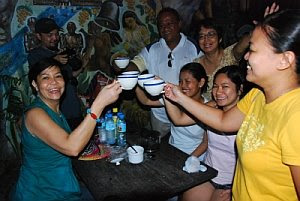 Tutubi's friends enjoying kape alamid brewed at Kape Kesada
Kape Alamid, called Kopi Luwak in Indonesia and weasel coffee in Vietnam, came from the ripest coffee berries that were ingested, processed and later defecated by the civet cat locally known as Alamid (Paradoxurus philippinensis).
After tasting the aromatic taste of the coffee brew, without the bitter taste, and the aroma lingers in your throat, several of the "beta testers" opted not to drink again the gourmet coffee blend after hearing how it's made.
Don't worry, kopi luwak undergoes sterilization process to get rid of viruses, bacteria, molds and mildews before packaging so it's safe and clean. It's only your mind subverting you not to ingest the unique aromatic taste of the exotic kopi luwak.
Tutubi's verdict: kopi luwak doesn't have that bitter aftertaste of most coffee blends since the biterness has been taken away during "processing" inside the civet cat's stomach leaving with you the goodness (no idea yet on caffeine content). For the penny-pinching Tutubi, kopi luwak is expensive, and not for everyday consumption unless you have money to burn.
Where to buy Kape Alamid/Kopi Luwak/Civet Coffee/Weasel Coffee in Manila?
Tutubi saw some Kape Alamid on sale at Tiendesitas in Pasig City (it's not easy to commute there but it's a taxi ride from MRT Ortigas station. Be prepared to wait for your return ride also since it seems only people with private cars frequent the place) near C5. The only option for commuting there is to go to Greenhills Shopping Center in San Juan and ride the free shuttle going to Tiendesitas (Greenhills and Tiendesitas' owners are the same). You won't find this in Starbucks (that overpriced coffee patronized by Filipinos), UCC (über-costly coffee), Mocha Blends, Coffee Bean, Gloria Jeans, Figaro, Filibeans Tagaytay and other coffee shops mushrooming in the Philippines.
How much does kopi luwak/kape alamid cost?
Price is about PhP500 ($12.50) for 50 grams or about PhP10,000/kilo so it's really the most expensive coffee in the world!
Note: Kopi Muncak (also Kopi Muntjak) is a similar type of coffee produced from the feces of the muntjac (barking deer)
After brewing the gourmet coffee, Tutubi egged the others unfamiliar to kape alamid to sample the coffee first, comment on the taste, before divulging the process on how kape alamid is prepared (since it's not really for the faint of heart)
 Tutubi's friends enjoying kape alamid brewed at Kape Kesada
Kape Alamid, called Kopi Luwak in Indonesia and weasel coffee in Vietnam, came from the ripest coffee berries that were ingested, processed and later defecated by the civet cat locally known as Alamid (Paradoxurus philippinensis).
After tasting the aromatic taste of the coffee brew, without the bitter taste, and the aroma lingers in your throat, several of the "beta testers" opted not to drink again the gourmet coffee blend after hearing how it's made.
Don't worry, kopi luwak undergoes sterilization process to get rid of viruses, bacteria, molds and mildews before packaging so it's safe and clean. It's only your mind subverting you not to ingest the unique aromatic taste of the exotic kopi luwak.
Tutubi's verdict: kopi luwak doesn't have that bitter aftertaste of most coffee blends since the biterness has been taken away during "processing" inside the civet cat's stomach leaving with you the goodness (no idea yet on caffeine content). For the penny-pinching Tutubi, kopi luwak is expensive, and not for everyday consumption unless you have money to burn.
Where to buy Kape Alamid/Kopi Luwak/Civet Coffee/Weasel Coffee in Manila?
Tutubi saw some Kape Alamid on sale at Tiendesitas in Pasig City (it's not easy to commute there but it's a taxi ride from MRT Ortigas station. Be prepared to wait for your return ride also since it seems only people with private cars frequent the place) near C5. The only option for commuting there is to go to Greenhills Shopping Center in San Juan and ride the free shuttle going to Tiendesitas (Greenhills and Tiendesitas' owners are the same). You won't find this in Starbucks (that overpriced coffee patronized by Filipinos), UCC (über-costly coffee), Mocha Blends, Coffee Bean, Gloria Jeans, Figaro, Filibeans Tagaytay and other coffee shops mushrooming in the Philippines.
How much does kopi luwak/kape alamid cost?
Price is about PhP500 ($12.50) for 50 grams or about PhP10,000/kilo so it's really the most expensive coffee in the world!
Note: Kopi Muncak (also Kopi Muntjak) is a similar type of coffee produced from the feces of the muntjac (barking deer)
Labels: Exotic Food
posted by GingGoy @ 11:06 PM,
,