Paete's Exotic Fruit = Chico-Mamei (Mexico)/Sapote/Zapote de Carne/Sapodilla
14 March 2012
A fruit tree that's so reminiscent of Tutubi's childhood (besides the lanzones, santol, aratilis and guava) for his creek-side, childhood home has one tall chico-mamei tree that grew beside a caimito (star apple), indian mango, guyabano, guava and putat trees.
Locally called mami in Paete, the mami tree of Tutubi's childood is no longer there but Tutubi still finds the fruits being sold at Paete Public Market for P20 to P30 a piece.
A few years ago, his curious mind asked Google on the origins and uses of the fruit and tree and Google was able to answer, albeit after several attempts and keywords, that gave away the true name of the fruit, called chico-mamei in Mexico, plus medicinal uses of the chico-mamei leaves and bark.
 the chico-mamei fruits with indian mangoes to give you an idea of its size plus its resemblance to chico fruits, thus the name
 the chico-mamei fruit showing the big seed and the dark orange flesh
How does chico-mamei tastes like? It's a cross between papaya and chico and chesa.
Tutubi's mother, endearing called Sugar, loves chico-mamei even if it's a forbidden fruit for diabetics like her.
Next time you're in Paete public market, do ask around for this fruit to sample a native American fruit exported from Mexico by the Spaniards via the Galleon trade.
Locally called mami in Paete, the mami tree of Tutubi's childood is no longer there but Tutubi still finds the fruits being sold at Paete Public Market for P20 to P30 a piece.
A few years ago, his curious mind asked Google on the origins and uses of the fruit and tree and Google was able to answer, albeit after several attempts and keywords, that gave away the true name of the fruit, called chico-mamei in Mexico, plus medicinal uses of the chico-mamei leaves and bark.
 the chico-mamei fruits with indian mangoes to give you an idea of its size plus its resemblance to chico fruits, thus the name
 the chico-mamei fruit showing the big seed and the dark orange flesh
How does chico-mamei tastes like? It's a cross between papaya and chico and chesa.
Tutubi's mother, endearing called Sugar, loves chico-mamei even if it's a forbidden fruit for diabetics like her.
Next time you're in Paete public market, do ask around for this fruit to sample a native American fruit exported from Mexico by the Spaniards via the Galleon trade.
Labels: Fruits
posted by GingGoy @ 9:02 PM,
,


Balimbing (Starfruit): Pinoy Slang for Political Turncoats
13 July 2011
During the 80's, this sometimes sweet, sometimes sour fruit that Tutubi finds on the slopes of the Sierra Madre mountain, growing wild between lanzones and santol trees in Paete, became a slang word for political turncoats i.e. politicians jumping from one party to another as if plainly changing clothes, usually transferring to the ruling administration party.
Why balimbing? It's simply because the balimbing has many sides, in reference to traditional politicians' many faces, showing compassion to the poor on the outside yet evil and contempt in the inside.
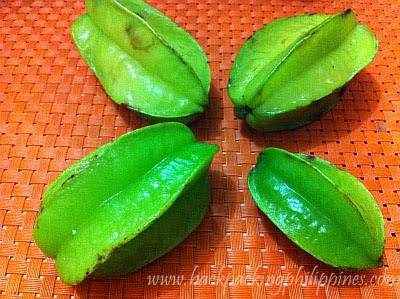 Balimbing, Starfruit in English, is star-shaped and a bit sour and sweet.
If only Filipino voters would be smarter, politicians would not have
made lives of the people better, instead of making life worse.
"Keep 'em poor and stupid" is the trapo's motto still
Why balimbing? It's simply because the balimbing has many sides, in reference to traditional politicians' many faces, showing compassion to the poor on the outside yet evil and contempt in the inside.
 Balimbing, Starfruit in English, is star-shaped and a bit sour and sweet.
If only Filipino voters would be smarter, politicians would not have
made lives of the people better, instead of making life worse.
"Keep 'em poor and stupid" is the trapo's motto still
Labels: Fruits
posted by GingGoy @ 9:51 PM,
,
Tart Little Mangoes Called Paho
18 October 2010
Tutubi has this post in Drafts for quite some time since summer then simply forgot about it. He remembered this post when a friend of his commented in an email that ayungin (silver perch) paired with paho as sawsawan [dip]. Instead of waiting again for next summer to post this, herewith are those delectable, mouth-watering little mangoes called pajo in tune with Tutubi's series on food recently (something like Laguna Food Trip).
 a bunch of paho from Batangas costs about P30.00
Pajo can be eaten raw with rock salt or made into an ensalada (enchilada) with onions, tomatoes and perfect as appetizer to liven up whatever dish, fried or not, seasoned with patis (fish sauce).
 paho enchilada with tomatoes and patis
Where to buy Paho? Tutubi requests an officemate every year to buy him paho in Batangas whenever he sees them. Price is around PhP for a small bunch (tumpok) at Tanauan Public Market but you can buy them in Manila. Paho season is around February to April so be on lookout always or you may have to wait another summer to sample it's heavenly sourness craved for by many.
 paho with a 5 peso coin to add scale
If any reader can leave information on the scientific name of paho, it'll be gladly appreciated. Tutubi will remind you again about this small wonder of an appetizer/dip the next time he gets of them.
 a bunch of paho from Batangas costs about P30.00
Pajo can be eaten raw with rock salt or made into an ensalada (enchilada) with onions, tomatoes and perfect as appetizer to liven up whatever dish, fried or not, seasoned with patis (fish sauce).
 paho enchilada with tomatoes and patis
Where to buy Paho? Tutubi requests an officemate every year to buy him paho in Batangas whenever he sees them. Price is around PhP for a small bunch (tumpok) at Tanauan Public Market but you can buy them in Manila. Paho season is around February to April so be on lookout always or you may have to wait another summer to sample it's heavenly sourness craved for by many.
 paho with a 5 peso coin to add scale
If any reader can leave information on the scientific name of paho, it'll be gladly appreciated. Tutubi will remind you again about this small wonder of an appetizer/dip the next time he gets of them.
Labels: Filipino Food, Fruits
posted by GingGoy @ 10:32 PM,
,
The Camachile Fruit (Guamachil, Manila Tamarind)
19 April 2009
To the average city dweller living in the north of the metro, camachile is just a place in Caloocan City with a flyover connecting traffic-prone Quirino Avenue (going to Baesa, Quezon City and Novaliches) with North Diverson road to NLEX with an Iglesia ni Cristo kapilya as landmark for commuters.
To people who grew up in the provinces, it's a tree and fruit that conjures images of ones youth, similar to memories of the aratilis of one's childhood.
Camachile (scientific name: Pithecellobium Dulce), like the aratilis, is not native to the Philippines. It's brought in from Mexico, where it's known as guamachil, by the Spaniards, spread to other neighboring Asian countries as far as India where it's called Manila tamarind. It's fruit is about one centimeter wide and several several centimeters long. The fruit is eaten by some people and taste a little sweet and sour, to some it may produce a pucker face though.
 camachile fruits bought by Tutubi on MacArthur highway in Pangasinan for PhP20.00
Camachile trees line the highways of Tarlac, Pangasinan and other northern provinces where you'll find children selling camachile fruits on MacArthur highway.
When an officemate of Tutubi, a fifty-something man who grew up in the town of Sexmoan (the former name of Sasmuan, Pampanga), saw his camachile, he narrated a game he used to play where his childhood friends will get camachile seeds and try to peel off the seed cover without exposing the white pulp otherwise he'd lose the game. This game, however, is foreign to Tutubi since he has no childhood memories of the trees unlike the aratilis, lanzones, santol, mami (scientific name: calucarpum sapota), kaimito, guavas, and, of course, mangoes.
Lastly, is Camachile, Caloocan City named after the camachile fruit? Was the area planted with camachile trees that's why it's called that way? Will somebody please confirm history of camachile?
To people who grew up in the provinces, it's a tree and fruit that conjures images of ones youth, similar to memories of the aratilis of one's childhood.
Camachile (scientific name: Pithecellobium Dulce), like the aratilis, is not native to the Philippines. It's brought in from Mexico, where it's known as guamachil, by the Spaniards, spread to other neighboring Asian countries as far as India where it's called Manila tamarind. It's fruit is about one centimeter wide and several several centimeters long. The fruit is eaten by some people and taste a little sweet and sour, to some it may produce a pucker face though.
 camachile fruits bought by Tutubi on MacArthur highway in Pangasinan for PhP20.00
Camachile trees line the highways of Tarlac, Pangasinan and other northern provinces where you'll find children selling camachile fruits on MacArthur highway.
When an officemate of Tutubi, a fifty-something man who grew up in the town of Sexmoan (the former name of Sasmuan, Pampanga), saw his camachile, he narrated a game he used to play where his childhood friends will get camachile seeds and try to peel off the seed cover without exposing the white pulp otherwise he'd lose the game. This game, however, is foreign to Tutubi since he has no childhood memories of the trees unlike the aratilis, lanzones, santol, mami (scientific name: calucarpum sapota), kaimito, guavas, and, of course, mangoes.
Lastly, is Camachile, Caloocan City named after the camachile fruit? Was the area planted with camachile trees that's why it's called that way? Will somebody please confirm history of camachile?
Labels: Caloocan City, Fruits, Metro Manila, National Capital Region
posted by GingGoy @ 6:25 PM,
,
Aratilis: Sweet Memories of Childhood
27 September 2008
Almost every "promdi" (from the province) person Tutubi knows has vivid memories of this tree, growing wild in almost every nook and cranny of the Philippines, and climbed by children searcing for succulent red fruits resembling cherries. Children and adults love to taste it yet you'll never see it being sold at public markets probably due to its ubiquity.
In his own experience, aratilis "cherries," called mansanitas in the Visayas, are not sweet during rainy days unlike in hot, summer ones, quite bland actually. It's also not good to partake of it if it's overripe. Eat it with just the right ripeness and it's a sure winner.
 a ripe fruit of aratilis with two green ones
Aratilis trees are not native to the Philippines, they came from Southern America, probably brought by the Spaniards by way of Mexico. This is similar to the abundance of the waterways-choking water hyacinths, erroneously called water lily by most Filipinos.
 an aratilis tree somewhere in Cabanatuan City, Nueva Ecija providing shade to a restaurant
According to Wikipedia:
"Muntingia calabura, the sole species in the genus Muntingia, is a flowering plant native to southern Mexico, the Caribbean, Central America, and western South America south to Peru and Bolivia. Common names include (English) Jamaican cherry, Panama berry, Singapore cherry, Strawberry tree; (Spanish) bolaina yamanaza, cacaniqua, capulín blanco, nigua, niguito, memizo or memiso; and (Filipino) aratilis, aratiles, manzanitas.
It is a small tree 7-12 meters tall with tiered and slightly drooping branches. It has serrated leaves 2.5-15 cm long and 1-6.5 cm wide. The flowers are small and white and gives rise to 1-1.5 cm light red fruit. The fruit is edible, sweet and juicy, and contains a large number of tiny (0.5 mm) yellow seeds."
Tutubi has a small aratilis tree at his rooftop garden that he's trying to turn into a butterfly garden.
How about you? Do you also have childhood memories of the aratilis?
In his own experience, aratilis "cherries," called mansanitas in the Visayas, are not sweet during rainy days unlike in hot, summer ones, quite bland actually. It's also not good to partake of it if it's overripe. Eat it with just the right ripeness and it's a sure winner.
 a ripe fruit of aratilis with two green ones
Aratilis trees are not native to the Philippines, they came from Southern America, probably brought by the Spaniards by way of Mexico. This is similar to the abundance of the waterways-choking water hyacinths, erroneously called water lily by most Filipinos.
 an aratilis tree somewhere in Cabanatuan City, Nueva Ecija providing shade to a restaurant
According to Wikipedia:
"Muntingia calabura, the sole species in the genus Muntingia, is a flowering plant native to southern Mexico, the Caribbean, Central America, and western South America south to Peru and Bolivia. Common names include (English) Jamaican cherry, Panama berry, Singapore cherry, Strawberry tree; (Spanish) bolaina yamanaza, cacaniqua, capulín blanco, nigua, niguito, memizo or memiso; and (Filipino) aratilis, aratiles, manzanitas.
It is a small tree 7-12 meters tall with tiered and slightly drooping branches. It has serrated leaves 2.5-15 cm long and 1-6.5 cm wide. The flowers are small and white and gives rise to 1-1.5 cm light red fruit. The fruit is edible, sweet and juicy, and contains a large number of tiny (0.5 mm) yellow seeds."
Tutubi has a small aratilis tree at his rooftop garden that he's trying to turn into a butterfly garden.
How about you? Do you also have childhood memories of the aratilis?
Labels: Fruits
posted by GingGoy @ 8:38 PM,
,
The Sweetest Lanzones (Langsat (Lansium Domesticum)
06 October 2007
 Known as langsat in Malaysia from where it originated, lanzones is a fruit that grows abundantly on the slopes of the Sierra Madre mountain range in Luzon, particularly Laguna province, in the volcanic island of Camiguin (that also have the Lanzones Festival) and various provinces of Mindanao.
Lanzones trees are slender and has only a single trunk growing to about 10 to 20 meters tall (picture above). The fruit has an acidic taste and bitter seeds but the translucent flesh can be very sweet when ripe.
In eating lanzones, it's always best to select the fruit already detached from the stem since it means it's ripe therefore sweeter than the ones left connected to the stem. Don't also bite the seed since it's very bitter. Big ones also mean lager seed; go for the medium sized fruit.
Tutubi, in his childhood, got to to experience trekking up the slopes of Mt. Humarap, the hill fronting Paete, Laguna, and part of Sierra Madre mountain to harvest lanzones. He still cherishes the thrill of actually going up and eating fallen lanzones fruits held by his shirt.
Lanzones peelings, when dried, are burned by some people in Laguna to drive away mosquitoes. This may be a cheap alternative to de-fogging and fumigation against dengue-carrying, diurnal mosquitoes (Aedes aegypto and Aedes albopictus) and malaria-carrying, nocturnal anopheles. ((Tutubi used to do this in their small plot of kaingin in Paete)
 freshly harvested lanzones by Tutubi in a basket
 Picture of lanzones showing innards
Where can you find the sweetest lanzones there is? Tutubi doesn't have to be asked. He'll swear it's the variety found in his hometown. He's tasted samples from around Laguna, Sulu (currently sold in Metro Manila), and from Camiguin (but not the ones with less seeds in Bangkok, Thailand).
In fact, a few years ago, people asked specifically for Paete's lanzones and not from Laguna due to the inexplicable succulence of the variety. It's just that the fruit is not commercially cultivated in Paete, reason why you can't find them in commercial quantities. Lanzones also spoil rapidly making it inappropriate for export to other countries.
Even the legend of lanzones' magical change from a poisoned fruit to a sweet sensation is attributed to the artistic town of Laguna.

Ang Alamat ng Lanzones (The Legend of Lanzones) depicted at Paete's Wawa Park
Tutubi may, however, change his mind on which is the sweetest if anyone of the readers can give him a sample of the sweetest kind! :P
Lazones is also known in other countries as langsat, lansa, langseh, langsep, lanzon, lanzone, lansone, longkong and kokosan
posted by GingGoy @ 11:09 AM,
,