Isdaan Floating Restaurant in Tarlac
08 April 2009
Combine tried and tested Barrio Fiesta Singing Cooks and Waiters Atbp's restaurant experience and Filipino cuisine, native-themed palaisdaan restaurant with an ambiance of native huts with Buddhist-inspired landscaping and you got yourself a satisfying meal and relaxing place called Isdaan Floating Restaurant.


Located along Gerona, Tarlac portion of MacArthur Highway where Tutubi passed by so many times in the past but never actually visited. This time, his officemates, coming from Camp John Hay in Baguio City, acquiesced to drop by for late lunch at the popular palaisdaan floating restaurant in Tarlac. This place is half-way to Baguio, and other northern provinces making it a popular stop-over for road trips reachable from Manila via NLEX, SCTEX and Tarlac City.
 Cory Aquino, a Tarlac native, consulting with the late Jaime Cardinal Sin
From MacArthur Highway, one can see the giant Buddhas, fishes and other Buddhist-inspired statues and mythical creatures that remind you of Buddhist nations of Southeast Asia like Thailand, Vietnam, Cambodia, and Laos if you've ever been to one of them.
 Giant Buddha at Isdaan
Price of food at Isdaan Floating Restaurant is only slightly lower than Barrio Fiesta restaurants in Manila but worth it due to the relaxing atmosphere, beside rice fields with fresh air, conducive to sleeping after a heavy meal.
Sample menu prices:
Crispy Pata: PhP254.00 (crispy pork knuckles)
Ginataang Hipon Sipitsipitan Luto sa Buho: PhP139.00 (a recommended dish of prawns in spicy coconut milk served in bamboo),
Lechon de Leche PhP2,800.00 (one whole pit-roasted baby suckling pig, quite cheap actually)
Lechon Manok (Inihaw sa Dahon): PhP191.00 (one whole roast chicken)
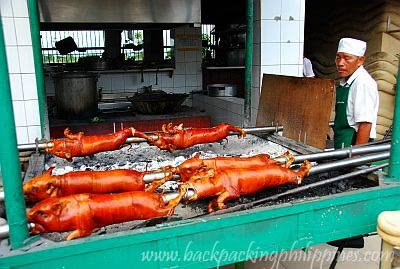 lechon de leche (roast suckling pig) only costs PhP2,800.00
 picture of the table with the food gone, reason why Tutubi doesn't take pictures of food if he's with hungry office mates. Note the restaurant serves food in environment-friendly banana leaves and bamboo-- no plastic except straws
Activities at Isdaan Floating Restaurant, Gerona, Tarlac:
Tacsiyapo Wall: Release your anger
Ungoy-Unggoyan: survive the spitting, urinating monkeys for a kilo of free fish
San Kilo Bridge: for 1 kilo of free fish, cooked the way you want it, cross the long bridge and survive
Mga Mahiwagang kamay: experience the legend of the giant hands
Wishing Buddhas: make your dreams come true
 Cross this concrete bridge called "Sang Kilo Bridge" about 20 centimeters wide and 30 meters long, laden with sea shells as obstacles, and get 1 free kilo of fish cooked to your preferred way...the fishpond is about 6 ft to 9 ft so prepare to get wet should you fall
Note the place is dangerous for playing kids to roam around unattended so better stick to the restaurant's policy of using life vests for hyperactive kids. Be careful also when stepping on or leaving the floating huts, this is specially for non-swimmers as you can get a splash of your life there.
 the tyrannosaurus rex dinosaur is out of place, it should've been moved to a children's playground as its a really distracting figure
Talking about negatives, their non-acceptance of credit cards -- it's a cash-only establishment so better bring wads of cash before visiting the restaurant. Budget about PhP300.00 and up per person and you'll really have a really nice meal. The establishment seems to be almost always full, attracting families of tourists and balikbayan so be early in order to get your desired seat/hut in the place.
How to get to Isdaan Floating Restaurant, Gerona, Tarlac:
Directions to Isdaan Floating Restaurant is easy, just follow this route: NLEX, SCTEX, exit at Tarlac, turn left going to Tarlac city proper and Hacienda Luisita then right on MacArthur Highway. Continue until you reach Gerona where the restaurant can be seen on your left. Travel time is about an hour from NLEX Dau exit entering SCTEX.
Update August 2010: there's an on-going construction of Isdaan restaurant in Bay, Laguna in between Kamayan sa Palaisdaan sa Bay and Samaral Seafood Restaurant. No information on opening date though.
UPDATE: November 2011: Isdaan Laguna is now open for business. No information yet on Isdaan telehone number for reservation nor contact person.


Located along Gerona, Tarlac portion of MacArthur Highway where Tutubi passed by so many times in the past but never actually visited. This time, his officemates, coming from Camp John Hay in Baguio City, acquiesced to drop by for late lunch at the popular palaisdaan floating restaurant in Tarlac. This place is half-way to Baguio, and other northern provinces making it a popular stop-over for road trips reachable from Manila via NLEX, SCTEX and Tarlac City.
 Cory Aquino, a Tarlac native, consulting with the late Jaime Cardinal Sin
From MacArthur Highway, one can see the giant Buddhas, fishes and other Buddhist-inspired statues and mythical creatures that remind you of Buddhist nations of Southeast Asia like Thailand, Vietnam, Cambodia, and Laos if you've ever been to one of them.
 Giant Buddha at Isdaan
Price of food at Isdaan Floating Restaurant is only slightly lower than Barrio Fiesta restaurants in Manila but worth it due to the relaxing atmosphere, beside rice fields with fresh air, conducive to sleeping after a heavy meal.
Sample menu prices:
Crispy Pata: PhP254.00 (crispy pork knuckles)
Ginataang Hipon Sipitsipitan Luto sa Buho: PhP139.00 (a recommended dish of prawns in spicy coconut milk served in bamboo),
Lechon de Leche PhP2,800.00 (one whole pit-roasted baby suckling pig, quite cheap actually)
Lechon Manok (Inihaw sa Dahon): PhP191.00 (one whole roast chicken)
 lechon de leche (roast suckling pig) only costs PhP2,800.00
 picture of the table with the food gone, reason why Tutubi doesn't take pictures of food if he's with hungry office mates. Note the restaurant serves food in environment-friendly banana leaves and bamboo-- no plastic except straws
Activities at Isdaan Floating Restaurant, Gerona, Tarlac:
Tacsiyapo Wall: Release your anger
Ungoy-Unggoyan: survive the spitting, urinating monkeys for a kilo of free fish
San Kilo Bridge: for 1 kilo of free fish, cooked the way you want it, cross the long bridge and survive
Mga Mahiwagang kamay: experience the legend of the giant hands
Wishing Buddhas: make your dreams come true
 Cross this concrete bridge called "Sang Kilo Bridge" about 20 centimeters wide and 30 meters long, laden with sea shells as obstacles, and get 1 free kilo of fish cooked to your preferred way...the fishpond is about 6 ft to 9 ft so prepare to get wet should you fall
Note the place is dangerous for playing kids to roam around unattended so better stick to the restaurant's policy of using life vests for hyperactive kids. Be careful also when stepping on or leaving the floating huts, this is specially for non-swimmers as you can get a splash of your life there.
 the tyrannosaurus rex dinosaur is out of place, it should've been moved to a children's playground as its a really distracting figure
Talking about negatives, their non-acceptance of credit cards -- it's a cash-only establishment so better bring wads of cash before visiting the restaurant. Budget about PhP300.00 and up per person and you'll really have a really nice meal. The establishment seems to be almost always full, attracting families of tourists and balikbayan so be early in order to get your desired seat/hut in the place.
How to get to Isdaan Floating Restaurant, Gerona, Tarlac:
Directions to Isdaan Floating Restaurant is easy, just follow this route: NLEX, SCTEX, exit at Tarlac, turn left going to Tarlac city proper and Hacienda Luisita then right on MacArthur Highway. Continue until you reach Gerona where the restaurant can be seen on your left. Travel time is about an hour from NLEX Dau exit entering SCTEX.
Update August 2010: there's an on-going construction of Isdaan restaurant in Bay, Laguna in between Kamayan sa Palaisdaan sa Bay and Samaral Seafood Restaurant. No information on opening date though.
UPDATE: November 2011: Isdaan Laguna is now open for business. No information yet on Isdaan telehone number for reservation nor contact person.
Labels: Central Luzon, Restaurants, Tarlac, Tarlac Restaurants
posted by GingGoy @ 9:27 PM,
,


Tarlac Tour Through the Car Window
11 October 2007
In just another unexpected turn of events, Tutubi was commissioned to deliver a talk in a company-sponsored seminar in Dagupan with only a few days notice. Being used to the arrangement, he just shrugged it off, prepared the powerpoint slides but wasn't able to prepare for possible sidetrips and itineraries of the opportunity.
The following Friday, Tutubi and his colleagues boarded a van on the way to Dagupan and passed many interesting places where people only see outside their car window.
The cruise at the North Luzon Expressway (NLEX) was a breeze and took the exit at the end of the highway.
On passing Capas town, a town made famous by the infamous Death March of World War II from where the endpoint is now the Capas National Shrine while in Sta. Juliana, also in Capas is the most popular jump-off point for trekking Mt. Pinatubo as well the presence of an Aeta community and Korean-owned Pinatubo Spa.
On reaching Tarlac City, caught sight of the Hacienda Luisita, owned by the powerful Cojuanco clan, and the site of recent bloody encounters of the peasants and military. From a distance, the old monument of Benigno "Ninoy" Aquino that used to stand at the corner of Ayala Avenue and Paseo de Roxas in Makati. Nearby are vintage tanks, airplanes, howitzers and other military ordnance at the Armed Forces Museum inside the Philippine Army Base, Camp Aquino (formerly called Camp Ord).
Feeling hunger pangs, decided to stop and partook lunch at Vilmar Restaurant, a Filipino restaurant open since 1956, on the highway at the corner of the road leading to Camiling. There they feasted on Filipino fare of longganisa (native sausages), pork skewers, adobo pusit (squid), stinking buro isda (fermented fish), kilawin, lechon (roasted pig) with a serving of Lita's pastillas for dessert. (Tutubi didn't take pictures of the food for fear that there'll be nothing left to eat if he took photos). Now satiated, proceeded to take the road going to the town of Camiling known in history as the hometown of Carlos P. Romulo, who became president of the United Nations General Assembly and chairman of the United Nations Security Council (Read also "The Fooling of America")
One of the daughters of Camiling, Leonor Rivera, was one of Jose Rizal's girlfriends and sweetheart for more than ten years. She was immortalized by Rizal in his novel Noli Me Tangere as Maria Clara. The Maria Clara Museum houses the memories of their love that never was.
The Camiling River looked inviting for some water fun like rafting that reminded Tutubi of his riverine adventures of his childhood while the ruins of Camiling church gave the idea of the immensity of the place of worship before the conflagration that destroyesd the heritage structure.
Tutubi's empty gaze outside the car window was interrupted when the driver made a wrong turn and had to ask for directions going to Dagupan but they finally their way to their destination famous for the tastiest variety of bangus (milkfish): the Philippines national fish!
Coming Up:
Bonuan Boneless Bangus, Dagupan food finds and a sidetrip to more than a hundred islands in Alaminos :)
Related Post:
Subic Clark Tarlac Expressway (SCTEx)
The following Friday, Tutubi and his colleagues boarded a van on the way to Dagupan and passed many interesting places where people only see outside their car window.
The cruise at the North Luzon Expressway (NLEX) was a breeze and took the exit at the end of the highway.
On passing Capas town, a town made famous by the infamous Death March of World War II from where the endpoint is now the Capas National Shrine while in Sta. Juliana, also in Capas is the most popular jump-off point for trekking Mt. Pinatubo as well the presence of an Aeta community and Korean-owned Pinatubo Spa.
On reaching Tarlac City, caught sight of the Hacienda Luisita, owned by the powerful Cojuanco clan, and the site of recent bloody encounters of the peasants and military. From a distance, the old monument of Benigno "Ninoy" Aquino that used to stand at the corner of Ayala Avenue and Paseo de Roxas in Makati. Nearby are vintage tanks, airplanes, howitzers and other military ordnance at the Armed Forces Museum inside the Philippine Army Base, Camp Aquino (formerly called Camp Ord).
Feeling hunger pangs, decided to stop and partook lunch at Vilmar Restaurant, a Filipino restaurant open since 1956, on the highway at the corner of the road leading to Camiling. There they feasted on Filipino fare of longganisa (native sausages), pork skewers, adobo pusit (squid), stinking buro isda (fermented fish), kilawin, lechon (roasted pig) with a serving of Lita's pastillas for dessert. (Tutubi didn't take pictures of the food for fear that there'll be nothing left to eat if he took photos). Now satiated, proceeded to take the road going to the town of Camiling known in history as the hometown of Carlos P. Romulo, who became president of the United Nations General Assembly and chairman of the United Nations Security Council (Read also "The Fooling of America")
One of the daughters of Camiling, Leonor Rivera, was one of Jose Rizal's girlfriends and sweetheart for more than ten years. She was immortalized by Rizal in his novel Noli Me Tangere as Maria Clara. The Maria Clara Museum houses the memories of their love that never was.
The Camiling River looked inviting for some water fun like rafting that reminded Tutubi of his riverine adventures of his childhood while the ruins of Camiling church gave the idea of the immensity of the place of worship before the conflagration that destroyesd the heritage structure.
Tutubi's empty gaze outside the car window was interrupted when the driver made a wrong turn and had to ask for directions going to Dagupan but they finally their way to their destination famous for the tastiest variety of bangus (milkfish): the Philippines national fish!
Coming Up:
Bonuan Boneless Bangus, Dagupan food finds and a sidetrip to more than a hundred islands in Alaminos :)
Related Post:
Subic Clark Tarlac Expressway (SCTEx)
Labels: Camiling, Tarlac, Tarlac City
posted by GingGoy @ 9:15 PM,
,
Tarlac: Capas National Shrine (Camp O'Donnell)
25 June 2007
After leaving Sta Juliana, Capas, Tarlac, (after trekking down the slopes of Mt. Pinatubo) we again passed by the Capas National Shrine, unknown to my companions, which used to be part of Camp O'Donnell: the final destination of the survivors of the infamous Death March of the Second World War.
I was thinking of not posting this picture since it's not that clear but again, for photojournalistic purposes, I posted it here. I wasn't able to get a better picture owing to the gray clouds providing not so good lighting and mostly my trekking mates opted not to get out of the van to even take pictures either they're tired or just plain indifferent/oblivious to history. The shot that you see here taken with my hand out of the window slightly skewed and blurred.
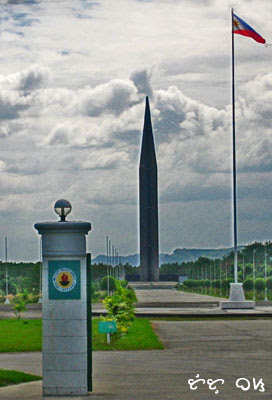 The infamous Bataan Death March (バターン死の行進) began shortly after the fall of Bataan peninsula on April 9, 1942 where Filipino and American POWs were forced to march from Bataan to San Fernando, Pampanga (where they're herded into suffocating trains) then marched again upon arrival in Capas, Tarlac
Note that survivors of the Fall of Corregidor on May 6, 1942 did not participate in the Death March like what my officemates were saying. The Death March lasted a few days before the Rock fell to the Japanese.
Capas National Shrine is actually the former internment camp of Camp O'Donnell and has a 70 meter obelisk, a wall where names of the Filipinos and Americans who died there is listed and a small monument by the Battling Bastards of Bataan.
This place requires a re-visit by the tutubi in the future for him to get up close to the historic place most Filipinos don't even hear of or taken for granted.
How to get to Capas, Tarlac:
Capas National Shrine is along the national highway in Capas, Tarlac. There's a small entrance fee of PhP5.00.
I was thinking of not posting this picture since it's not that clear but again, for photojournalistic purposes, I posted it here. I wasn't able to get a better picture owing to the gray clouds providing not so good lighting and mostly my trekking mates opted not to get out of the van to even take pictures either they're tired or just plain indifferent/oblivious to history. The shot that you see here taken with my hand out of the window slightly skewed and blurred.
 The infamous Bataan Death March (バターン死の行進) began shortly after the fall of Bataan peninsula on April 9, 1942 where Filipino and American POWs were forced to march from Bataan to San Fernando, Pampanga (where they're herded into suffocating trains) then marched again upon arrival in Capas, Tarlac
Note that survivors of the Fall of Corregidor on May 6, 1942 did not participate in the Death March like what my officemates were saying. The Death March lasted a few days before the Rock fell to the Japanese.
Capas National Shrine is actually the former internment camp of Camp O'Donnell and has a 70 meter obelisk, a wall where names of the Filipinos and Americans who died there is listed and a small monument by the Battling Bastards of Bataan.
This place requires a re-visit by the tutubi in the future for him to get up close to the historic place most Filipinos don't even hear of or taken for granted.
How to get to Capas, Tarlac:
Capas National Shrine is along the national highway in Capas, Tarlac. There's a small entrance fee of PhP5.00.
Labels: Central Luzon, History, Monuments, Tarlac, World War II
posted by GingGoy @ 11:41 PM,
,
The Conquest of Mount Pinatubo: Trek via Capas, Tarlas Trail
13 June 2007
In June 1991, one of the largest volcanic eruptions of the century happened in the Philippines, about 100 kilometers north of Manila. A few hundred people were killed and hundreds of thousand people rendered homeless, mostly Aeta people (the aborigines who call the mountain "Apo Malyari (The Great Provider)" and believe the mountain is home to spirits). The death toll could've been much more if then Philippine Institute of Seismology and Volcanology (Philvocs) weren't able to persuade people living around the volcano including the Americans to vacate the area. The Americans, then still occupying Clark Airbase, were driven out. The big explosion occurred on June 15 where large volumes of sulfur, volcanic ash and other gases that cooled world temperatures for a few years. The situation was worsened by a tropical deppression present in the area turning ashes on the slopes into rampaging and deadly lahar.
I was in Manila at that time, and I can still remember how the sky transformed from sunny to dark and gloomy with portent of things to come. The following day, volcanic ash from Pinatubo covered the big Manila making it look like a giant "espasol" (can't help the comparison, I love that rice flour-covered sweet Filipino delicacy).
This time around, the tutubi is set to scale the mountain responsible for driving the American war machinery out of the largest overseas US military base.(The Americans didn't return to Clark. They turned over the destroyed facility to the Philippines later that year)
Mt Pinatubo: The Road to Middle Earth
Having learned of a friend's intention on scaling the mountain to reach the crater, I instantly made arrangements for the trip, not actually a mountaineer, that I bought a 50 liter backpack in Landmark, Bombproof gear trekking pants in Robinsons Galleria, sleeping bag and earth mat at a certain Buendia mountaineering shop in Makati, to equip the tutubi for the overnight trip to the once angry crater.
Meeting with the group at Chowking, EDSA Central, we boarded a van chartered by our guides and headed to North Luzon Expressway (NLEX) exiting Dau toll plaza, passed by O'Donnell and ended in Sta. Juliana, Capas town in Tarlac province.
In Capas town, our guides negotiated for us to board 4x4 vehicles that took us to the jump-off point of the trail, traversing miles and miles of volcanic sand offering glimpses on the destruction wrought by the gargantuan explosion that ravaged thousands of hectares of rice fields and forests turning them into sand deserts. The bumpy ride with numerous stream crossings took about an hour.
The real trek began.
 Loading our heavy backpacks, loaded with clothes, sleeping bags, earth mat, tent, food, water, and other things needed to survive this "sad fate," we ourselves asked for, was quite easy. Bringing them all the way to our destination was another thing.
 The trail is just sand, sand and sand through valleys created by the rampage of Pinatubo aided by typhoons that helped carved the geologic beauty.
 Stream crossings avoiding slippery rocks. I wore my usual open sandals that's why I can get my feet wet. It's also a good thing it's partly cloudy.
The trek is called to a stop for short water breaks, comfort breaks, lunch, or when someone's too far back. A leader, "middleman," and a sweeper composed our guides and made sure we're all accounted for.
We even encountered a group of politicians, television crewmen and perhaps tourism people who took video footage of the place before us. (too bad they didn't catch a glimpse of the kawai tutubi :)
 The last photo-op of the group on the last push towards the crater for a trek that lasted three hours
 Pinatubo crater, at first sight: We're not alone!
The guides immediately brought out their rappelling equipment for us to rappel down the crater lake on a cliff. This took a long time and I gave way for the ladies to rappel down first so I just did what i like best: descend on the lake taking pictures along the way.
Down the lake, our guides inflated their kayak. It was I who first dipped into the water even tried to taste how the water tasted like to satisfy the curiosity of the tutubi: it's just like ordinary fresh water, even odorless without any tinge of sulfur. But it's also like swimming in salt water where I floated effortlessly. There's also the added bonus of bathing in sulfur-soaked water without paying an arm and a leg at the nearby Pinatubo Spa where they smother their guests with volcanic sand to achieve their claimed therapeutic properties.
At sundown, we pitched our tents on the roofed portion of the place (Capas local government also provided toilets to the place sans running water. We had to fetch water from the nearby waterfall) and prepared dinner mostly packed or canned goods strictly observed no trash to be left behind.
Early in the morning, I decided to get up to catch the early morning light to light up my photographic subject: Pinatubo crater at its serene best!

 There's life in Pinatubo: one of the best in my portfolio (as if I have one) that I sometimes print to a large size and give to my friends.

The return trip to the point where we boarded the 4x4 anew took only ninety minutes against 3 hours on the ascent. Big smiles can be seen from our faces, even if exhausted and sunburned, knowing we earned the bragging rights to proudly say: we survived Pinatubo!
~~~
How to get to Mt. Pinatubo
Pinatubo crater can also be reached via a more difficult trail in Porac, Pampanga suited for the people looking for more difficult challenge. Mt. Pinatubo i located at the boundary of the three provinces of Tarlac, Pampanga and Zambales in Central Luzon.
How to get to Mt. Pinatubo via Capas, Tarlac backpacking way:
From Manila, take the North Luzon Expressway; exit Dau Toll Plaza; take north-bound MacArthur Highway. Upon reaching town market in Capas, Tarlac, turn left to Bgy. Sto. Rosario; proceed to Bgy. Sta. Juliana. Register with local officials and 4x4 jeep.
Mt. Pinatubo Tour cost/rates:
Costs: 4x4 jeep PhP3,500.00 (3-4 persons), guide PhP500 (per 5 persons).
Warning: Avoid the Korean-owned Pinatubo Spa. Touristy prices aside from Korean-centric in the land of Filipinos. Try bathing at the crater instead for your dose of therapeutic, sulfur-rich sand. (If you don't have the money or time, try Dr, Kauffman's medicinal sulfur soap :)
I was in Manila at that time, and I can still remember how the sky transformed from sunny to dark and gloomy with portent of things to come. The following day, volcanic ash from Pinatubo covered the big Manila making it look like a giant "espasol" (can't help the comparison, I love that rice flour-covered sweet Filipino delicacy).
This time around, the tutubi is set to scale the mountain responsible for driving the American war machinery out of the largest overseas US military base.(The Americans didn't return to Clark. They turned over the destroyed facility to the Philippines later that year)
Mt Pinatubo: The Road to Middle Earth
Having learned of a friend's intention on scaling the mountain to reach the crater, I instantly made arrangements for the trip, not actually a mountaineer, that I bought a 50 liter backpack in Landmark, Bombproof gear trekking pants in Robinsons Galleria, sleeping bag and earth mat at a certain Buendia mountaineering shop in Makati, to equip the tutubi for the overnight trip to the once angry crater.
Meeting with the group at Chowking, EDSA Central, we boarded a van chartered by our guides and headed to North Luzon Expressway (NLEX) exiting Dau toll plaza, passed by O'Donnell and ended in Sta. Juliana, Capas town in Tarlac province.
In Capas town, our guides negotiated for us to board 4x4 vehicles that took us to the jump-off point of the trail, traversing miles and miles of volcanic sand offering glimpses on the destruction wrought by the gargantuan explosion that ravaged thousands of hectares of rice fields and forests turning them into sand deserts. The bumpy ride with numerous stream crossings took about an hour.
The real trek began.
 Loading our heavy backpacks, loaded with clothes, sleeping bags, earth mat, tent, food, water, and other things needed to survive this "sad fate," we ourselves asked for, was quite easy. Bringing them all the way to our destination was another thing.
 The trail is just sand, sand and sand through valleys created by the rampage of Pinatubo aided by typhoons that helped carved the geologic beauty.
 Stream crossings avoiding slippery rocks. I wore my usual open sandals that's why I can get my feet wet. It's also a good thing it's partly cloudy.
The trek is called to a stop for short water breaks, comfort breaks, lunch, or when someone's too far back. A leader, "middleman," and a sweeper composed our guides and made sure we're all accounted for.
We even encountered a group of politicians, television crewmen and perhaps tourism people who took video footage of the place before us. (too bad they didn't catch a glimpse of the kawai tutubi :)
 The last photo-op of the group on the last push towards the crater for a trek that lasted three hours
 Pinatubo crater, at first sight: We're not alone!
The guides immediately brought out their rappelling equipment for us to rappel down the crater lake on a cliff. This took a long time and I gave way for the ladies to rappel down first so I just did what i like best: descend on the lake taking pictures along the way.
Down the lake, our guides inflated their kayak. It was I who first dipped into the water even tried to taste how the water tasted like to satisfy the curiosity of the tutubi: it's just like ordinary fresh water, even odorless without any tinge of sulfur. But it's also like swimming in salt water where I floated effortlessly. There's also the added bonus of bathing in sulfur-soaked water without paying an arm and a leg at the nearby Pinatubo Spa where they smother their guests with volcanic sand to achieve their claimed therapeutic properties.
At sundown, we pitched our tents on the roofed portion of the place (Capas local government also provided toilets to the place sans running water. We had to fetch water from the nearby waterfall) and prepared dinner mostly packed or canned goods strictly observed no trash to be left behind.
Early in the morning, I decided to get up to catch the early morning light to light up my photographic subject: Pinatubo crater at its serene best!

 There's life in Pinatubo: one of the best in my portfolio (as if I have one) that I sometimes print to a large size and give to my friends.
The return trip to the point where we boarded the 4x4 anew took only ninety minutes against 3 hours on the ascent. Big smiles can be seen from our faces, even if exhausted and sunburned, knowing we earned the bragging rights to proudly say: we survived Pinatubo!
~~~
How to get to Mt. Pinatubo
Pinatubo crater can also be reached via a more difficult trail in Porac, Pampanga suited for the people looking for more difficult challenge. Mt. Pinatubo i located at the boundary of the three provinces of Tarlac, Pampanga and Zambales in Central Luzon.
How to get to Mt. Pinatubo via Capas, Tarlac backpacking way:
From Manila, take the North Luzon Expressway; exit Dau Toll Plaza; take north-bound MacArthur Highway. Upon reaching town market in Capas, Tarlac, turn left to Bgy. Sto. Rosario; proceed to Bgy. Sta. Juliana. Register with local officials and 4x4 jeep.
Mt. Pinatubo Tour cost/rates:
Costs: 4x4 jeep PhP3,500.00 (3-4 persons), guide PhP500 (per 5 persons).
Warning: Avoid the Korean-owned Pinatubo Spa. Touristy prices aside from Korean-centric in the land of Filipinos. Try bathing at the crater instead for your dose of therapeutic, sulfur-rich sand. (If you don't have the money or time, try Dr, Kauffman's medicinal sulfur soap :)
Labels: Central Luzon, Tarlac, Trekking, Volcanoes
posted by GingGoy @ 10:35 PM,
,