Martial Law Travel Ban: Passports, Permits and Travel Tax
18 September 2018
Millennials who like to travel and post their life on social media (Facebook, Twitter, Instagram et al) may not be aware of it but if you are one of those who believe stories that Martial Law by Marcos was great, did you know at during Martial Law, you cannot just travel out of the country, moreso get a passport? Thisis beside the well-documented fact that people were arrested, torutured, murdered and disappeared without a trace during this period that Marcos apologists claim is the "golden age"

to get a passport then, you need to attend an orientation about the glories of Martial Law but if authorities suspect you are up to something, you will end up in jail
a few years later in 1977, the travel ban was lifted but replaced with travel tax, the presently PhP1920.00 travel tax all outbound passengers pay, but back then, the cost was too high that ordinary citizens cannot afford...
Read: "... President Marcos ordered the Secretary of Foreign Affairs to stop issuing travel papers, including passports, to any citizen, except to those who were sent abroad by the Philippine government. For a person to leave the country, he must be cleared by the Travel committee, which included the DFA, the Department of National Defense, Department of Tourism, and National Intelligence Coordinating Agency."
the letter of instruction, effectively banning travel outside the country in full text:
---------------------------------------------------------------------------------------------------------
4, s. 1972
Signed on September 22, 1972
MALACAÑANG
MANILA
Letter of Instruction No. 4
The Secretary
Department of Foreign Affairs
Padre Faura, Manila
Pursuant to Proclamation No. 1081 dated Sept. 21, 1972, and in my capacity as commander-in-chief of all armed forces of the Philippines and in order to prevent the escape from the country of persons who are known to be actively engaged or suspected to be actively engaged in a criminal conspiracy to seize political and state power in the Philippines and to take over the Government by force and violence the extent of which has now assumed the proportion of an actual war against our people and their legitimate Government, you are hereby ordered not to issue travel papers of any kind such as passports and other like documents to any citizens of the Philippines who may wish to depart from the Philippines for any foreign country after the date of this order except only to those citizens of the Philippines who are being sent abroad in the service of the Government or to those citizens of the Philippines who are members of the crew of any inter-ocean going vessel or to those citizens of the Philippines who are member of the crew of any commercial aircraft engaged in the international carriage of persons or cargoes or both. In all such exceptional cases, care must be exercised to fully identify the individual in whose favor such travel documents or papers are to be issued.
This order shall remain effective for the duration of the present national emergency or until otherwise ordered by me or by my duly designated representative.
Done in the City of Manila, this 22nd day of September, in the year of our Lord, nineteen hundred and seventy-two.
(Sgd.) FERDINAND E. MARCOS
-------------------------------------------------------------------------------------------------------------------
People, enjoy your freedom to travel now, glorifying Martial Law and loving travel (and using Facebook) do not go well together.
#NeverAgain
Labels: History
posted by GingGoy @ 12:04 PM,
,


World War II: Raid at UPLB, Los Banos, Laguna
23 February 2014
Following the American forces landing on Leyte Gulf to begin the liberation of the Philippines, the Japanese Imperial Army massacred Prisoners-of-War internees including those at Plaza Cuartel in Palawan.
Gen. MacArthur was worried that other POWs would suffer the same fate that he devised plans to rescue thousands of them interned at various concentration camps including those in Cabanatuan, University of Sto. Tomas and in UP College of Agriculture in Los Banos, Laguna (now the University of the Philippines Los Baños or UPLB).
It was at Baker Hall, now UPLB gymnasium and named after Charles Fuller Baker, the former Dean of Agriculture of UP which housed more than two thousand prisoners.

If the Great Raid at Cabanatuan was executed by crawling soldiers under the cover of darkness and a P61 Black Widow as decoy, the raid at Los Banos was executed with the help or paratroopers as the POW camp is located on the hills of Mt. Makiling with reinforcements also from Laguna de Bay.
If the Raid at Cabanatuan was made into a Hollywood movie titled "The Great Raid," the raid at Los Banos was also turned into a movie in 2004 called "Rescue at Dawn: the Los Banos Raid"

After a few days, Japanese forces arrived at the camp and found it empty of prisoners. With the help of MAKAPILI (Makabayang Katipunan ng mga Pilipino), they rounded up and massacred about 1500 men, women and children (including people who sought refuge in a chapel) and burned their homes.
The people of Los Banos felt betrayed when the Americans left them behind to feel the wrath of the Japanese but soon learned to forgive them years later.
Labels: Calabarzon, History, Laguna, Southern Tagalog, World War II
posted by GingGoy @ 8:39 PM,
,
History: Sabah, Sultan of Sulu, Malaysia and MNLF/MILF Rebellion in Mindanao
23 February 2013
History of Sabah should be taught, studied and learned lessons from instead of repeating the folly:
1457: Founding of Sultanate of Sulu, with territories south of Mindanao
1658: the Sultan of Brunei ceded Sabah to the Sultan of Sulu in compensation for the latter's help in settling the Brunei Civil War in the Brunei Sultanate.
1878: the Sultanate of Sulu leased Sabah to a British company in return for payment of 5000 Malayan Dollar per year (to which Malaysia still pays up to now to the heirs of the Sultan of Sulu). The rights over Sabah were later transferred to the British North Borneo Company
1946: British North Borneo Company cedes rights over Sabah to Great Britain, making Sabah a British colony.
1957: The Sultan of Sulu revokes the 1878 contract and claims the territory of North Borneo for the Sultanate of Sulu
1963: Sabah became part of the Federation of Malaysia, formed by the imperialist British, even if the rights to the land belong to the Sultan of Sulu
1967: Then Philippine president Ferdinand Marcos hatched a destabilization plan called Operation Merdeka to take Sabah by force from Malaysia
December 1967: Many Tausug and Sama Muslims from Sulu and Tawi-Tawi were recruited and trained from island of Simunul in Tawi-Tawi, south of Mindanao and the nearest Philippine province to Sabah (North Borneo)
January 3, 1968: the recruits boarded a Philippine Navy vessel for Corregidor Island in Luzon for the "specialized training." The name of the commando unit was Jabidah (named after a beautiful woman in Muslim lore)
March 1963: The recruits discovered their true mission: sow terror in Sabah, including fighting their brother Muslims and possibly their own Tausug and Sama relatives living there
March 18, 1968: the trainees on Corregidor, batches of 12, were mowed down with gunfire on Corregidor's airstrip. Only one trainee survived, Jibin Arula, who was wounded in his left knee, swam for his life on Manila bay and was fished out of the waters off Cavite by fishermen the next morning
March 28, 1968: opposition Sen. Benigno “Ninoy” Aquino Jr., the father of now President Noynoy Aquino, delivered an exposé privilege speech titled “Jabidah: Special Forces of Evil?” about the recruitment of Muslims to infiltrate North Borneo (Sabah)
1969: Enraged by the Jabidah Massacre incident, Nur Misuari, a political science professor at the University of the Philippines (UP), founded the Moro National Liberation Front (MNLF), which fought for a separate Moro homeland in Mindanao, supported by Libya's Muammar Gadaffy, who provided arms, and Malaysia, who helped and trained MNLF fighters in the war against the Philippine government
1977: the Moro Islamic Liberation Front (MILF) broke away from the MNLF
1996: MNLF signed peace accord with the Government of the Republic of the Philippines in 1996 under Pres. Fidel V. Ramos)
2012: MILF signed a framework agreement towards peace with the Philippine government under Noynoy Aquino
2013: The Royal Army of the Sultanate of Sulu "invaded" Sabah where "sabah massacre" happened to followers of Sultan Jamalul Kiram III and some Malaysian forces
It was reported that Malaysian-trained fighters of the MNLF joined in the 2013 edition of the "Sabah invasion." Ironic, isn't it?
Years from now, a similar incident will surely happen again until the issue is finally resolved...
-----
Do you believe Malaysia will let go of Sabah? Will the Philippines someday claim Luzon, Visayas, Mindanao and Sabah?
Tutubi doesn't think so. Instead, let's hope for a future of United Philippines, Malaysia and Indonesia (if not ASEAN) where a borderless country, single currency, single economy, and free to live and roam with Malaysian and Indonesian brothers who we all share the same race, the same blood!
Instead of hating Malaysians, let's dream of if to happen in our lifetime!
If you're looking for student reaction paper or research paper on the Sabah issue, you're looking at the wrong page. Do your homework for a brighter future!
Labels: History
posted by GingGoy @ 9:30 PM,
,
Bataan Death March Km 0 Marker Bagac
09 April 2011
Along the fork of the road leading to Bagac town proper is a relatively unnoticed and forgotten historical marker on one of the two spots where the Bataan Death March historically started (the one is in Mariveles Bataan, the town at the tip of Bataan Peninsula near the fortress Island of Corregidor).
This is Tutubi's post on the anniversary of the infamous Bataan Death March which started on April 9, 1942, the historic Fall of Bataan.
 old picture of Bataan Death March, survivors called themselves the Battling Bastards of Bataan after the United States abandoned them (Gen. MacArthur escaped to Australia from Corregidor, right?)
 the people pass by on the fork oblivious of the historical importance of the marker. From Balanga, the right road leads to Bagac town proper, the (Bagac Church) and the Las Casas Filipinas de Acuzar; the left road leads to Montemar Beach Club and other Bagac beach resorts. (Marker coordinates: N14 35 58.0 E120 23 41.3)
Bataan Death March trail (the whole route is marked by milestones, km 0 shown here):
1a. March start in Bagac Bataan to Balanga along the present Balanga-Bagac Road
1b. March start from Mariveles, Bataan to Balanga along Bataan Provincial Highway and join with the Bagac group (distance: 30 km)
2. Bataan Provincial highway to San Fernando Train station in Pampanga (distance: 53 km)
3. train ride from San Fernando, Pampanga to Capas, Tarlac (48 km in cramped train cars)
4. Marched again from Capas train station to the concentration camp (distance: 12 km)
5. Endpoint: Camp O'Donell now known as Capas National Shrine (where a list of prisoners-of-war, The Battling Bastards of Bataan, who made it alive to the camp can be found)
Note: some peole claim the many wicked soldiers of Death March were Koreans conscripted into the Japan Imperial Army. Note that Korea was part of the Empire of Japan during the World War II.
Tutubi will someday visit the other Kilometer Zero marker of the Death March plus the trains stations in San Fernando, Pampanga and Capas, Tarlac to finish the World War II historical trail (along with a Bataan Death March Route Map, in Japanese: Batān Shi no Kōshin (バターン死の行進?). There's also the Bataan Death March Marathon Run event some years ago but not sure if still held this year.).
Labels: Bataan, History, World War II
posted by GingGoy @ 1:30 AM,
,
Gregoria de Jesus: Lakambini ng Katipunan
30 November 2010
Tutubi's personal encounter with Oriang occured at the Nakpil-Bautista house turned museum in Quiapo, Manila where you can see Gregoria de Jesus' memorabilia plus a short biography of the heroine posted on a wall in one of the museum's rooms.
 Gregoria de Jesus' memorabilia inside Bahay Nakpil-Bautista, an old "bahay na bato" in Quiapo, Manila
Andres' courtship of Oryang lasted only six months and it's no secret history that the parents of Oryang did not approve of her affair with Andres Bonifacio, a mason and widower whose first wife was a leper. Oryang's parents tried to separate the two even to the point of keeping her against her will in their house, but as history shows, they ended up together.
as posted on the wall of Bahay Nakpil-Bautista house:
"Gregoria de Jesus and Andres Bonifacio were married in March 1893 in Binondo Church. The simple Catholic ceremony took place at the insistence of Oriang's parents and was witnessed by Restituto Javier and his wife, Benita Rodriguez.
The following week, at the home of their godparents, the couple said their wedding vows again, this time in Katipunan rites. A celebratory dinner took place attended by close friends. Among the guests were, Pio Valenzuela, Santiago Turiano, Ramon Basa, Marina Dizon, Josefa and Trining Rizal.
That same night, Oriang was admitted into the Katipunan. She became the first woamn to be full-pledged member and chose the code name "Lakambini" meaning muse or first lady."
It is noteworthy that they claimed Andres Bonifacio and Gregoria de Jesus were married in Binondo Church but no actual church records were found to corroborate this claim that's why there's a suspicion that they were married under assumed names.
When Andres Bonifacio was arrested by Aguinaldo's men in the mountains of Cavite led by Col. Agapito Bonzon (or Yntong Bonzon), Yntong attempted to rape her on several occasions. (noted historian Ambeth Ocampo postulated in his book that Gregoria de Jesus was indeed raped if you read between the lines of the official transcripts of Bonifacio's trial).
With the execution of her husband Andres Bonifacio leaving her widowed, Oriang later married Julio Nakpil, another Katipunero and gifted with eight children. Her family lived in a a house in Quiapo owned by Dr. Ariston Bautista and his wife Petrona Nakpil that is now turned into a museum called Bahay Nakpil-Bautista on Bautista St., Quiapo, Manila.
Inside Bahay Nakpil-Bautista is also "Sampung Aral ni Oriang...
1. Igalang at mahalin ang magulang pagka’t ito ang pangalawang Dios sa lupa.
2. Alalahanin tuwina ang mga banal na aral ng mga bayani na nasawi dahil sa pag-ibig sa bayan.
3. Huwag magaksaya ng panahon ng di pamarisan.
4. Pagsikapang magkaroon ng anomang karunungan na tumutugon sa kanyang hilig upang paki-nabangan ng bayan.
5. Ang kabaitan ay alalahaning isang malaking kayamanan.
6. Igalang ang mga gurong nagpapamulat ng isip pagka’t kung utang sa magulang ang pagiging tao ay utang naman sa nagturo ang pagpapakatao.
7. Iligtas ang api sa panganib.
8. Matakot sa kasaysayan pagka’t walang lihim na di nahahayag.
9. Kapag napagingatan ang kasamaan ay doon manggagaling ang malaking karangalan.
10. Sikapin ang ikapagkakaisa ng lahat at ika uunlad ng bayan upang huwag magkaroon ng sagabal ang kasarinlan."
Take note of the eight counsel translated as “Fear history, for there's no secret that will remain secret.”
Cavite, then, was not so kind to Andres Bonifacio: Emilio Aguinaldo, Daniel Tirona (who insulted him after the rigged election in Tejeros) and the most evil of them all-- Col. Yntong Bonzon, who divested Oryang of her personal belongings, including her wedding ring, and forced her to go up a room to rape her. Whether raped or just attempted, Col. Yntong Bonzon never paid for the crime, proof that the culture of impunity of the powers that be already existed then as it is now.
Labels: History, Manila, Metro Manila, National Capital Region
posted by GingGoy @ 6:14 PM,
,
Forgotten History: Battle of Mabitac (Laguna)
16 September 2010
Tutubi stumbled on the colorful tableau, located near the Mabitac Church (Our Lady of Candelaria Parish Church), depicting the battle quite some time ago but posted the photos just now in time for the 110th anniversary of the encounter.

It was here where Filipino soldiers, who used mastery of terrain and employed guerilla tactics and under the leadership of Gen. Juan Cailles and Lt. Col. Fidel Sario, held back a contingent of soldiers under Col. Benjamin Cheatham upon orders of Gen. Henry Lawton. The Americans suffered numerous casualties even if supported by a Gatling gun-armed gun boat in Laguna de Bay.

In the aftermath of the battle, Gen. Cailles, in contrast to American propaganda that he was a barbaric and murderous man, allowed Col. Cheatham to retrieve the bodies of slain American soldiers, in contrast to the disrespect the victorious Americans did to the dead bodies of Gen. Gregorio Del Pilar after the bloody Battle of Tirad Pass.

This post is written in memory of forgotten heroes of the Philippine-American War (formerly and erroneously called the Philippine Insurrection against the United States of America), not just the leaders but the hundreds of those killed, wounded, or suffered at the senseless war that befell these islands called the Philippines, long before Vietnam, Iraq and Afghanistan.
You'll always be remembered!
---
Battle of Mabitac Historical Figures:
American Side:
Gen. Henry Ware Lawton: Then a captain, was one of those responsible for the surrender of the Apache Indian warrior Geronimo. It's such an ironic twist of fate that as he was instrumental in capturing Apache Indian Geronimo, yet he died from sniper fire by a sharpshooter under the command of Gen. Licerio Geronimo during the Battle of Paye in San Mateo, Morong (now called province of Rizal). The City of Lawton, Oklahoma and the former name of Liwasang Bonifacio, Plaza Lawton, bear his name.
Col. Benjamin Cheatham: later served as a general during World War I in Europe, rose to that rank of Major General. Died in 1944 and buried at Arlington National Cemetery.
Filipino Side:
Gen. Juan Cailles: originally from Nasugbu, Batangas from a Filipino father and mother of Indian descent, leader of revolutionary forces in Laguna during the Philippine-American War later appointed by Aguinaldo as military governor of Laguna, served as governor of Laguna where he served multiple, non-contiguous terms and appointed representative of Mountain Province in the Philippine Legislature. Died of heart attack in 1951.
Lt. Col. Fidel Sario: no confirmation yet if indeed a native of Paete, Laguna with one of major street named after him. Died from bullet wounds incurred during the Battle of Mabitac. Waiting for more information from the National Historical Commission of the Philippines.
Labels: Calabarzon, History, Laguna, Philippine-American War, Southern Tagalog
posted by GingGoy @ 6:36 PM,
,
Cebu: Mactan Shrine, Lapu-lapu Monument and Myths about Ferdinand Magellan
25 August 2010
Tutubi again visited the place on the request of his peer who wanted to see the famous site of the "battle of mactan".
Ferdinand Magellan’s Monument
A coral stone obelisk Erected in 1866 in honor of Hernando de Magallanes). It bears the words “Glorias Españolas (Glory to Spain)."

The Lapu-lapu Monument, made of bronze, at dusk...

a closer view of the bronze monument...

the Mactan Shrine mural and historical marker. The Battle of Mactan mural wrongly depict Lapu-lapu in combat with Magellan. The marker states "Here, on 27 April 1521 Lapulapu and his men repulsed the Spanish invaders, killing their leader ferdinand Magellan thus Lapulapu became the first Filipino to have repelled European aggresion."
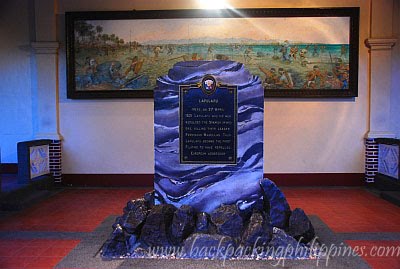
How did Ferdinand Magellan die? So many historical myths and hoaxes abound here but it's not really Lapu-lapu who killed him but a poisoned arrow to the leg. It was probably Lapu-lapu who dealt the final blow. He was killed due to his "stupidity" to charge at an enemy he didn't have any information on (remember Sun Tzu's Art of War?), and on the prodding of Rajah Humabon, an enemy of Lapu-lapu.
Rajah Humabon, who converted to Christianity earlier, later poisoned his Christian friends. What was left of Magellan's expedition later circumnavigated the world.
---
Travel Information on Mactan Shrine:
Mactan Shrine entrance fees: None but a donation box can be seen at the shrine entrance gate. Parking fee is at P10/vehicle.
There's also a Lapu-lapu Monument at Rizal Park in Manila (Luneta) "watching" the back of Jose Rizal Monument
How to get to Mactan Shrine / Lapu-lapu Monument, Lapu-lapu City:
Commuting from the Mactan-Cebu International Airport, you can flag a taxi to take you there directly or a jeepney, popularly called multicab, with signboard Punta Engaño. Tutubi also observed jeepneys with So-ong Maribago signboards passed by the place from Mandaue Highway. The Shrine is near Shangri-la Mactan Resort and Spa and the the famous Sutukil seafood restaurants. No information on jeepney fares but the taxi fare may be about P250 from downtown Cebu City.
Directions to Mactan shrine? It's just a straight drive from Mandaue City via Marcelo Fernan Bridge then right to M.L. Quezon Highway all the way to the shrine.
Labels: Cebu, Historical Shrines, History, Lapu-Lapu City, Metro Cebu, Monuments
posted by GingGoy @ 8:30 PM,
,
First Mass Controversy: Magellan's Mazaua, Limasawa or Butuan?
31 March 2010
The day, March 31, 1521, was on an island recorded by Magellan's chronicler as Mazaua but the issue on Mazaua's exact location is still hot debated by several groups that even the National Historical Institutes stand on the issue is not accepted.
The official NHI stand points to Limasawa Island off the coast of Leyte, an island without a harbor making it impossible to be the lost harbor of Magellan according to others. Another claim is that Mazaua is in Butuan, but Butuan is not an island (unless geomorphologists can really prove the island of Mazaua is now part of Butuan where the balangay boats were excavated). The third claim is the area of Pinamanculan-Bancasi.
The issue can only be settled unless archeologists can dig up artifacts attesting to the claims or any person who witnessed the event resurrects on Easter Sunday.
The latter seems improbable and the former needs lots of money and time. For now the controversy and debate will go on the issue: “Where is the site of the first mass?"
Annually, a Tridentine Mass is held at Bood Promontory in Pinamanculan, Butuan to commemorate the first mass while there's also a commemoration in Magallanes, Limasawa island, Southern Leyte (that still some quarters claim happened in Barangay Triana, not Magallanes)
Are you still not confused? :P
489 years and counting, that's how long the search for Magellan's lost harbor has been going on.
 The First Mass in the Philippines on Limasawa Island, Leyte depiction at the neo-classical Leyte Provincial Capitol. Another bas relief features the MacArthur landing in Palo near the end of World War II
---
Other significant events of March 1521:
March 28, 1521, Ferdinand Magellan's three ship Armada de Molucca anchored on Mazaua
The first blood compact in the islands, to be known later as The Philippines, happened between Ferdinand Magellan and Raia Siaiu. (This is contrary to the misinformed claims of some Boholanos that the Sandugo, the blood compact between Legazpi and Sikatuna in the island of Bohol was the first treaty of "friendship." The said Sandugo was also not honored by the Spaniards when they later enslaved the Filipinos so why celebrate the historically-inaccurate Sandugo Festival?)
Magellan then took ownership of the island group and named it Islas de San Lazaro for it was the feast day of San. Lazaro. The name shall only be changed to Islas de Filipinas, by Ruy Lopez de Villalobos more than two decades later.
Labels: History
posted by GingGoy @ 9:49 PM,
,
The Historic Bell House, Camp John Hay, Baguio City
16 September 2009
Walking distance from The Manor Hotel and inside the Historic core of Camp John Hay is the charming Bell house, the original vacation home of the Commanding General of the Philippines. It was named after General J. Franklin Bell who's credited for transforming Camp John Hay into a major military resort.
 Bell House, historic vacation home, surrounded by a nice manicured garden and pine trees at Camp John Hay Historical Core
 The seal of Camp John Hay, used to be displayed at the main gate, marking more than 100 years of existence from 1903
The Bell House of today currently serves as a museum of American colonial architecture and lifestyle. A portrait of John Milton Hay is displayed in the living room, complete with a fireplace, while the walls narrate Camp John Hay history through various images.

 the dining room displaying lifestyle of American commanding general
At one corner of the vacation home stands a totem pole with descriptive plaque that states:

"Carved by Ernesto Dul-ang, a succession of historical figures during the first half of the 20th century form a totem pole that once looked out on top of Scout Hill
Admiral George Dewey led the Battle of Manila Bay
General Emilio Aguinaldo was the first president of the Republic of the Philippines
President William Howard Taft was the first governor-general of the Philippines and later Secretary of War took a great interest in the development of Baguio City and Camp John Hay
Secretary John Milton Hay was secretary of state when the Philippines became a colony of the United States. He died as the construction of the camp named in his honor went into full gear.
William Cameron Forbes was a governor-general of the Philippines who is credited with the development of Baguio City
President Theodore Roosevelt signed the order that designated 535 acres as the military reservation that became Camp John Hay
Major General Franklin Bell was commander of the Philippines department and designer of Italian Garden as well as Bell House and Amphitheater
Lt. Col. Lyman W. Kennon oversaw the completion of the road that facilitated the construction and development of Baguio City and Camp John Hay
Mayor James Halsema was the last American Mayor of Baguio City
General Douglas McArthur was the famous liberator of the Philippines during World War II"
Near the historic Bell house is the Bell Amphitheater, a favorite venue for weddings, debuts, parties and other events.

The Bell House and Amphitheater are not just tourist attractions in Baguio City but also has historical and heritage significance that should be preserved for posterity.
Interesting Places near Bell House and inside Camp John Hay:
The Manor Hotel
Cemetery of Negativity
How to get there:
The best way to get there is via a taxi from Baguio CBD/Session Road as public transportation (jeepneys) don't enter the former military camp (unless you love to do lots of walking)
Labels: Baguio City, Benguet, Cordillera Administrative Region, History, Museums
posted by GingGoy @ 9:15 PM,
,
Ferdinand Magellan Did NOT Discover The Philippines; Capt. James Cook Did NOT Discover Australia
05 September 2009
The Australian tour guide shook his head in disbelief and said that indeed Capt. James Cook arrived in 1770, not 1778, in Australia, but it would be disrespectful to the Aborigines to say he discovered the island for the Aborigines already discovered Australia thousands of years before the white men came to the land of kangaroos, emus, platypuses, koalas and wombats.
The answer of the Australian tour guide to his own question was concurred by Tutubi in that back home in his beloved Philippine Islands, most Philippine history books still erroneously state that on March 17, 1521 Ferdinand Magellan "discovered" the Philippines.
 Tutubi stumbled upon Capt. James Cook monument at Hyde Park located near his hotel in Sydney CBD
The Australian aborigines arrived in Australia way before the British
came and so deserve credit for the discovery; the English merely arrived
in Australia in 1770.
 The monument honors the "discoverer" of Australia with the iconic Sydney Tower in the background
On the same note, the little black people, the aborigines of the
Philippines called Aeteas or Negritos, settled on the islands way before the Austronesians, the ancestors of modern Filipinos, came from Taiwan, before they spread out to the nearby islands of Indonesia, Malaysia, Timor Leste, Micronesia, Polynesia, Hawaii and even as far as Madagascar on the east coast of Africa.
How could the Portuguese navigator in the service of Spain have "discovered" the islands that he named San Lazaro, later to be called The Philippines, when people were already living on the various islands? When the Chinese, Vietnamese, Indians and other Asian countries were already trading goods with pre-hispanic Filipinos; when Maynila, was already a thriving city ruled by a vassal of Brunei; when Cebu and Mactan were ruled by the warring Rajah Humabon and Lapu-lapu respectively.
To the eyes of the European, Ferdinand Magellan may have "discovered" the Philippines for them, but it's not right for a FIlipino to say Magellan discovered Philippines for he merely arrived in these islands in 1521.
History needs to be re-written to reflect the perspective of the locals and not of the Europeans who think they discovered and later colonized most of the world.
Times have changed and so must your view of history.
Labels: Australia, Beyond Asia, History, Sydney
posted by GingGoy @ 10:31 PM,
,
National Heroes Day Tribute to Emilio Jacinto: The Brains of the Katipunan
31 August 2009
This day, Tutubi honors a man whose face used to be featured on the old 20 peso bill during the time of Pres. Marcos and also on the old 20 centavo coin: Emilio Jacinto
Emilio Jacinto was the young adviser of Katipunan Supremo Andres Bonifacio and the acknowledged "Brains of the Katipunan" for having prepared many Katipunan documents including the constitution and the Kartilya ng Katipunan. He's known in Katipunan circle as Pingkian.
Short Biography and Trivia:
Birthday: December 15, 1875
Birthplace: Trozo, Manila
Father's Name: Mariano Jacinto
Mother's Name: Josefa Dizon
Death: April 16, 1899
Works:
Author of Kartilya ng Katipunan (Primer of the Katipunan)
The oath of the pledges: "Sa Mga Kababayan," "Pahayag," and "A La Patria"
Founder and editor of the Kalayaan, the newspaper of the Katipunan under the pen name Dimasilaw
In February 1898 during the Philippine Revolution, he was wounded in a skirmish with Spanish riflemen in Maimpis (a barrio of Magdalena town), brought to the Catholic Church of Magdalena but was denied refuge and treatment. He was taken instead to Santa Cruz Church where a doctor treated his wound. To evade capture by the Spaniards, he used a pass that belonged to Florentino Reyes, a Filipino spy captured before the Maimpis encounter.
 Tutubi chanced upon an old forsaken maker of Emilio Jacinto on the national highway in Magdalena, Laguna commemorating the battle of Emilio Jacinto. Opposite the marker is Bahay ng Laguna, a museum dedicated to the former Laguna governor Felicissimo San Luis.
Emilio Jacinto was made the leader of the Katipunan in Laguna where he established his secret headquarters in the town of Majayjay. He died at a young age of 24 due to malaria.
Thought to ponder:
What makes a person a national hero? Legislation did not make one for there's really no Philippine law declaring a person as such; there's only popular acclaim, even in Jose Rizal's case.
Labels: Calabarzon, History, Laguna, National Heroes, Southern Tagalog
posted by GingGoy @ 9:09 PM,
,
A Visit to Jose Rizal Shrine in Dapitan, Zamboanga Del Norte
07 August 2009
It was during the period from June 1892 to July 31, 1896 that Jose Rizal spent years of his life as a physician where he treated many eye patients including that of his mother; an engineer, even without formal training, managed to design and build a water system that provided water to Dapitan (that awed modern day engineers due to lack of tools during his time); an educator where he founded a school for boys (one of his students was Jose Caancan who came all the way from Paete, Laguna); a businessman engaged in hemp, copra and log trading; agriculturist by planting various trees in his Talisay estate. All these in addition to being a linguist (fluent in 22 languages), inventor, scientist and artist.
 photo of Rizal's house in Dapitan (yeah, NHI chairman Ambeth Ocampo should be informed that those NHI markers obstruct the view). The woman in white, not a nun but a member of a Rizalist sect worshiping Rizal as a God doing, does volunteer work in maintaining the shrine.
Rizal described his life in Dapitan in a letter to his Austrian friend Ferdinand Blumentritt dated Dec. 19, 1893:
"I shall tell you how we live here. I have three houses; one square, another hexagonal, and a third octagonal, all of bamboo, wood and nipa. In the square house we live, my mother, sister Trinidad, a nephew and I; in the octagonal live my boys or some good youngsters whom I teach arithmetic, Spanish and English; and in the hexagonal live my chickens. From my house I hear the murmur of a crystal clear brook which comes from the high rocks ; I see the seashore , the sea where I have small boats, two canoes or barotos, as they say here. I have many fruit trees, mangoes, lanzones, guayabanos, baluno, nangka, etc. I have rabbits, dogs, cats,etc. I rise early - at five - visit my plants, feed the chickens, awaken my people and put them in movement. At half-past seven we breakfast with tea, pastries, cheese, sweetmeats, etc. Later I treat my poor patients who come to my land; I dress, I go to the town in my baroto, treat the people there, and return at 12 when my luncheon awaits me. Then I teach the boys until 4 P.M. and devote the after- noon to agriculture. I spend the night reading and studying."
 Casa Redonda, the hexagonal house of Rizal where his chickens lived (lucky chickens)
 Casa Cuadrada, the square house of Rizal Shrine, Dapitan City
Significant events of Jose Rizal's Exile in Dapitan:
Sept. 21, 1892 Rizal received his lottery winnings, via the mail boat Butuan, for second prize of P20,000.00. His share of the "lotto" winnings was P6,200.00, P2000 of which he gave to his father, P200 to his friend Jose Maria Basa in Hong Kong and the rest he used to buy the land in Talisay that he developed. It should be noted that Jose Rizal had no vices, except playing the lottery.
The aborted duel with a Frenchman named Juan Lardet due to a business deal. Mr. Lardet wrote a Dapitan merchant about the deal that was forwarded to Rizal who was instantly angered as it's an affront to his integrity. The duel didn't materialize due to the intercession of Spanish Captain Carnicero on Mr. Lardet due to his knowledge of Rizal's expertise on martial arts especially fencing and pistol shooting, making the Frenchman the underdog in the field of honor.
Fr. Sanchez, Rizal's favorite teacher at the Ateneo, visited him in another effort to bring him back to the Catholic fold; it again ended in failure. Fr. Sanchez was the only priest to publicly defend the Noli Me Tangere in public.
The Jose Rizal Pastells debate on religion occurred during this time where the Jesuit priest Fr. Pastells tried to win back Rizal to the Catholic faith. In spite of this, Rizal still heard mass at Dapitan Church but with his own variant of enlightened Catholicism.
Pablo Mercado, whose real name was Florencio Namanan, was sent by Recollect Friars in a secret mission to spy on Rizal in order to incriminate him for revolutionary activities. He never succeeded in his mission as Rizal figured him out early on (it's not an assasination attempt on Rizal, but merely an espionage mission)
Due to his earlier successful stint as an eye doctor in Hong Kong, Mr. Taufer accompanied by his stepdaughter Josephine Bracken visited him for an eye operation. Josephine Bracken later became his wife (though they never really had a church wedding nor a civil wedding due to refusal by the friars and civil authorities, Rizal and Josephine had a son who died shortly after birth due to miscarriage).
Perhaps the most significant event that occurred in Dapitan was the visit by Pio Valenzuela (from whom Valenzuela City of Metro Manila was named after), a member of the secret society of the Katipunan founded by Andres Bonifacio, where Rizal was presented the plan of the Katipunan to which he decided not to support arguing that the people should wait for the right time to launch a revolution and avert shedding of blood. He also didn't approve of the Katipunan's plan to rescue him as it would reflect negatively on his word of honor.
 A pool of water that comprise Jose Rizal's aqueduct that supplied potable water to Dapitan, a feat of water works engineering well ahead of his time according to modern day enngineers
 The Mi Retiro Rock, a large rock in Talisay where Rizal enjoyed watching sunsets. He also wrote a poem titled "Mi Retiro" on this rock.
Notes:
Rizal Shrine is maintained by the National Historical Institute. The Shrine coumpound is always open and provided with a security guard. A museum is also inside the shrine that's closed on Mondays. Volunteer shrine tour guides and photographers are present at the gate. A tour of this shrine is included at Dapitan tour packages and field trips by Buklod and Dakak Park and Beach Resort. Contact number of the shrine to be posted once available. Rizal Shrine entrance fee: None (it's free)
How to get there:
Rizal Shrine is just a short tricycle ride away from "The Shrine City of Dapitan" proper. The closest airport is Dipolog Airport where you ride a tricycle to Dipolog Transport Terminal then a bus to Dapitan City. Travel time is just less than an hour.
Please don't request Tutubi for some sort of analysis and reaction paper to Jose Rizal's life in Dapitan. He doesn't tolerate laziness of some students looking for shortcuts. Jose Rizal won't be proud of you for sure.
Related Posts:
Jose Rizal in Hong Kong
Jose Rizal's Grave in Paco Cemetery
Jose Rizal in UST
Labels: Dapitan, Historical Shrines, History, Jose Rizal, Zamboanga del Norte, Zamboanga Peninsula
posted by GingGoy @ 8:30 PM,
,
Araw ng Maynila: Manila's Foundation Day is NOT June 24, 1571
23 June 2009
Was Manila really founded on June 24, 1571? History will answer this question that what was founded 438 years ago was the walled city of Intramuros by Legazpi over the ruins of Maynila. Manila was already a thriving community at the mouth of the Pasig river and Manila bay even before the coming of the Spaniards so why celebrate the "foundation" of Manila on June 24?
What about the Nilad tree? Ambeth Ocampo asserts that there really is no nilad tree, rather a nila tree. Maynila was so named because of the presence of the nila tree in the area. Nilad tree is just a legend as well as Maynilad only for misinformed souls.
It is also noteworthy that Manila's coat-of-arms under the Spaniards used a symbol of the merlion, a half-man, half-fish, icon on the seal symbolic of Manila's marine lion beginnings. The Merlion symbol use thus preceeds Singapore Merlion for about 400 years and yet the image is now synonymous with Singapore.
 the Coat-of-Arms of Manila during Spanish times.
 The present seal of the City of Manila still feature the merlion symbol unknown to most people of Manila and Filipinos. Will Manila ever regain the recall of the merlion symbol it once owned or forever lurk in the shadow of the now more popular merlion of Singapore, now the popular icon of the Lion City conceived only in 1964?
Today, Manila is now part of Metro Manila, a conglomeration of cities and a lone municipality. Rajah Soliman (Sulayman) is honored mostly for the park named in his honor in Manila's Malate district.
 A calesa on Roxas Blvd in front of Rajah Sulayman Park
Tutubi is not one with the people of Manila in celebration of Araw ng Maynila for he does not approve of the date of celebration. June 24 is a non-working holiday in Manila but not in the whole country. The day is marked with celebration and schedule of activities all over the historic city but Manila denizens (of which Tutubi was once one for ten years) should know that they're really celebrating a historical error.
As Carmen Guerrero Nakpil puts it, June 24 should not be Araw ng Maynila but rather Araw ng Kastila!
Labels: History, Manila, Metro Manila, National Capital Region
posted by GingGoy @ 9:37 PM,
,
Tarlac: Capas National Shrine (Camp O'Donnell)
25 June 2007
I was thinking of not posting this picture since it's not that clear but again, for photojournalistic purposes, I posted it here. I wasn't able to get a better picture owing to the gray clouds providing not so good lighting and mostly my trekking mates opted not to get out of the van to even take pictures either they're tired or just plain indifferent/oblivious to history. The shot that you see here taken with my hand out of the window slightly skewed and blurred.
 The infamous Bataan Death March (バターン死の行進) began shortly after the fall of Bataan peninsula on April 9, 1942 where Filipino and American POWs were forced to march from Bataan to San Fernando, Pampanga (where they're herded into suffocating trains) then marched again upon arrival in Capas, Tarlac
Note that survivors of the Fall of Corregidor on May 6, 1942 did not participate in the Death March like what my officemates were saying. The Death March lasted a few days before the Rock fell to the Japanese.
Capas National Shrine is actually the former internment camp of Camp O'Donnell and has a 70 meter obelisk, a wall where names of the Filipinos and Americans who died there is listed and a small monument by the Battling Bastards of Bataan.
This place requires a re-visit by the tutubi in the future for him to get up close to the historic place most Filipinos don't even hear of or taken for granted.
How to get to Capas, Tarlac:
Capas National Shrine is along the national highway in Capas, Tarlac. There's a small entrance fee of PhP5.00.
Labels: Central Luzon, History, Monuments, Tarlac, World War II
posted by GingGoy @ 11:41 PM,
,
World War 2 History: The Fall of Corregidor (May 6, 1942)
06 May 2007
This happened long after British-controlled Singapore, a vaunted impregnable fortess, capitulated in the middle of February 1942 that ended British's feared invinciblity in Asia. (note the brilliant strategist of Singapore invasion was Tomoyuki Yamashita)
 a memorial to the heroes of war near the ruins of Cine Corregidor
This is the first of a series on Corregidor, a tadpole-shaped island fortress at the mouth of Manila Bay, politically part of Cavite even if geographically nearer to Bataan, that I visited three times: the first time in 2004 with Japanese friends (my rusty knowledge of Japanese helped a lot), the second time for the occular inspection and the third time for company team building activities
To be continued...
Related Posts:
Corregidor Guided Tour,
Corregidor Guided Tour,
Corregidor Team building,
Corregidor Ghosthunting
Labels: Calabarzon, Cavite, Corregidor, History, World War II
posted by GingGoy @ 8:24 PM,
,
300 The Movie, Battle of Thermopylae and the Battle of Tirad Pass in History
30 March 2007
 300 is about a historic battle set in Greece where 300 Spartans defended a very narrow pass, Thermopylae, for days againsts the ravaging war machine of the Persian Empire of Xerxes I against the Greek army of 300 plus allied Thebans and Thespians.
It was only after Ephialtes, a Malian, betrayed the Greeks by showing the Persian army a trail leading behind the lines of the Greek army.King Leonidas and most of the Spartan army with him perished.
Wheneever I read something about this historic battle, I also remember, being a Filipino, a battle whose story is very similar to that of Thermopylae: The Battle of Tirad Pass.
During the Philippine-American War (that most Americans still call incorrectly as Philippine Insurrection against the United States), Gen Aguinaldo gave orders to Gen. Gregorio Del Pilar to watch his back (rear guard) while trying to escape pursuing American troups.
For hours, the 60 hand-picked Filipino troups held off the advancing American force of 500 until a Filipino, Januario Galut, led the Americans to a trail that led behind the Filipino lines. Most defenders died including the young general.
General del Pilar was stripped of everything including his shoes and left unburied by the American marauders.
In the aftermath of the Battle of Thermopylae, the Greeks won decisive victories against the Persians and lost their ambition of expansion of their empire; after Tirad Pass and succeeding battles resulting in the conquest of the Philippines, the United States of America, where all men are (said to be) created equal became an empire!
Note:I wasn't able to visit Tirad Pass (Pasong Tirad) in November 2005 when I visited Sagada with Ferdz as well as the near (relatively yet so hard to reach) Kiangan town where Gen. Yamashita surrendered to the Americans at the end of WW2) maily due to an urgent need to come home. A fellow traveller/history enthusiast friend of ours, however, was able to inspect the site and again remarked how biased the history reports of the Americans were.
There are two sides to every story: their side and the truth! :)
Labels: Gregorio del Pilar, History, National Heroes, Philippine-American War
posted by GingGoy @ 10:10 PM,
,
Nielson Tower: Makati CBD Was an Airport
11 March 2007
While the United States' economy traversed the economic downward spiral due to the Great Depression, the Philippine economy rode high with unprecedented growth. Along with this came economic prosperity that made many foreigners coming to our shores dubbed then as the Pearl of the Orient.
One of those who came to the Philippines was Laurie Reuben Nielson, by way of New Zealand, quickly made successes in businesses. He later became involved in building an airport and aviation school in Manila, badly needed at that time, due to the booming needs of the economy. He was able to convince several investors in the airport project and secured a lease from Ayala y Cia for several hectares of land carved out of the vast Hacienda San Pedro de Makati.
The new airport, baptized Nielson Airport, was completed in 1937 and touted as the largest and most modern airport in Asia. It became the home of the country's first airline: Philippine Air Taxi Company (PATCO) and where Philippine Airlines made her maiden flight on March 15, 1941 to Baguio. (Philippine Airlines is the oldest operating airline in Asia, established by a group of businessmen led by Andres Soriano in February 1941)
When war spilled into the country in December 1941 and soldiers of the Land of the Rising Sun overran the archipelago, Laurie Nielson, due to his British citizenship, was taken to Hong Kong while his family brought to the University of Sto. Tomas then converted into an internment camp.
Laurie was never seen nor heard from again and his family moved to the United States after the war.
When airport subsequently transferred to a new location in Paranaque in 1948, Ayala y Cia, reborn Ayala Corporation in 1968, developed Makati into the present modern city while Nielson Tower, with its art deco-inspired architecture that resemble an airplane if viewed from above, was saved from demolition, converted into a library called Filipinas Heritage Library in 1996.

In 2001, UNESCO, recognizing the Nielson Tower for the impressive conversion from airport tower to library, renovation and adaptive reuse, conferred to it the prestigious annual UNESCO Asia-Pacific Cultural Heritage Award,
The same award was given to Gota de Leche building in 2003 and Far Eastern University campus in 2005.
Nielson Tower still stands in an area known as Ayala Triangle while the airport's two major runways are the present day Ayala Avenue and Paseo de Roxas.

bird's eyeview of Ayala avenue corner Makati avenue taken through dirty glasswindow of my new office with Nielson Tower in view
 I happened to organize a seminar for my company, the freelance events organizer that I am, shopped around Makati for a suitable venue to accommodate about a hundred seminar participants and this nearby building came to mind: Filipinas Heritage Library and gave me the chance to take pictures of the structure using my reliable point-and-shoot camera. The seminar turned out success to the enjoyment of the attendees and satisfaction of my various sponsors. Maybe I should change career into events management! :)
Labels: Architecture, History, Makati, Metro Manila, National Capital Region, UNESCO
posted by GingGoy @ 8:23 PM,
,
The Liberation of Manila
03 March 2007
The "dynamic duo" of American carpet bombing and Japanese demolition resulted in the destruction of grand churches, exquisite buidings, museums along with priceless collections, and grand bridges across the Pasig River-- historical and cultural treasures of Filipinos lost forever!

Rear Admiral Iwabuchi Sanji, a navy officer untrained in urban warfare, led the Japanese defense of Manila, committed to defend the city to the last man, disobeyed orders by Gen. Yamashita to retreat to the mountains of Baguio where it's easier to defend.
(Gen. Yamashita surrendered to the Americans in Kiangan town, Mountain Province at the end of the war. He later went through a mistrial by an American kagaroo court then eventually hanged (in Los Banos, laguna) by the Americans for war crimes committed in the Philippines even if he wasn't actually responsible for them-- he came to the Philippines only a few days before liberation-- a fact unknown to most Filipinos)
The Americans led by Gen MacArthur, ordered the retaking of Manila at all costs at the soonest possible time seen as a boost of his ego, giving the go signal to level the once proud city instead of using other tactics to capture it. (The man thought and planned in advance for a celebration announcing the liberation of the capital to the world even before the battle began-- that's something most politicians are good at)
In desperation, on realizing impending defeat, the Japanese defenders entrenched themselves in various buildings, and turned their wrath on the civilians resulting to deaths of innocent civilians estimated to be a hundred thousand, and countless rapes of women witnessed by foreigners.
There were even reports of babies thrown into the air and bayonetted to death by Nihon-jin soldiers
Only two of the original seven churches of Intramuros, San Agustin and Manila Cathedral, remained standing. Manila Cathedral needed to be demolished and replaced due to irreparable damage.
The battle of Manila was deemed the deadliest urban fighting of the second world war and made Manila the most ravaged city after Warsaw.

Avenida Rizal after the war with Avenue Theater in view. Sadly, Avenue Theater also fell prey to its uncaring owner last year and gave it the demolition ball only recently. Avenue Theater is an art deco work by National Artist for Architecture Juan Nakpil. That's what's happening to works of National Artists-- demolished to give way to newer buildings in the name of progress!


Up to now the Japanese government is in denial of the occurence of the Manila Massacre as well as others such as the more (in)famous Rape of Nanking (China) and other atrocities across Asia even glossing over these events in present history books to the dismay and outrage of Asians particularly Chinese and Koreans.
It's also perplexing to note that the US didn't pursue much of the war crimes against the Japanese emperor, the royal family and other warmongers not like the zeal they had in pursuing warmongers in Europe especially the Nazis. In fact, they even absolved some people directly responsibile to the war. This is the reason why some nations particularly Russia have yet to sign the document officially ending the war with Japan. Most of the US documents pertaining to these issues are still classified up to this day.

the memorial in Intramuros honoring the innocent victims of the senseless war
In war, there are no real winners, all are losers!
-------------------------------------------------------
Disclaimer: As always, I didn't take these pictures (except for the one signed with my name) of the war for practical reason i wasn't born yet. All pictures part of US National Archives and already belonging to public domain.
Also wrote my name both in Baybayin, the ancient script of our forefathers and Japanese (katakana). Isn't it cool?
Labels: History, Manila, Metro Manila, World War II
posted by GingGoy @ 8:36 AM,
,
Manila's Grand Bridges of Pasig River: Jones, Quezon, MacArthur
16 February 2007
Jones Bridge:

 Jones Bridge constructed in the 1920's as part of the grand scheme of neo-classical architecture in Manila, designed by the same architect of the the Post Office Building, Metropolitan Theater, and US Embassy: Juan Arellano.
Jones Bridge was named after William Atkinson Jones, a member of the U.S. Congress and chairman of the Insular Affairs Committee who sponsored the Philippine Autonomy Act in 1916.
 Before Jones bridge, there was Puente de España, erected in 1875 to replace the earlier Puente Grande, the Puente de España can accommodate pedestrian and horse or carabao drawn carts and carriages as well as tranvias, the Puente de España needed to be destroyed and replaced by Jones Bridge to accommodate automobiles.
But, again, before Puente de Espana, there was Puente Grande, a seven-arch bridge established in 1632 to link Intramuros to Binondo (established in 1592) served before by a ferry service. Puente Grande was destroyed by the earthquake of 1863 and replaced by Puente de España.
Quezon Bridge

the south end of Quezon Bridge beside Arroceros Park

the north end of Quezon bridge near Quiapo
The precursor of Quezon bridge, called Puente Colgante (suspension bridge) held the distinction as the the first suspension bridge in East Asia (I don't use Far East since I'm in the Philippines) , built in 1852 with two lanes in opposite directions for carriages and a pedestrian lane in the center island but demolished in 1938 to give way to vehicular traffic.
 Quezon Bridge was opened a year after the Golden Gate Bridge was inaugurated, sporting the art deco style and inspired by the Sydney Harbor Bridge-- no wonder it looks similar!
Ayala Bridge

The third tulay to be built spanning the Pasig was the Puente de Convalecencia, now known as the Ayala Bridge, originally composed of two separate spans connected by the Isla de Convalecencia, which is home to Hospisio de San Jose, the bridge over this island was originally made of wooden arched trusses. Completed in 1880 and suffered major damage to the structure and collapsed completely after 10 years. This was subsequently replaced with a simple metal saw trussed bridge during the 1890's, designed by an engineer that goes by the name of Gustave Eiffel, who later gained fame for the eponymous tower in Paris and the interiors of the Statue of Liberty, in the construction of the bridge in collaboration with Ayala y Cia.
MacArthur Bridge
 MacArthur Bridge obscured by the Light Rail Transit (LRT)
Those four original bridges must've been an awesome sight back then but sadly the original ones were destroyed by the Japanese during the second world war and what we're seeing today are poor reconstructions of the originals.
This last picture of a bridge crossing the Pasig, bears the mission of the Pasig River Rehabilitation Commission's mission:

PRRC may have been beset with problems particularly lack of funds but their continuing program of accomplishing their mission is now noticeable partcularly with the relocation of "informal settlers" along the riverbanks, the construction of linear parks of the cities and the eventual improvement of water quality.
Note that under Proclamation 780, the annual Pasig River Marathon is to be held on the month of February also declared the Pasig River Month.
This year, the marathon will be held on February 25.
Disclaimer:
the small black and white photos were not taken by me (obviously I haven't been born yet) but now belong to the public through the US archives. If I should be proven wrong, please drop a comment and I will oblige by removing the picture posted here.
Related Posts:
Pasig River Cruise,
Pasig River Lighthouse,
Pasig River Structures,
People of Pasig,
Labels: Bridges, History, Manila, Metro Manila, National Capital Region, Rivers
posted by GingGoy @ 11:11 PM,
,