Bridgewalk: Crossing Sydney Harbour Bridge
09 June 2009
Days before Tutubi's "historic" trip to the "Land Down Under," he was asked by his excited officemate who's going with him what they're going to do in Sydney to which he simply replied: "Let's cross the bridge when we get there."
And on landing in Sydney Airport one chilly Sydney winter morning, hurriedly dropped their bags at the Metro Hotel on Pitt, walked towards Circular Quay and historic The Rocks district of Sydney near Sydney Opera House and crossed the iconic Sydney Harbour Bridge

The first glimpse of Sydney Harbour bridge from Circular Quay in front of Museum of Contemporary Art

Northern end of the iconic Sydney Harbour Bridge from Milson Point
A Sydney Harbour Bridge history marker states Sydney Harbour Bridge was opened for traffic on March 18, 1932. On May 28, 2000, more than 250,000 people walked across the bridge in support of reconciliation and a million more in months that followed.
Want to know the way to Cross Sydney Harbour Bridge?
From Circular Quay, you need to walk towards Museum of Contemporary Art, continue towards Argyle St then turn left just before entering Argyle cut (looks like a tunnel) then right up a flight of stairs, cross the street where you'll see the entrance to the pedestrian walkway of the bridge that leads to the other side. Tutubi got there by finding the way as he didn't find the signs leading to the stairs but at least he found it.
If you're quite adventurous and with money to burn, you can also do the more daring BridgeClimb where you can climb the bridge for a fee of course. A lesser adventure by climbing one of the pylons where a view is offered plus a museum (entrace fee/admission price apply) about Sydney Harbour Bridge's history can be viewed. Tutubi opted for the free tour of Sydney Harbour Bridge just by walking across it.
warning: Don't believe online travel guides that crossing the bridge takes only fifteen minutes; Tutubi took about an hour just to cross to the other side-- delayed by taking too many pictures of Circular Quay, Sydney Opera House, Fort Denison and the bridge itself.
Sydney harbour Bridge is listed as one of the "1000 Places Before You Die" book by Patricia Schultz. It has a pedestrian walkway on the eastern lane, a bike lane to the west, a train track and several lanes for vehicles.
This is the start of a new series on Beyond Asia detailing Tutubi's first adventure outside of Asia. Will go back to regular programming later
And on landing in Sydney Airport one chilly Sydney winter morning, hurriedly dropped their bags at the Metro Hotel on Pitt, walked towards Circular Quay and historic The Rocks district of Sydney near Sydney Opera House and crossed the iconic Sydney Harbour Bridge

The first glimpse of Sydney Harbour bridge from Circular Quay in front of Museum of Contemporary Art

Northern end of the iconic Sydney Harbour Bridge from Milson Point
A Sydney Harbour Bridge history marker states Sydney Harbour Bridge was opened for traffic on March 18, 1932. On May 28, 2000, more than 250,000 people walked across the bridge in support of reconciliation and a million more in months that followed.
Want to know the way to Cross Sydney Harbour Bridge?
From Circular Quay, you need to walk towards Museum of Contemporary Art, continue towards Argyle St then turn left just before entering Argyle cut (looks like a tunnel) then right up a flight of stairs, cross the street where you'll see the entrance to the pedestrian walkway of the bridge that leads to the other side. Tutubi got there by finding the way as he didn't find the signs leading to the stairs but at least he found it.
If you're quite adventurous and with money to burn, you can also do the more daring BridgeClimb where you can climb the bridge for a fee of course. A lesser adventure by climbing one of the pylons where a view is offered plus a museum (entrace fee/admission price apply) about Sydney Harbour Bridge's history can be viewed. Tutubi opted for the free tour of Sydney Harbour Bridge just by walking across it.
warning: Don't believe online travel guides that crossing the bridge takes only fifteen minutes; Tutubi took about an hour just to cross to the other side-- delayed by taking too many pictures of Circular Quay, Sydney Opera House, Fort Denison and the bridge itself.
Sydney harbour Bridge is listed as one of the "1000 Places Before You Die" book by Patricia Schultz. It has a pedestrian walkway on the eastern lane, a bike lane to the west, a train track and several lanes for vehicles.
This is the start of a new series on Beyond Asia detailing Tutubi's first adventure outside of Asia. Will go back to regular programming later
Labels: 1000 Places To See Before You Die, Australia, Beyond Asia, Sydney
posted by GingGoy @ 10:17 PM,
,


Banaue Rice Terraces, Manunggul Jar, Langgal : Philippine National Treasures on the 1000 Peso Bill
11 January 2008
A few weeks ago, Tutubi was asked by a friend, while holding a crisp 1000 peso bill, if he's been to the famous Banaue Rice Terraces. Tutubi replied affirmatively, reached for the P1000 bill, not to pocket it but to explain the other pictures on the reverse side of the Philippine bank note.
He went on to explain the meaning and significance of the Banaue Rice Terraces, the langgal and manunggul jar in Philippine culture and national pride.
 photos of the three national treasures of the Philippines on the P1000 bank note: the rice terraces on the left, manunggul jar at the upper right and the langgal on the lower right.
Hagdan-Hagdang Palayan ng Banawe (Rice Terraces of Banaue) is estimated to have been in existence for two thousand years. Tutubi was able to see this "wonderful staircase to the heavens" in 2004 after his tour of breathtaking Sagada and Bontoc Museum with Ferdz as guide. It was raining that time that hindered picture taking. The rice terraces, together with local customs and traditions tied to it, is enlisted as a UNESCO World Heritage Site and made it to the list of "1000 places to see before you die."
Manunggul Jar, excavated in Manunggul Cave near the famous Tabon Caves in Lipuun Point, Quezon, Palawan by US Peace Corps volunteers, is a burial jar with a cover portraying a boat-of-the-dead with souls sailing into the next world (quite similar to, but not copied from, Charon in Greek Mythology ferrying dead across the river Acheron or Styx). Now exhibited at the National Museum of the Filipino People in Manila, it dates back to the Neolithic period of Philippine history. Note the boat even has a face that denotes the makers belief in the anito of yore where inanimate objects possess spirits and therefore should be respected. The manunggul jar is one of those exhibits displayed at the National Museum that Tutubi never fails to miss every time he goes there.
The langgal, sometimes called ranggar by the Maranao people of Mindanao, is a Muslim place of worship in the Sulu Archipelago (particularly the Yakans) headed by an imam, and assisted by two helpers, the habib and the bilal, as prescribed by Islam.
These three vignettes project a new cultural image of the greatness of the Filipino people here and abroad but, sadly, only the rice terraces seem to be well-known and won't even show up for list of common Filipiniana list of most Filipinos.
---
How to go to National Museum, Manila:
Commuting there is easy with jeepneys from Quezon City with signboards Kalaw, Mabini, Harrison Plaza, Taft, Herran, PGH all pass by Rizal Park (Luneta) where the museum is located. It's also within walking distance from LRT UN Avenue station. Driving there is no problem also as it's fairly popular. Parking space, however, is a problem.
How to get to Banaue Rice Terraces:
Commute to Banaue by bus: Autobus, with terminal at Espana corner Cataluna St in Manila, has the Manila to Banaue daily trip that takes about 8 hours. Its terminal is mere walking distance from the rice terraces view deck and Banaue Hotel and Youth Hostel for cheap accommodations.
Travel Tip: In Banaue, you may also visit Sagada and Bontoc Museum to complete your itinerary.
Further Reading:
Artes Filipinas on Manunggul Jar
BSP: Know Your Currency
NOTES: The only other place in the Philippines that made it to the "1000 Places to See Before You Die" list is the über-exclusive and pricey Amanpulo Resort in Palawan (though Tutubi sort of looks at the book as trivializing travel to just a mere shopping list)
Jose Abad Santos, Vicente Lim, and Josefa Llanes Escoda featured on the obverse side of the bill are three heroes/martyrs during the second world war.
If you're interested in Paleolithic Pre-history of the Philippines, go to the museum in Tuguegarao where excavations in Cagayan Valley proved the presence of paleolithic life in these islands.
If you're a treasure hunter hunting for treasures in the Philippines, just follow directions on how to "discover" the treasures discussed above. No details and maps will lead you to the lost treasure of Yamashita or the golden buddha.
Related Post:
How to Get to Banaue
He went on to explain the meaning and significance of the Banaue Rice Terraces, the langgal and manunggul jar in Philippine culture and national pride.
 photos of the three national treasures of the Philippines on the P1000 bank note: the rice terraces on the left, manunggul jar at the upper right and the langgal on the lower right.
Hagdan-Hagdang Palayan ng Banawe (Rice Terraces of Banaue) is estimated to have been in existence for two thousand years. Tutubi was able to see this "wonderful staircase to the heavens" in 2004 after his tour of breathtaking Sagada and Bontoc Museum with Ferdz as guide. It was raining that time that hindered picture taking. The rice terraces, together with local customs and traditions tied to it, is enlisted as a UNESCO World Heritage Site and made it to the list of "1000 places to see before you die."
Manunggul Jar, excavated in Manunggul Cave near the famous Tabon Caves in Lipuun Point, Quezon, Palawan by US Peace Corps volunteers, is a burial jar with a cover portraying a boat-of-the-dead with souls sailing into the next world (quite similar to, but not copied from, Charon in Greek Mythology ferrying dead across the river Acheron or Styx). Now exhibited at the National Museum of the Filipino People in Manila, it dates back to the Neolithic period of Philippine history. Note the boat even has a face that denotes the makers belief in the anito of yore where inanimate objects possess spirits and therefore should be respected. The manunggul jar is one of those exhibits displayed at the National Museum that Tutubi never fails to miss every time he goes there.
The langgal, sometimes called ranggar by the Maranao people of Mindanao, is a Muslim place of worship in the Sulu Archipelago (particularly the Yakans) headed by an imam, and assisted by two helpers, the habib and the bilal, as prescribed by Islam.
These three vignettes project a new cultural image of the greatness of the Filipino people here and abroad but, sadly, only the rice terraces seem to be well-known and won't even show up for list of common Filipiniana list of most Filipinos.
---
How to go to National Museum, Manila:
Commuting there is easy with jeepneys from Quezon City with signboards Kalaw, Mabini, Harrison Plaza, Taft, Herran, PGH all pass by Rizal Park (Luneta) where the museum is located. It's also within walking distance from LRT UN Avenue station. Driving there is no problem also as it's fairly popular. Parking space, however, is a problem.
How to get to Banaue Rice Terraces:
Commute to Banaue by bus: Autobus, with terminal at Espana corner Cataluna St in Manila, has the Manila to Banaue daily trip that takes about 8 hours. Its terminal is mere walking distance from the rice terraces view deck and Banaue Hotel and Youth Hostel for cheap accommodations.
Travel Tip: In Banaue, you may also visit Sagada and Bontoc Museum to complete your itinerary.
Further Reading:
Artes Filipinas on Manunggul Jar
BSP: Know Your Currency
NOTES: The only other place in the Philippines that made it to the "1000 Places to See Before You Die" list is the über-exclusive and pricey Amanpulo Resort in Palawan (though Tutubi sort of looks at the book as trivializing travel to just a mere shopping list)
Jose Abad Santos, Vicente Lim, and Josefa Llanes Escoda featured on the obverse side of the bill are three heroes/martyrs during the second world war.
If you're interested in Paleolithic Pre-history of the Philippines, go to the museum in Tuguegarao where excavations in Cagayan Valley proved the presence of paleolithic life in these islands.
If you're a treasure hunter hunting for treasures in the Philippines, just follow directions on how to "discover" the treasures discussed above. No details and maps will lead you to the lost treasure of Yamashita or the golden buddha.
Related Post:
How to Get to Banaue
Labels: 1000 Places To See Before You Die, Bank Notes, Cordillera Administrative Region, Ifugao, National Cultural Treasures
posted by GingGoy @ 8:56 PM,
,
Victoria Harbour Cruise Tour: 1 of 1000 Places To See Before You Die
21 September 2007
After all the Philippine historical tours, Disneyland, Madame Tussauds Wax Museum, and free Hong Kong city tour, one of the most recognizable images of Hong Kong can be experienced through Star Ferry's Harbour Tour.


the last authentic Chinese junk still sailing in Victoria Harbour: the Duk Ling moored at the Central Pier

Central pier and International Finance Center, the tallest skyscraper in Hong Kong towering over the magnificent skyline

the spaceage-looking Hong Kong Cultural Center and the Clock Tower in Tsim Sha Tsui, Kowloon, both landmarks of the modern city.
The Clock Tower is what's only left of the Kowloon station of the Kowloon-Canton railway in Tsim Sha Tsui.
Nearby are Hong Kong Museum of Art, Hong Kong Space Museum, and the Avenue of Stars


The Hong Kong Convention and Exhibition Centre in Wan Chai. Behind is the World Plaza, Hong Kong's second tallest skyscraper
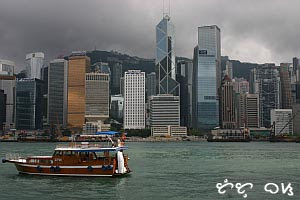
the magnificent skyline of Central, Hong Kong Island. The edifice, with unique climbing lines resembling growing bamboo shoots symbolizing livelihood and prosperity, is the Bank of China Tower: the 3rd highest building there.

Crossing the Victoria Harbour is one of the 50 places of a lifetime according to National Geographic and also one of the 1000 places to see before you die.
Tutubi has only been to seven of the 1000 places...993 places more to visit! :)
Star Ferry's Harbour Tour Ticket Prices:
Round Trip Ticket costs HK$45 during the day, HK$95 at night and HK$135 during A Symphony of Lights multimedia show featuring the buildings on the harbour front in a spectacular light sequence.
You may get your tickets at the following outlets:
Central Star Ferry Pier, Wan Chai Star Ferry Pier, Hung Hom Star Ferry Pier, Tsim Sha Tsui Star Ferry Pier
UPDATED: July 2013


the last authentic Chinese junk still sailing in Victoria Harbour: the Duk Ling moored at the Central Pier

Central pier and International Finance Center, the tallest skyscraper in Hong Kong towering over the magnificent skyline

the spaceage-looking Hong Kong Cultural Center and the Clock Tower in Tsim Sha Tsui, Kowloon, both landmarks of the modern city.
The Clock Tower is what's only left of the Kowloon station of the Kowloon-Canton railway in Tsim Sha Tsui.
Nearby are Hong Kong Museum of Art, Hong Kong Space Museum, and the Avenue of Stars


The Hong Kong Convention and Exhibition Centre in Wan Chai. Behind is the World Plaza, Hong Kong's second tallest skyscraper

the magnificent skyline of Central, Hong Kong Island. The edifice, with unique climbing lines resembling growing bamboo shoots symbolizing livelihood and prosperity, is the Bank of China Tower: the 3rd highest building there.

Crossing the Victoria Harbour is one of the 50 places of a lifetime according to National Geographic and also one of the 1000 places to see before you die.
Tutubi has only been to seven of the 1000 places...993 places more to visit! :)
Star Ferry's Harbour Tour Ticket Prices:
Round Trip Ticket costs HK$45 during the day, HK$95 at night and HK$135 during A Symphony of Lights multimedia show featuring the buildings on the harbour front in a spectacular light sequence.
You may get your tickets at the following outlets:
Central Star Ferry Pier, Wan Chai Star Ferry Pier, Hung Hom Star Ferry Pier, Tsim Sha Tsui Star Ferry Pier
UPDATED: July 2013
posted by GingGoy @ 9:47 PM,
,