The Old Cemetery and Ermita Ruins in Dimiao, Bohol
01 March 2012
Tutubi stumbled on these historical ruins of an old chapel and cemetery, with honeycomb tombs similar to those in Paco Cemetery, just beside Dimiao Church called the Ruins of Ermita, while he was taking pictures of the old church and the nearby Dimiao Tourism Office.
 the ruins of ermita with the walls of the chapel lined with the honeycomb tombs
For the history of Ermita ruins, here's what a marker at the site states:
"Ermita is a Spanish term for a small church or chapel in a lonely place.
In a study conducted by a team from the National Museum entitled Archaelogical
Exposition of the 18th Century structure, Ermita Ruins is an 18th century structure which has the closest resemblance to Paco Cemetery, a historical site in Paco, Manila. Built in 1800 until 1815 by Fr. Enrique de Santo de Villanueva, it was constructed during the Spanish colonial period that has been abandoned and erected by a population that was willing to work for the church and the Ermita.
It has honeycombed-arranged tombs or sepulchers that are unique and so far, the only one found in the the Philippines, which make up the walls of the Ermita.
The researchers, were surprised why no graves were found in the tombs. To them, perhaps, it was constructed not only as a chapel but also as a cemetery. But even before it was completed, it could be possible that a big catastrophic event occured, an epidemic perhaps =, which explains the mass burial as evidenced by skeletons excavaed from the ground, not properly arranged but just laid on top of the others.


On the other hand, researchers consider the idea that perhaps, the absence of bones in the hndreds of small niches (akthough there were few sets of bones recovered and transferred to the municipal cemetery) explained byt the clousre of the cemetery in 1844 by Fr. Manuel Carususan; its nearness to the church was deemed unhealthy.
The preservation of the ERMITA RUINS is a joint project of the Diocese of Tagbilaran, the St. Nicholas paarish and local government of Dimiao. The preservation is in accordance with the policies of the National Heritage (sic) Institute (NHI) to retain the antiquity of the place and preserve its natural beauty and attraction."
 the ruins of ermita with the walls of the chapel lined with the honeycomb tombs
For the history of Ermita ruins, here's what a marker at the site states:
"Ermita is a Spanish term for a small church or chapel in a lonely place.
In a study conducted by a team from the National Museum entitled Archaelogical
Exposition of the 18th Century structure, Ermita Ruins is an 18th century structure which has the closest resemblance to Paco Cemetery, a historical site in Paco, Manila. Built in 1800 until 1815 by Fr. Enrique de Santo de Villanueva, it was constructed during the Spanish colonial period that has been abandoned and erected by a population that was willing to work for the church and the Ermita.
It has honeycombed-arranged tombs or sepulchers that are unique and so far, the only one found in the the Philippines, which make up the walls of the Ermita.
The researchers, were surprised why no graves were found in the tombs. To them, perhaps, it was constructed not only as a chapel but also as a cemetery. But even before it was completed, it could be possible that a big catastrophic event occured, an epidemic perhaps =, which explains the mass burial as evidenced by skeletons excavaed from the ground, not properly arranged but just laid on top of the others.


On the other hand, researchers consider the idea that perhaps, the absence of bones in the hndreds of small niches (akthough there were few sets of bones recovered and transferred to the municipal cemetery) explained byt the clousre of the cemetery in 1844 by Fr. Manuel Carususan; its nearness to the church was deemed unhealthy.
The preservation of the ERMITA RUINS is a joint project of the Diocese of Tagbilaran, the St. Nicholas paarish and local government of Dimiao. The preservation is in accordance with the policies of the National Heritage (sic) Institute (NHI) to retain the antiquity of the place and preserve its natural beauty and attraction."
Labels: Bohol, Cemeteries, Central Visayas
posted by GingGoy @ 11:23 PM,
,


Baguio: The Lost Cemetery of Negativism, Camp John Hay Historic Core
23 March 2009
Imagine visiting a place where all your negative emotions, thoughts and impediments to achieving your goals can be buried. A cemetery where no former living thing is buried but where you'll find tombs with funny yet thought-provoking epitaphs inscribed on tombstones. It's a place where you can bury your negative traits and thoughts where you'll end not grieving and instead make you a better person.

Welcome to the Cemetery of Negativism, sometimes called Lost Cemetery, part of Camp John Hay Historic Core that includes the historic Bell House and Amphitheater.

The welcome "tombstone" states: "Negativism is man's greatest sel-imposed infliction, his most limiting factor, his heaviest burden.
No more, for here is buried the world's negativism for all time. those who rest here have died not in vain - but for you a stern reminder -- as you leave this hill remember that the rest of your life, Be more positive.
have a good day! - Treat today like it's your last - though it's the first of the rest...
CJH"

Some of the "buried" negativisms in a slideshow:
After the interment of your negativisms, negative traits and bad vibes, leave them all there, never resurrect again. Your highway to achieving your goals may have now been cleared of unnecessary obstructions and be able to harness the power of positive thinking.
Entrance fee to the whole Historic Core is PhP20.00 per head (PhP15.00 for students and senior citizens). Park is open from 8am to 5pm from Mondays to Sundays.
How to get to Camp John Hay:
Besides, The Lost Cemetery, Camp John Hay boasts of two hotels, the upscale The Manor Hotel and the mid-end The Forest Lodge, a Butterfly garden and the historic Bell House and Bell Amphitheater.
To get to Camp John Hay,, take a jeepney plying the route Baguio Plaza - Scout Barrio and request the driver to drop you off at the gate then walk towards Cam John Hay historic core. If you're three of four, best to take taxi as it's almost the same with jeepney fare summed in total
Related Posts:
Driving Directions to Baguio
Flights to Baguio
Bell Church: Taoist Temple in Baguio
Panagbenga Flower Festival

Welcome to the Cemetery of Negativism, sometimes called Lost Cemetery, part of Camp John Hay Historic Core that includes the historic Bell House and Amphitheater.

The welcome "tombstone" states: "Negativism is man's greatest sel-imposed infliction, his most limiting factor, his heaviest burden.
No more, for here is buried the world's negativism for all time. those who rest here have died not in vain - but for you a stern reminder -- as you leave this hill remember that the rest of your life, Be more positive.
have a good day! - Treat today like it's your last - though it's the first of the rest...
CJH"

Some of the "buried" negativisms in a slideshow:
After the interment of your negativisms, negative traits and bad vibes, leave them all there, never resurrect again. Your highway to achieving your goals may have now been cleared of unnecessary obstructions and be able to harness the power of positive thinking.
Entrance fee to the whole Historic Core is PhP20.00 per head (PhP15.00 for students and senior citizens). Park is open from 8am to 5pm from Mondays to Sundays.
How to get to Camp John Hay:
Besides, The Lost Cemetery, Camp John Hay boasts of two hotels, the upscale The Manor Hotel and the mid-end The Forest Lodge, a Butterfly garden and the historic Bell House and Bell Amphitheater.
To get to Camp John Hay,, take a jeepney plying the route Baguio Plaza - Scout Barrio and request the driver to drop you off at the gate then walk towards Cam John Hay historic core. If you're three of four, best to take taxi as it's almost the same with jeepney fare summed in total
Related Posts:
Driving Directions to Baguio
Flights to Baguio
Bell Church: Taoist Temple in Baguio
Panagbenga Flower Festival
Labels: Baguio City, Cemeteries, Cordillera Administrative Region
posted by GingGoy @ 10:08 PM,
,
Jose Rizal: In Memoriam at Paco Cemetery and Luneta Park, Manila
30 December 2006
I don't need to state here that it's Jose Rizal day. I can only say I'm home again in Paete.
Let me share these two photos I took from my recent "11 hour unplanned" trip:

The Spaniards furtively buried JR in this unmarked grave without proper Christian rites. It was Rizal's sister, Narcisa, who searched for a freshly dug grave in Manila and found this one with guards stationed at the gate and beside the unmarked grave. Narcisa gave gifts to the guards and marked the grave RPJ.
A heated debate on Rizal's retraction continues up to this day.
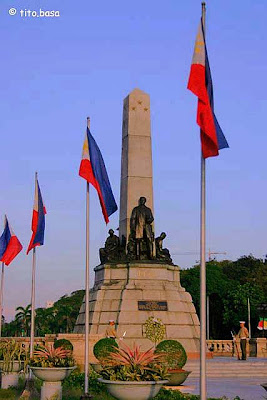
It was only during the time of the American colonizers, who installed Jose Rizal as national hero allegedly for his pacifist views, that Rizals remains were transferred to the present Rizal Monument.
How to get to Paco Park, Manila:
Paco Park entrance fee: PhP5.00
Commute: Jeepneys plyig Taft avenue pass by Padre Faura St where Paco Park in at one end. The nearest LRT station is UN Avenue.
Driving Directions: the park is at the corner of Padre Faura St and San Marcelino. Note San Marcelino is a one-way street. The best access route is via UN Avenue coming from Taft Avenue or Nagtahan Bridge.
Let me share these two photos I took from my recent "11 hour unplanned" trip:

The Spaniards furtively buried JR in this unmarked grave without proper Christian rites. It was Rizal's sister, Narcisa, who searched for a freshly dug grave in Manila and found this one with guards stationed at the gate and beside the unmarked grave. Narcisa gave gifts to the guards and marked the grave RPJ.
A heated debate on Rizal's retraction continues up to this day.

It was only during the time of the American colonizers, who installed Jose Rizal as national hero allegedly for his pacifist views, that Rizals remains were transferred to the present Rizal Monument.
How to get to Paco Park, Manila:
Paco Park entrance fee: PhP5.00
Commute: Jeepneys plyig Taft avenue pass by Padre Faura St where Paco Park in at one end. The nearest LRT station is UN Avenue.
Driving Directions: the park is at the corner of Padre Faura St and San Marcelino. Note San Marcelino is a one-way street. The best access route is via UN Avenue coming from Taft Avenue or Nagtahan Bridge.
Labels: Cemeteries, History, Jose Rizal, Manila, Metro Manila, National Capital Region, National Heroes, Parks
posted by GingGoy @ 9:26 PM,
,
Manila: Paco Park, Paco Cemetery and St. Pancratius Chapel
15 December 2006
From Lido Panciteria, we again walked towards the other end end of Ongpin where we momentarily visited the Taoist temple on Kipuja street since we were turned off by the arrogant sekyu of the place.
We rode a jeepney to take us to UN Avenue and hailed a cab since I don't remember where exactly was the cemetery (this is unplanned remember?) and shortly found out it's just a walking distance from there exactly at the corner of Padre Faura and General Luna.
The former cemetery, built in the early 19th century to accommodate the dead of a cholera epidemic of the time, with its two walled design, is now a charming venue for weddings and concerts. There's actually a wedding taking place inside the quiant Pancratius chapel when we arrived with the reception also with a garden setting cum the romantic multi-colored fountain at the center of the cemetery turned park.
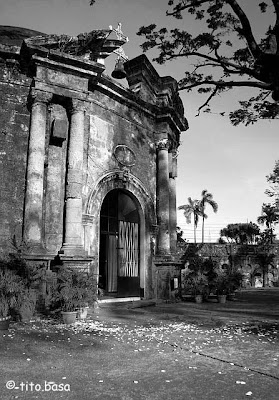
St. Pancratius Chapel

the niches, mostly now empty

This place is of great historical importance due to the little known fact that Jose Rizal was buried surreptitiously here after his execution and his remains were only transferred to the present Rizal monument at the Luneta when the Americans came.
Another notable fact is that the remains of the 3 martyred priests: Burgos, Gomez and Zamorra, garrotted in 1872, were also secretly interred here.
How to get to Paco Cemetery, Manila:
The park can be reached on foot, a mere 400 meters or so, from Taft Ave coming from Padre Faura. The nearest LRT station is UN Avenue. Paco Park entrance fee is only PhP5.00. Taking pictures/photography is not allowed unless with special permit. Weddings at Paco Park, please get in touch with paco park administration by visiting their officieal website or calling contact number
We rode a jeepney to take us to UN Avenue and hailed a cab since I don't remember where exactly was the cemetery (this is unplanned remember?) and shortly found out it's just a walking distance from there exactly at the corner of Padre Faura and General Luna.
The former cemetery, built in the early 19th century to accommodate the dead of a cholera epidemic of the time, with its two walled design, is now a charming venue for weddings and concerts. There's actually a wedding taking place inside the quiant Pancratius chapel when we arrived with the reception also with a garden setting cum the romantic multi-colored fountain at the center of the cemetery turned park.

St. Pancratius Chapel

the niches, mostly now empty

This place is of great historical importance due to the little known fact that Jose Rizal was buried surreptitiously here after his execution and his remains were only transferred to the present Rizal monument at the Luneta when the Americans came.
Another notable fact is that the remains of the 3 martyred priests: Burgos, Gomez and Zamorra, garrotted in 1872, were also secretly interred here.
How to get to Paco Cemetery, Manila:
The park can be reached on foot, a mere 400 meters or so, from Taft Ave coming from Padre Faura. The nearest LRT station is UN Avenue. Paco Park entrance fee is only PhP5.00. Taking pictures/photography is not allowed unless with special permit. Weddings at Paco Park, please get in touch with paco park administration by visiting their officieal website or calling contact number
Labels: Cemeteries, Churches, History, Jose Rizal, Manila, Metro Manila, National Capital Region, National Heroes, Parks
posted by GingGoy @ 7:25 PM,
,