Visita Iglesia Nueva Vizcaya: Old Church of Dupax del Sur
17 January 2012
Reputedly the best preserved old stone church of Nueva Vizcaya can be found in the town of Dupax del Sur that Tutubi tried to pass by just to take a pitcure of the really impressive facade with red bricks for the old belfry.
San Vicente de Ferrer Church Dupax del Sur, Nueva Vizcaya
 St. Vincent Ferrer Parish Church with newly-painted facade but still sporting the red bricks of the bell tower
Dupax del Sur is a town in Nueva Vizcaya that you'll pass by if you're going to Isabela and Tuguegarao (Cagayan) but this old church is at the town center, quite a distance from Maharlika Highway en route to Bambang, Bayombong and Solano towns.
An unplanned trip actually, Tutubi found it by asking locals where it is but he was only able to find it after a few tries in nearby Dupax del Norte.
The church interior may be great to marvel but Tutubi had to go to catch on time plus his stomach is complaining as it's already lunch time.
Doing a Nueva Vizcaya Visita Iglesia may be a different activity, somewhere north east of Metro Manila and about hours away by land.
San Vicente de Ferrer Church Dupax del Sur, Nueva Vizcaya
 St. Vincent Ferrer Parish Church with newly-painted facade but still sporting the red bricks of the bell tower
Dupax del Sur is a town in Nueva Vizcaya that you'll pass by if you're going to Isabela and Tuguegarao (Cagayan) but this old church is at the town center, quite a distance from Maharlika Highway en route to Bambang, Bayombong and Solano towns.
An unplanned trip actually, Tutubi found it by asking locals where it is but he was only able to find it after a few tries in nearby Dupax del Norte.
The church interior may be great to marvel but Tutubi had to go to catch on time plus his stomach is complaining as it's already lunch time.
Doing a Nueva Vizcaya Visita Iglesia may be a different activity, somewhere north east of Metro Manila and about hours away by land.
Labels: Cagayan Valley, Churches, Nueva Vizcaya, Visita Iglesia
posted by GingGoy @ 8:06 PM,
,


A Jordanian's Jose Rizal Shrine in Bayombong, Nueva Vizcaya
30 December 2011
It's unusual for Tutubi to come a place unprepared i.e. without his usual list of interesting places or noteworthy restaurants featuring local specialties and delicacies since he found out that the still promoted yet already extinct Salinas Salt Springs is not worth a visit. In a recent visit to Solano, Nueva vizcaya, he was taken to this place, called Jordanian by the locals, that turned out to be a newly-built shrine in honor of Jose Rizal and 15 other national heroes located in barangay Casat, Bayombong, Nueva Vizcaya near the road that leads to Mt. Pulag.
The Jose rizal Shrine features a nice hillside park with a fountain, some retail space, winding road (that puts poorly-maintained national roads to shame), nicely manicured garden, an obelisk, helipad and some sort of clubhouse, still unfinished in front of the Jordanian's mansion. The centerpiece of the Rizal Shrine is the (now second) largest Jose Rizal monument built with fiber glass covered by a bronze-colored metal layer. The body weighs 1.2 tons while the base weighs 1.3 tons, according to Mahmoud Asfour, the naturalized Filipino developer of the park.
Jose Rizal Shrine in Bayombong, Nueva Vizcaya:
 a national heroes obelisk
 the now second largest jose rizal monument covered in bronze-colored metal. Note the presence of a NHCP (National Historical Commission of the Philippines, formerly NHI) marker
 the huge Rizal Monument with a person on the frame to add scale
 a nice view of the green fields of Bayombong from the hillside park
About Mahmoud Asfour:
Mahmoud Asfour was former vice president of Citibank International and a former official of the International Monetary Fund.
His "utang na loob" to a Filipino was rooted sometime when he was stranded for two days in middle of the desert in Saudi Arabia before the Gulf War without food and water, when he was found and rescued by a "good samaritan" Filipino truck driver.
He has since married a Filipina and settled in Nueva Vizcaya (Tutubi even met the good man and his son, a newly-minted computer engineering graduate) and helped put up business and charitable works in addition to the new Rizal Shrine. He was granted Filipino citizenship in July 2005.
---
The Jose Rizal Monument in Nueva Vizcaya held the title of "largest Rizal monument" for a short time only due to the construction of the giant Jose rizal monument in front of Calamba City Hall in Laguna, the birthplace of Jose Rizal, which was made taller by about 5 feet from this monument upon the orders of local politicians who've heard of the presence of this monument.
---
Tutubi, in one of his lucky days, chanced upon Mr Mahmoud Ashfour, sporting a Rizal t-shirt, personally supervising workers of his Rizal Shrine. He asked him his nationality, to which he promptly replied Filipino, and why was he building such a nice place. His reply turned a quizzical look on Tutubi and is not worth publishing here.
---
Jose Rizal Shrine and Monument
Barangay Casat, Bayombong, Nueva Vizcaya
Coordinates: N16 31 07.6 E121 08 30.2
road map here with the POI and road network personally added by Tutubi (mapping places is another one of his advocacy and worthwhile pastime)
Other Jose Rizal related posts (you may also click the Jose Rizal Category on the navigation pane):
How to Get to Fort Santiago
Jose Rizal Shrine Dapitan
Jose Rizal in Hong Kong,
Jose Rizal in Paco Cemetery
The Jose rizal Shrine features a nice hillside park with a fountain, some retail space, winding road (that puts poorly-maintained national roads to shame), nicely manicured garden, an obelisk, helipad and some sort of clubhouse, still unfinished in front of the Jordanian's mansion. The centerpiece of the Rizal Shrine is the (now second) largest Jose Rizal monument built with fiber glass covered by a bronze-colored metal layer. The body weighs 1.2 tons while the base weighs 1.3 tons, according to Mahmoud Asfour, the naturalized Filipino developer of the park.
Jose Rizal Shrine in Bayombong, Nueva Vizcaya:
 a national heroes obelisk
 the now second largest jose rizal monument covered in bronze-colored metal. Note the presence of a NHCP (National Historical Commission of the Philippines, formerly NHI) marker
 the huge Rizal Monument with a person on the frame to add scale
 a nice view of the green fields of Bayombong from the hillside park
About Mahmoud Asfour:
Mahmoud Asfour was former vice president of Citibank International and a former official of the International Monetary Fund.
His "utang na loob" to a Filipino was rooted sometime when he was stranded for two days in middle of the desert in Saudi Arabia before the Gulf War without food and water, when he was found and rescued by a "good samaritan" Filipino truck driver.
He has since married a Filipina and settled in Nueva Vizcaya (Tutubi even met the good man and his son, a newly-minted computer engineering graduate) and helped put up business and charitable works in addition to the new Rizal Shrine. He was granted Filipino citizenship in July 2005.
---
The Jose Rizal Monument in Nueva Vizcaya held the title of "largest Rizal monument" for a short time only due to the construction of the giant Jose rizal monument in front of Calamba City Hall in Laguna, the birthplace of Jose Rizal, which was made taller by about 5 feet from this monument upon the orders of local politicians who've heard of the presence of this monument.
---
Tutubi, in one of his lucky days, chanced upon Mr Mahmoud Ashfour, sporting a Rizal t-shirt, personally supervising workers of his Rizal Shrine. He asked him his nationality, to which he promptly replied Filipino, and why was he building such a nice place. His reply turned a quizzical look on Tutubi and is not worth publishing here.
---
Jose Rizal Shrine and Monument
Barangay Casat, Bayombong, Nueva Vizcaya
Coordinates: N16 31 07.6 E121 08 30.2
road map here with the POI and road network personally added by Tutubi (mapping places is another one of his advocacy and worthwhile pastime)
Other Jose Rizal related posts (you may also click the Jose Rizal Category on the navigation pane):
How to Get to Fort Santiago
Jose Rizal Shrine Dapitan
Jose Rizal in Hong Kong,
Jose Rizal in Paco Cemetery
Labels: Cagayan Valley, Jose Rizal, Monuments, Nueva Vizcaya
posted by GingGoy @ 12:01 AM,
,
A Sampling of G&B Buko Pie and Pancit Cabagan in Bagabag, Nueva Vizcaya
12 August 2008
On the national highway of Bagabag, Nueva Vizcaya, Tutubi's driver prodded him to stop and sample the best buko pie (pie made from buco, young coconuts) in town to which he acceded to the request.
The driver parked the car in front of a small restaurant named G&B Noodle Station, with many other vehicles parked nearby, to buy a famous pasalubong of the province that even buses, on the request of passengers, stop to buy the stuff in boxes.
Sampling the buco pie, Tutubi tasted hints of cheese and milk, a recipe quite different from those sold in Laguna, particularly Los Banos' Orient Original Buko Pie but equally good.
 photo of G&B buco pie. The pie is about 6 inches in diameter and 3/4" thick.
 fresh buko juice to wash down the buko pie and later the pancit
Similar though to Orient Original buko pie is the so called "Original" syndrome where all buko pie vendors in Laguna now put the word "original" in their own "trademarks" to confuse buyers unaware of the authentic original. In Nueva Vizcaya, you can see buko pie vendors boarding buses selling pies with the same, almost identical, colors of G&B buko pies, the reason why at G&B, there's a sign warning unknowing people that they only sell their pies at their store and ambulant vendors boarding buses sell G&B buko pie clones are not sanctioned.
Looking at the menu plastered on the walls of the street side restaurant, the picture of pancit cabagan tickled the curiosity of Tutubi that triggered his ordering the local version of pancit that originated in Cabagan town of Isabela. Tutubi's driver told him the authentic version of Cabagan pancit comes with raw egg smothered on the wheat noodles the same way Filipinos do with sisig.
 pancit cabagan in all it's goodness.
G&B's version of pancit cabagan comes with pieces of hard-boiled eggs. The pancit version is named after Cabagan town of Isabela where the noodles are made, similar to the naming of pancit bato in Bicol named after Bato town of Camarines Sur.

G&B Buko pie costs P40/box and usually bundled in boxes of three for P120.On the way to Isabela, Tutubi bought one box to sample and later bought three boxes on his way back to Manila as pasalubong.
Question: should you happen to sample both, can you give your opinion on which is the best buko pie out there? Or do you have other pies in mind?
You may visit G&B official website for history and contact telephone numbers.
How to get to G&B Noodle Station:
Commuters riding buses to/from Isabela, Tuguegarao or Banaue will just have to ask drivers and conductors to make a brief stop at the place. Oftentimes, you don't have for chances are other passengers already requested a stop-over at the place.
The driver parked the car in front of a small restaurant named G&B Noodle Station, with many other vehicles parked nearby, to buy a famous pasalubong of the province that even buses, on the request of passengers, stop to buy the stuff in boxes.
Sampling the buco pie, Tutubi tasted hints of cheese and milk, a recipe quite different from those sold in Laguna, particularly Los Banos' Orient Original Buko Pie but equally good.
 photo of G&B buco pie. The pie is about 6 inches in diameter and 3/4" thick.
 fresh buko juice to wash down the buko pie and later the pancit
Similar though to Orient Original buko pie is the so called "Original" syndrome where all buko pie vendors in Laguna now put the word "original" in their own "trademarks" to confuse buyers unaware of the authentic original. In Nueva Vizcaya, you can see buko pie vendors boarding buses selling pies with the same, almost identical, colors of G&B buko pies, the reason why at G&B, there's a sign warning unknowing people that they only sell their pies at their store and ambulant vendors boarding buses sell G&B buko pie clones are not sanctioned.
Looking at the menu plastered on the walls of the street side restaurant, the picture of pancit cabagan tickled the curiosity of Tutubi that triggered his ordering the local version of pancit that originated in Cabagan town of Isabela. Tutubi's driver told him the authentic version of Cabagan pancit comes with raw egg smothered on the wheat noodles the same way Filipinos do with sisig.
 pancit cabagan in all it's goodness.
G&B's version of pancit cabagan comes with pieces of hard-boiled eggs. The pancit version is named after Cabagan town of Isabela where the noodles are made, similar to the naming of pancit bato in Bicol named after Bato town of Camarines Sur.

G&B Buko pie costs P40/box and usually bundled in boxes of three for P120.On the way to Isabela, Tutubi bought one box to sample and later bought three boxes on his way back to Manila as pasalubong.
Question: should you happen to sample both, can you give your opinion on which is the best buko pie out there? Or do you have other pies in mind?
You may visit G&B official website for history and contact telephone numbers.
How to get to G&B Noodle Station:
Commuters riding buses to/from Isabela, Tuguegarao or Banaue will just have to ask drivers and conductors to make a brief stop at the place. Oftentimes, you don't have for chances are other passengers already requested a stop-over at the place.
Labels: Cagayan Valley, Delicacies, Nueva Vizcaya, Pasalubong
posted by GingGoy @ 8:44 PM,
,
Driving By Nueva Vizcaya
"Welcome to Nueva Vizcaya," the welcome arch near the historic Dalton pass says with an obelisk marking the gateway to Cagayan Valley with the town of Sta. Fe where Tutubi made a brief stop to take pictures of Balete Pass viewdeck.
Nueva Vizcaya is nestled amid the Caraballo, Cordillera, and Sierra Madre mountains, with Ifugao province to the north, Isabela to the northeast, Quirino to the east, Aurora to the southeast, Nueva Ecija to the south, Pangasinan to the southwest, and Benguet to the west. Three major towns of the province are Bayombong, the capital town, Solano and Bambang.
While driving by Bambang after Aritao town, Tutubi's driver was able to see an old friend in his store just on the main road. It's in Bambang town where cheap vegetables grown in the upland town, with cold weather, of Kasibu are sold (Kasibu, besides boasting a cool weather, also prides itself with the Capisaan Cave system for spelunking). You can also find direction signs leading to Salinas Salt Springs, a mountain topped with salt, actually called travertine, coming from salt spring of the hill.
 Signspotting: Don't ever try to sell something here. People are miserly :P
 Salinas Salt Spring, anyone?
After Bambang town is Bayombong, the provincial capital but due to lack of time, Tutubi decided not to pass by Bayombong town proper to catch a glimpse of St. Dominic Cathedral, the Nueva Vizcaya Provincial Capitol and People's Museum and Library that showcases the province's history and heritage

Next to Bayombong is the town of Solano, quite progressive judging from various establishments you see on the road. Tutubi passed by an alternate route inside town to avoid traffic and was able to see large hotels and places like Centro (shown below)

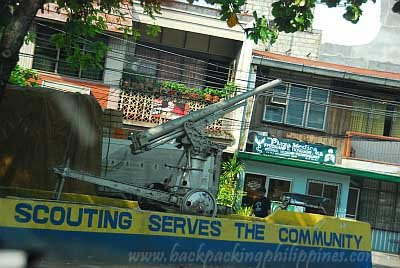 an anti-aircraft gun in Solano, probably of WWII vintage, with Scouting references.
Nueva Vizcaya has large eco-tourism potential that can attract adventurers with a list of interesting places and tourist spots. Tutubi hopes to fully explore the place given the chance to return there.
Again, pictures taken inside a moving vehicle with tinted windshield :(
Notes on Nueva Vizcaya Tourism:
For adventurers, trekkers, mountain climbers, the towns of Ambaguio and Kayapa offer an alternate jump-off point to Mt. Pulag, the Philippines' second highest mountain, home of rare plants like pitcher plant and animals like the nocturnal giant cloud rats (locally called buut). Spelunkers can visit Lion-Alayan Cave, Malabing Valley network of pristine underground caves and subterranean river in Kasibu particularly Capisaan Caves visited by one of Tutubi's friends. (Note this is undeveloped and not for the faint of heart but pretty much rewarding for brave souls)
People chasing waterfalls can choose to look for Imugan Falls in Sta. Fe town and Mapalyao Falls in Quezon town
For "hysterical" people, historical sites include Dalton Pass (Balete Pass) in Sta. Fe and Kirang Pass in Aritao, both silent witnesses to bloody battles between the Americans, Filipinos and Japanese at the end of World War II.
For those into Visita Iglesia visiting old churches, the province lists St. Dominic Cathedral and the Dupax del Sur church, St. Vincent Ferrer Church declared a National Cultural Treasure (Tutubi was too much in a hurry he decided not to again pass by this town since it's way too out of way)
Town fiestas and festivals are also present particularly Panagyaman Festival, or Thanksgiving Festival, celebrated on May 19 up to May 23 in Bayombong, the capital town of Nueva Vizcaya with its capitol located in a park.
For the ever-present pasalubong, there's G&B buko pie in Bagabag just before the fork on the road going to Isabela and Ifugao provinces.
Where to Stay in Nueva Vizcaya: Hotels, Inns, Lodges and other accommodations
Finding a place to stay in Nueva Vizcaya is just like most other places in the country. Most of them are located on the main highway, with
no Internet sites to look up information and rely mostly on walk-in guests, a list below may prove helpful with some photos (some items sourced from an old NV tourism brochure that may need updating of telephone numbers):
Bambang Lodge
Bambang Poblacion
Bambang Pension House
Bambang Poblacion
Elnora Zulaek's Rainbow Hotel Serviced Apartments
(Solano?)
Governor's Hotel
Solano
Tel. No. +63.78.326.6053
Juel Garden Hotel
Hilltop, Bambang
Tel. no. +63.78.803.1315

Josefina's Hotel
near the Bayombong welcome arch

MC Capitol View Inn and Restaurant
Bayombong
Tel. No. +63.78.321.2001
Melissa Lodge
Solano
Tel. No. +63.78.326.540
MY Dream Garden Hotel
Solano
Tel. No. +63.78.326.6149
Neptune Hotel
Solano
Tel. No.: +63.78.326.5701
Rafael Inn
Gaddang St., Solano
Tel. No. +63.78.326.7343
Saber Inn
Bayombong
Tel. No. +63.78.321.2222
Sports City Hotel
Bayombong
Villa Margarita Mountain Resort
Tel. No.: +63.78.326.5501
Nueva Vizcaya is composed of 15 towns, namely: Alfonso Castañeda, Ambaguio, Aritao, Bagabag, Bambang, Bayombong, Diadi, Dupax del Norte,
Dupax del Sur, Kayapa, Kasibu, Quezon, Santa Fe, Solano, and Villaverde
How to get to Nueva Vizcaya:
Commute: Bus companies servicing the province include Baliwag Transit, Victory Liner, Royal Eagle and Autobus all bound for Cagayan Valley pass by the province.
Driving Directions: Follow this route going to Nueva Vizcaya:
Driving Directions: On NLEX, take Sta. Rita Exit then just follow the route that will lead to Pulilan, Plaridel, Baliuag, San Ildefonso, and San Miguel, Gapan, San Leonardo, Sta. Rosa, Cabanatuan City, Talavera, Muñoz, San Jose then Sta. Fe town.
Those with motorcycles or want to avoid toll fees on NLEX can opt to go via MacArthur Highway passing through Caloocan, Valenzuela, Meycauayan, Marilao, Bocaue, Balagtas, Guiguinto (Tabang), Plaridel, Pulilan, Baliuag, San Rafael, San Ildefonso, San Miguel , Gapan, San Leonardo, Sta. Rosa, Cabanatuan City, Talavera, Muñoz, San Jose City before seeing the boundary arch of Nueva Vizcaya with Sta. Fe town.
Nueva Vizcaya is nestled amid the Caraballo, Cordillera, and Sierra Madre mountains, with Ifugao province to the north, Isabela to the northeast, Quirino to the east, Aurora to the southeast, Nueva Ecija to the south, Pangasinan to the southwest, and Benguet to the west. Three major towns of the province are Bayombong, the capital town, Solano and Bambang.
While driving by Bambang after Aritao town, Tutubi's driver was able to see an old friend in his store just on the main road. It's in Bambang town where cheap vegetables grown in the upland town, with cold weather, of Kasibu are sold (Kasibu, besides boasting a cool weather, also prides itself with the Capisaan Cave system for spelunking). You can also find direction signs leading to Salinas Salt Springs, a mountain topped with salt, actually called travertine, coming from salt spring of the hill.
 Signspotting: Don't ever try to sell something here. People are miserly :P
 Salinas Salt Spring, anyone?
After Bambang town is Bayombong, the provincial capital but due to lack of time, Tutubi decided not to pass by Bayombong town proper to catch a glimpse of St. Dominic Cathedral, the Nueva Vizcaya Provincial Capitol and People's Museum and Library that showcases the province's history and heritage

Next to Bayombong is the town of Solano, quite progressive judging from various establishments you see on the road. Tutubi passed by an alternate route inside town to avoid traffic and was able to see large hotels and places like Centro (shown below)

 an anti-aircraft gun in Solano, probably of WWII vintage, with Scouting references.
Nueva Vizcaya has large eco-tourism potential that can attract adventurers with a list of interesting places and tourist spots. Tutubi hopes to fully explore the place given the chance to return there.
Again, pictures taken inside a moving vehicle with tinted windshield :(
Notes on Nueva Vizcaya Tourism:
For adventurers, trekkers, mountain climbers, the towns of Ambaguio and Kayapa offer an alternate jump-off point to Mt. Pulag, the Philippines' second highest mountain, home of rare plants like pitcher plant and animals like the nocturnal giant cloud rats (locally called buut). Spelunkers can visit Lion-Alayan Cave, Malabing Valley network of pristine underground caves and subterranean river in Kasibu particularly Capisaan Caves visited by one of Tutubi's friends. (Note this is undeveloped and not for the faint of heart but pretty much rewarding for brave souls)
People chasing waterfalls can choose to look for Imugan Falls in Sta. Fe town and Mapalyao Falls in Quezon town
For "hysterical" people, historical sites include Dalton Pass (Balete Pass) in Sta. Fe and Kirang Pass in Aritao, both silent witnesses to bloody battles between the Americans, Filipinos and Japanese at the end of World War II.
For those into Visita Iglesia visiting old churches, the province lists St. Dominic Cathedral and the Dupax del Sur church, St. Vincent Ferrer Church declared a National Cultural Treasure (Tutubi was too much in a hurry he decided not to again pass by this town since it's way too out of way)
Town fiestas and festivals are also present particularly Panagyaman Festival, or Thanksgiving Festival, celebrated on May 19 up to May 23 in Bayombong, the capital town of Nueva Vizcaya with its capitol located in a park.
For the ever-present pasalubong, there's G&B buko pie in Bagabag just before the fork on the road going to Isabela and Ifugao provinces.
Where to Stay in Nueva Vizcaya: Hotels, Inns, Lodges and other accommodations
Finding a place to stay in Nueva Vizcaya is just like most other places in the country. Most of them are located on the main highway, with
no Internet sites to look up information and rely mostly on walk-in guests, a list below may prove helpful with some photos (some items sourced from an old NV tourism brochure that may need updating of telephone numbers):
Bambang Lodge
Bambang Poblacion
Bambang Pension House
Bambang Poblacion
Elnora Zulaek's Rainbow Hotel Serviced Apartments
(Solano?)
Governor's Hotel
Solano
Tel. No. +63.78.326.6053
Juel Garden Hotel
Hilltop, Bambang
Tel. no. +63.78.803.1315

Josefina's Hotel
near the Bayombong welcome arch

MC Capitol View Inn and Restaurant
Bayombong
Tel. No. +63.78.321.2001
Melissa Lodge
Solano
Tel. No. +63.78.326.540
MY Dream Garden Hotel
Solano
Tel. No. +63.78.326.6149
Neptune Hotel
Solano
Tel. No.: +63.78.326.5701
Rafael Inn
Gaddang St., Solano
Tel. No. +63.78.326.7343
Saber Inn
Bayombong
Tel. No. +63.78.321.2222
Sports City Hotel
Bayombong
Villa Margarita Mountain Resort
Tel. No.: +63.78.326.5501
Nueva Vizcaya is composed of 15 towns, namely: Alfonso Castañeda, Ambaguio, Aritao, Bagabag, Bambang, Bayombong, Diadi, Dupax del Norte,
Dupax del Sur, Kayapa, Kasibu, Quezon, Santa Fe, Solano, and Villaverde
How to get to Nueva Vizcaya:
Commute: Bus companies servicing the province include Baliwag Transit, Victory Liner, Royal Eagle and Autobus all bound for Cagayan Valley pass by the province.
Driving Directions: Follow this route going to Nueva Vizcaya:
Driving Directions: On NLEX, take Sta. Rita Exit then just follow the route that will lead to Pulilan, Plaridel, Baliuag, San Ildefonso, and San Miguel, Gapan, San Leonardo, Sta. Rosa, Cabanatuan City, Talavera, Muñoz, San Jose then Sta. Fe town.
Those with motorcycles or want to avoid toll fees on NLEX can opt to go via MacArthur Highway passing through Caloocan, Valenzuela, Meycauayan, Marilao, Bocaue, Balagtas, Guiguinto (Tabang), Plaridel, Pulilan, Baliuag, San Rafael, San Ildefonso, San Miguel , Gapan, San Leonardo, Sta. Rosa, Cabanatuan City, Talavera, Muñoz, San Jose City before seeing the boundary arch of Nueva Vizcaya with Sta. Fe town.
Labels: Accommodations, Cagayan Valley, Hotels, Nueva Vizcaya
posted by GingGoy @ 8:20 PM,
,
Nueva Vizcaya: The Historic Dalton Pass and the Battle with Gen. Yamashita
07 August 2008
The exciting thing about unplanned travels is the joy of "discovering" something you never knew exists in a place that's not actually in your destination, but somewhere along the journey. Tutubi again was surprised when crossing the zigzag roads of Cagayan Valley road nearing the boundary of the provinces of Nueva Ecija and Nueva Vizcaya, he saw from the distance big letters on top of the highest hills sandwiched by the Caraballo and Sierra Madre mountain ranges indicating Balete Pass.
On reaching the boundary arch and the signs at the place, Tutubi didn't expect he'd stumble unto a historic site with markers and memorials for thousands of soldiers-- Filipinos, Americans, Japanese and Chinese -- of World War II died in battle for gateway of Cagayan Valley. He only read about the pass in history books.

The obelisk of Region 2: Cagayan Valley and the Balete Pass Marker that states:
"Erected in honor of those soldiers ofthe 25th Division who sacrificed their lives in winning this desperate struggle.
BALETE PASS
Intaking this pass 7403 Japanese counted killed 2365 25th Division killed and wounded.
May 13, 1945"
 the viewdeck where a NHI marker is installed to commemorate the event.
The NHI marker, written in Filipino and translated as "Site of the battle between Americans and Japanese in order to control Cagayan Valley from February 21 up to May 1945. Attacked by combined forces of US 25th Division, Filipino Luzon Guerilla Forces (LGAF) under Col. Robert Lapham, and Chinese. Was able to push Japanese Shobu under Gen. Tomoyuki Yamashita. The Japanese retreated to Central Corldillera.The first American patrol arrived on May 9 1945. Declared open to Allied Forces 13 May 1945. Renamed Dalton Pass 13 May 1945 in honor of Brig. Gen. James L. Dalton who was killed by sniper fire on 16 May 1945."
 The various cabanas for shelter at the viewdeck
 A memorial to the 8 fallen comrades of the Chinese Overseas Wartime Hsuekan Militia (COWHM) during mopping-up operations...only eight of them perished...still a lucky number? better if none of them made the supreme sacrifice

 marker with Japanese inscriptions and a cross with the words PEACE FOREVER!
 The viewdeck was constructed from the highest point, about 3000 ft above sea level, with a strategic view of the snake road below.Note that it's located at the boundary of Nueva Ecija and Nueva Vizcaya provinces.
 in these mountains lie diggings by treasure hunters searching for the fabled Yamashita's Treasure various caves looking for spelunkers and adventurers
 Somewhere in this valleys and hills lie Imugan waterfalls said to be reachable by 30 minute trek from the Imugan poblacion.
 Tutubi's service vehicle, a Toyota Innova parked near the viewdeck (it's nice you don't need to trek up) plus the comfort room. Notice also trees that look like pine trees, probably agoho.
History tells us after capturing Balete Pass, Gen. Tomoyuki Yamashita retreated to the Cordilleras and eventually surrendered in Kiangan town of Ifugao (there's a marker at the surrender site), tried by a kangaroo court of Gen. Douglas MacArthur and executed somewhere in Los Baños, Laguna (that Tutubi still hasn't found out exactly where due to limited information).
What's odd and common to historic places are the seeming apathy of Filipinos to history e.g. Tutubi's driver is from Santiago City, always passing by the place, and yet he was only able to go up the shrine on the prodding of Tutubi.
----
Notes:
There is an entrance fee of P5 for visitors to the historic shrine.
The Balete Pass National Shrine is under the jurisdiction of the town of Sta. Fe, Nueva Vizcaya and also holds the annual Kalanguya Festival that celebrates the indigenous culture and way of life of the Kalanguya tribe of Ifugao. The Kalanguya tribe Also nearby is Capintalan in the town of Carranglan. It is also the gateway to the Cagayan Valley Region and the Ifugao Rice Terraces.
Nearby is another historic pass, Kirang Pass in Barangay Kirang, municipality of Aritao, built by the Rakunsankai Society of Japan.
Another historic pass is Bessang Pass in Cervantes, Ilocos Sur and Tirad Pass in Del Pilar, also in Ilocos Sur.
The most popular pass in Philippine history is Tirad Pass (or Pasong Tirad in Filipino), located in Ilocos Sur province in the town of Del Pilar, named after the Filipino revolutionary general Gregorio del Pilar, who along with a few select men, defended the pass valiantly against the Americans then pursuing Gen. Emilio Aguinaldo. Similar to the Greek Thermopylae immortalized in the Hollywood movie 300, the Americans were only able to break through the defenses of the gallant Filipinos when a local guided the Americans through a trail that lead behind the lines of defending Filipinos who all died in the battle.
On reaching the boundary arch and the signs at the place, Tutubi didn't expect he'd stumble unto a historic site with markers and memorials for thousands of soldiers-- Filipinos, Americans, Japanese and Chinese -- of World War II died in battle for gateway of Cagayan Valley. He only read about the pass in history books.

The obelisk of Region 2: Cagayan Valley and the Balete Pass Marker that states:
"Erected in honor of those soldiers ofthe 25th Division who sacrificed their lives in winning this desperate struggle.
BALETE PASS
Intaking this pass 7403 Japanese counted killed 2365 25th Division killed and wounded.
May 13, 1945"
 the viewdeck where a NHI marker is installed to commemorate the event.
The NHI marker, written in Filipino and translated as "Site of the battle between Americans and Japanese in order to control Cagayan Valley from February 21 up to May 1945. Attacked by combined forces of US 25th Division, Filipino Luzon Guerilla Forces (LGAF) under Col. Robert Lapham, and Chinese. Was able to push Japanese Shobu under Gen. Tomoyuki Yamashita. The Japanese retreated to Central Corldillera.The first American patrol arrived on May 9 1945. Declared open to Allied Forces 13 May 1945. Renamed Dalton Pass 13 May 1945 in honor of Brig. Gen. James L. Dalton who was killed by sniper fire on 16 May 1945."
 The various cabanas for shelter at the viewdeck
 A memorial to the 8 fallen comrades of the Chinese Overseas Wartime Hsuekan Militia (COWHM) during mopping-up operations...only eight of them perished...still a lucky number? better if none of them made the supreme sacrifice
 marker with Japanese inscriptions and a cross with the words PEACE FOREVER!
 The viewdeck was constructed from the highest point, about 3000 ft above sea level, with a strategic view of the snake road below.Note that it's located at the boundary of Nueva Ecija and Nueva Vizcaya provinces.
 in these mountains lie diggings by treasure hunters searching for the fabled Yamashita's Treasure various caves looking for spelunkers and adventurers
 Somewhere in this valleys and hills lie Imugan waterfalls said to be reachable by 30 minute trek from the Imugan poblacion.
 Tutubi's service vehicle, a Toyota Innova parked near the viewdeck (it's nice you don't need to trek up) plus the comfort room. Notice also trees that look like pine trees, probably agoho.
History tells us after capturing Balete Pass, Gen. Tomoyuki Yamashita retreated to the Cordilleras and eventually surrendered in Kiangan town of Ifugao (there's a marker at the surrender site), tried by a kangaroo court of Gen. Douglas MacArthur and executed somewhere in Los Baños, Laguna (that Tutubi still hasn't found out exactly where due to limited information).
What's odd and common to historic places are the seeming apathy of Filipinos to history e.g. Tutubi's driver is from Santiago City, always passing by the place, and yet he was only able to go up the shrine on the prodding of Tutubi.
----
Notes:
There is an entrance fee of P5 for visitors to the historic shrine.
The Balete Pass National Shrine is under the jurisdiction of the town of Sta. Fe, Nueva Vizcaya and also holds the annual Kalanguya Festival that celebrates the indigenous culture and way of life of the Kalanguya tribe of Ifugao. The Kalanguya tribe Also nearby is Capintalan in the town of Carranglan. It is also the gateway to the Cagayan Valley Region and the Ifugao Rice Terraces.
Nearby is another historic pass, Kirang Pass in Barangay Kirang, municipality of Aritao, built by the Rakunsankai Society of Japan.
Another historic pass is Bessang Pass in Cervantes, Ilocos Sur and Tirad Pass in Del Pilar, also in Ilocos Sur.
The most popular pass in Philippine history is Tirad Pass (or Pasong Tirad in Filipino), located in Ilocos Sur province in the town of Del Pilar, named after the Filipino revolutionary general Gregorio del Pilar, who along with a few select men, defended the pass valiantly against the Americans then pursuing Gen. Emilio Aguinaldo. Similar to the Greek Thermopylae immortalized in the Hollywood movie 300, the Americans were only able to break through the defenses of the gallant Filipinos when a local guided the Americans through a trail that lead behind the lines of defending Filipinos who all died in the battle.
Labels: Cagayan Valley, Historical Shrines, Nueva Vizcaya, World War II
posted by GingGoy @ 9:55 PM,
,
The Roadtrip to Isabela
28 July 2008
In just another trip, Tutubi went on a planned trip, not a backpacking one since he has a car and a driver, to San Mateo town in Isabela for a work assignment and made stops to various attractions and restaurants along the way, mostly unplanned based mostly on Tutubi's scant knowledge of the place since it's his first time to visit Nueva Vizcaya and Isabela provinces of Cagayan Valley.
 "Isabela, Thy Will be Done" welcomes visitors to the Isabela and Nueva Vizcaya Boundary (picture taken inside a speeding vehicle that's why it's slightly blurred and color skewed)
Tutubi will share his usual stories and photos chronologically as he passed by places including Cabanatuan City's historic cathedral where Antonio Luna was murdered, a former concentration camp of WW II where "Ghost Soldiers" successfully made "The Great Raid" and rescue of American POWs, drove and shot pictures of Science City of Munoz and San Jose City in the province of Nueva Ecija. Commemorated heroic deeds of soldiers long gone in a historic pass at the boundary of Nueva Ecija and Nueva Vizcaya. Witnessed everyday images of Bambang and Solano, Nueva Vizcaya, sampled a famous buko pie stand and pancit cabagan on Maharlika Highway (now called Cagayan Valley Road). Traveled back in time at a museum in Santiago City. Wondered at the immensity of a dam and hydroelectric power plant between the towns of Alfonso Lista in Ifugao and Ramon, Isabela and indulged to his stomach's content at an "all you can eat" restaurant in Cabanatuan City for a measly P100.00
 two children resting in the shade of a large World War II memorial somewhere in Nueva Ecija
Pictures and funny street signs coming up with a mostly unplanned tour of Cagayan Valley!
Stay tuned!
 "Isabela, Thy Will be Done" welcomes visitors to the Isabela and Nueva Vizcaya Boundary (picture taken inside a speeding vehicle that's why it's slightly blurred and color skewed)
Tutubi will share his usual stories and photos chronologically as he passed by places including Cabanatuan City's historic cathedral where Antonio Luna was murdered, a former concentration camp of WW II where "Ghost Soldiers" successfully made "The Great Raid" and rescue of American POWs, drove and shot pictures of Science City of Munoz and San Jose City in the province of Nueva Ecija. Commemorated heroic deeds of soldiers long gone in a historic pass at the boundary of Nueva Ecija and Nueva Vizcaya. Witnessed everyday images of Bambang and Solano, Nueva Vizcaya, sampled a famous buko pie stand and pancit cabagan on Maharlika Highway (now called Cagayan Valley Road). Traveled back in time at a museum in Santiago City. Wondered at the immensity of a dam and hydroelectric power plant between the towns of Alfonso Lista in Ifugao and Ramon, Isabela and indulged to his stomach's content at an "all you can eat" restaurant in Cabanatuan City for a measly P100.00
 two children resting in the shade of a large World War II memorial somewhere in Nueva Ecija
Pictures and funny street signs coming up with a mostly unplanned tour of Cagayan Valley!
Stay tuned!
Labels: Isabela, Nueva Ecija, Nueva Vizcaya
posted by GingGoy @ 9:27 PM,
,