Cebu: Mactan Shrine, Lapu-lapu Monument and Myths about Ferdinand Magellan
25 August 2010
A return visit to the historic site of the battle between the natives led by Lapu-lapu and the Portuguese explorer in the service of Spain Ferdinand Magellan where Magellan met his death, mostly due to his ineptness as a general.
Tutubi again visited the place on the request of his peer who wanted to see the famous site of the "battle of mactan".
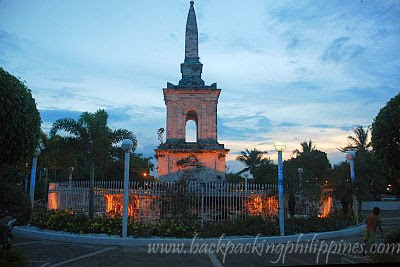
Ferdinand Magellan’s Monument
A coral stone obelisk Erected in 1866 in honor of Hernando de Magallanes). It bears the words “Glorias Españolas (Glory to Spain)."
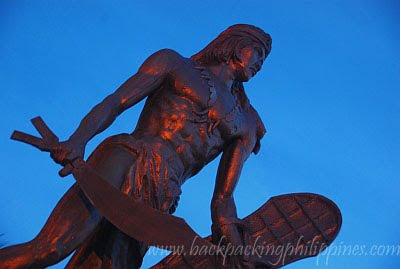
The Lapu-lapu Monument, made of bronze, at dusk...

a closer view of the bronze monument...
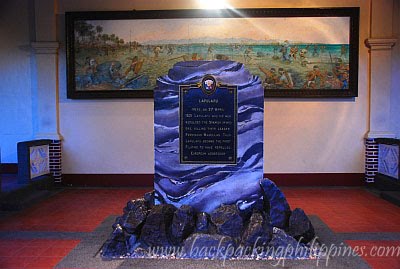
the Mactan Shrine mural and historical marker. The Battle of Mactan mural wrongly depict Lapu-lapu in combat with Magellan. The marker states "Here, on 27 April 1521 Lapulapu and his men repulsed the Spanish invaders, killing their leader ferdinand Magellan thus Lapulapu became the first Filipino to have repelled European aggresion."

How did Ferdinand Magellan die? So many historical myths and hoaxes abound here but it's not really Lapu-lapu who killed him but a poisoned arrow to the leg. It was probably Lapu-lapu who dealt the final blow. He was killed due to his "stupidity" to charge at an enemy he didn't have any information on (remember Sun Tzu's Art of War?), and on the prodding of Rajah Humabon, an enemy of Lapu-lapu.
Rajah Humabon, who converted to Christianity earlier, later poisoned his Christian friends. What was left of Magellan's expedition later circumnavigated the world.
---
Travel Information on Mactan Shrine:
Mactan Shrine entrance fees: None but a donation box can be seen at the shrine entrance gate. Parking fee is at P10/vehicle.
There's also a Lapu-lapu Monument at Rizal Park in Manila (Luneta) "watching" the back of Jose Rizal Monument
How to get to Mactan Shrine / Lapu-lapu Monument, Lapu-lapu City:
Commuting from the Mactan-Cebu International Airport, you can flag a taxi to take you there directly or a jeepney, popularly called multicab, with signboard Punta Engaño. Tutubi also observed jeepneys with So-ong Maribago signboards passed by the place from Mandaue Highway. The Shrine is near Shangri-la Mactan Resort and Spa and the the famous Sutukil seafood restaurants. No information on jeepney fares but the taxi fare may be about P250 from downtown Cebu City.
Directions to Mactan shrine? It's just a straight drive from Mandaue City via Marcelo Fernan Bridge then right to M.L. Quezon Highway all the way to the shrine.
Tutubi again visited the place on the request of his peer who wanted to see the famous site of the "battle of mactan".
Ferdinand Magellan’s Monument
A coral stone obelisk Erected in 1866 in honor of Hernando de Magallanes). It bears the words “Glorias Españolas (Glory to Spain)."

The Lapu-lapu Monument, made of bronze, at dusk...

a closer view of the bronze monument...

the Mactan Shrine mural and historical marker. The Battle of Mactan mural wrongly depict Lapu-lapu in combat with Magellan. The marker states "Here, on 27 April 1521 Lapulapu and his men repulsed the Spanish invaders, killing their leader ferdinand Magellan thus Lapulapu became the first Filipino to have repelled European aggresion."
How did Ferdinand Magellan die? So many historical myths and hoaxes abound here but it's not really Lapu-lapu who killed him but a poisoned arrow to the leg. It was probably Lapu-lapu who dealt the final blow. He was killed due to his "stupidity" to charge at an enemy he didn't have any information on (remember Sun Tzu's Art of War?), and on the prodding of Rajah Humabon, an enemy of Lapu-lapu.
Rajah Humabon, who converted to Christianity earlier, later poisoned his Christian friends. What was left of Magellan's expedition later circumnavigated the world.
---
Travel Information on Mactan Shrine:
Mactan Shrine entrance fees: None but a donation box can be seen at the shrine entrance gate. Parking fee is at P10/vehicle.
There's also a Lapu-lapu Monument at Rizal Park in Manila (Luneta) "watching" the back of Jose Rizal Monument
How to get to Mactan Shrine / Lapu-lapu Monument, Lapu-lapu City:
Commuting from the Mactan-Cebu International Airport, you can flag a taxi to take you there directly or a jeepney, popularly called multicab, with signboard Punta Engaño. Tutubi also observed jeepneys with So-ong Maribago signboards passed by the place from Mandaue Highway. The Shrine is near Shangri-la Mactan Resort and Spa and the the famous Sutukil seafood restaurants. No information on jeepney fares but the taxi fare may be about P250 from downtown Cebu City.
Directions to Mactan shrine? It's just a straight drive from Mandaue City via Marcelo Fernan Bridge then right to M.L. Quezon Highway all the way to the shrine.
Labels: Cebu, Historical Shrines, History, Lapu-Lapu City, Metro Cebu, Monuments
posted by GingGoy @ 8:30 PM,
,


A Rainy Day at Dambana ng Kagitingan (Shrine of Valor), Mt. Samat Bataan
09 September 2009
"Bumagsak na ang Bataan," Tutubi said when he went to Bataan to attend his officemates' wedding at St. Joseph Cathedral in Balanga with a sidetrip to the historic Mt. Samat, the site of fierce fighting at the onset of World War II and where the Dambana ng kagitingan (Shrine of Valor) stands to remind visitors of the gallant stand of American and Filipino soldiers in World War II.
Mt. Samat was the stronghold of combined American and Filipino forces defending the mountainous peninsula of Bataan against the Japanese from December 1941 until its capitulation on April 9, 1942.
The almost four month long resistance, caught the Japanese by surprise and delayed their war plan thereby saving Australia from the onslaught of the Land of the Rising Sun.
The Fall of Bataan on April 9, 1942 started the harrowing war crime called Bataan Death March where thousands of American and Filipino POWs were forced to march for about 100 kilometers, by foot interrupted by a train ride in cramped cars, for days without food and water to get to Capas, Tarlac. Thousands died during the ordeal and thousands more died at the concentration camp during captivity.
 Mt. Samat Shrine, dubbed "Dambana ng Kagitingan (Shrine of Valor)," was built to honor not just the heroic efforts of the World War II soldiers who valiantly fought the Japanese invaders against insurmountable odds but also all other heroes whose heroics and deeds were enshrined like Jose Rizal whose bas relief occupies one side of the Memorial Cross, Juan Luna, Emilio Aguinaldo, Lapu-Lapu, Apolinario Mabini, Emilio Jacinto, Melchora Aquino, Gabriela Silang et al.
Now declared a National Historical Shrine, it was built during the time of Pres. Ferdinand Marcos on top of Mt. Samat, the base of the site of fierce fighting with main feature of a Monument Cross standing 92 meters tall made of concrete, marble and steel.
The hurriedly taken picture of Dambana ng Kagitingan's Monument Cross in just in time before fog and rain enveloped the monument
 a brief lull in the rain allowed Tutubi to take a photo of two "young-at-hearts" playing with a gun battery similar to the ones displayed on Corregidor Island
 The sad part about the trip was that the rain almost spoiled the trip completely. Tutubi didn't bother to ride the elevator to get to the top of the Monument Cross to get a sweeping view of Bataan peninsula, Manila Bay and even Corregidor Island. A brief photo-op with officemates resulted to a few pictures (with one of his peers did an Oblation-like pose near the cross' base in silhouette). No other pictures were taken as the entire Mt. Samat was covered in rain clouds that even Tutubi's waterproof camera was rendered useless.
Dambana ng Kagitingan deserves a return trip for Tutubi as well as his wish to re-trace the infamous Death March route someday.
---
Dambana ng Kagitingan Travel Information
Mt. Samat Shrine Entrance Fees:
PhP30.00 for foreigners
PhP20.00 for locals
PhP10.00 for students
Parking fee:
PhP20.00 cars/small vehicles
PhP50.00 large vehicles
Overnight accommodations at Mt. Samat Shrine is offered at the Dambana ng Kagitingan Guesthouse. No information was gathered due to the rains.
There's also a museum inside the shrine but was not visited by Tutubi due to lack of time.
Shrine is open to the public from 8am to 5pm, Tuesdays to Sundays (closed on Mondays, no information on holidays as of posting time). Elevator access to the top of the Cross is closed during lunch break
Comfort Rooms available with PhP3.00 per "pee fee."
How to get to Mt. Samat Shrine Bataan:
Driving Directions: From EDSA northbound to Balintawak take NLEX and exit at the SCTEx spur road after passing Dau toll plaza. After getting ticket at SCTex tollgate, choose the road going to Subic and exit at Dinalupihan (Toll fee: PhP88.00) Turn right at the end of the SCTEx exit road and follow road signs leading to Mt. Samat, Balanga or your destination town.
On reaching Pilar, Bataan junction, you'll see direction signs on your right pointing the way to Mt. Samat where you turn right (sign says the historic shrine is 11 kilometers away). Turn left on the road after passing Kilometer 19 Death March Marker
Travel time to Bataan (Mt Samat or Balanga) is around 2.5 to 3 hours from EDSA, Quezon City via NLEX and SCTEx.
Commute to Bataan, the backpacking way is not easy for the route to the historic shrine is not served by public transportation. The nearest point can be reached by Bataan buses is the Pilar, Bataan junction on the national highway where the shrine's 11 kilometers away. You can ride a tricycle at the junction or do some muscle flexing by trekking up the mountain.
Ferries to Bataan are available from SM Mall of Asia complex by MetroStar serving the Pasay to Orion Port ferry route. In Orion, you can ride jeepneys going to Balanga that pass by Pilar and alight at the junction for the jump-off point to Mt. Samat Shrine
Mt. Samat was the stronghold of combined American and Filipino forces defending the mountainous peninsula of Bataan against the Japanese from December 1941 until its capitulation on April 9, 1942.
The almost four month long resistance, caught the Japanese by surprise and delayed their war plan thereby saving Australia from the onslaught of the Land of the Rising Sun.
The Fall of Bataan on April 9, 1942 started the harrowing war crime called Bataan Death March where thousands of American and Filipino POWs were forced to march for about 100 kilometers, by foot interrupted by a train ride in cramped cars, for days without food and water to get to Capas, Tarlac. Thousands died during the ordeal and thousands more died at the concentration camp during captivity.
 Mt. Samat Shrine, dubbed "Dambana ng Kagitingan (Shrine of Valor)," was built to honor not just the heroic efforts of the World War II soldiers who valiantly fought the Japanese invaders against insurmountable odds but also all other heroes whose heroics and deeds were enshrined like Jose Rizal whose bas relief occupies one side of the Memorial Cross, Juan Luna, Emilio Aguinaldo, Lapu-Lapu, Apolinario Mabini, Emilio Jacinto, Melchora Aquino, Gabriela Silang et al.
Now declared a National Historical Shrine, it was built during the time of Pres. Ferdinand Marcos on top of Mt. Samat, the base of the site of fierce fighting with main feature of a Monument Cross standing 92 meters tall made of concrete, marble and steel.
The hurriedly taken picture of Dambana ng Kagitingan's Monument Cross in just in time before fog and rain enveloped the monument
 a brief lull in the rain allowed Tutubi to take a photo of two "young-at-hearts" playing with a gun battery similar to the ones displayed on Corregidor Island
 The sad part about the trip was that the rain almost spoiled the trip completely. Tutubi didn't bother to ride the elevator to get to the top of the Monument Cross to get a sweeping view of Bataan peninsula, Manila Bay and even Corregidor Island. A brief photo-op with officemates resulted to a few pictures (with one of his peers did an Oblation-like pose near the cross' base in silhouette). No other pictures were taken as the entire Mt. Samat was covered in rain clouds that even Tutubi's waterproof camera was rendered useless.
Dambana ng Kagitingan deserves a return trip for Tutubi as well as his wish to re-trace the infamous Death March route someday.
---
Dambana ng Kagitingan Travel Information
Mt. Samat Shrine Entrance Fees:
PhP30.00 for foreigners
PhP20.00 for locals
PhP10.00 for students
Parking fee:
PhP20.00 cars/small vehicles
PhP50.00 large vehicles
Overnight accommodations at Mt. Samat Shrine is offered at the Dambana ng Kagitingan Guesthouse. No information was gathered due to the rains.
There's also a museum inside the shrine but was not visited by Tutubi due to lack of time.
Shrine is open to the public from 8am to 5pm, Tuesdays to Sundays (closed on Mondays, no information on holidays as of posting time). Elevator access to the top of the Cross is closed during lunch break
Comfort Rooms available with PhP3.00 per "pee fee."
How to get to Mt. Samat Shrine Bataan:
Driving Directions: From EDSA northbound to Balintawak take NLEX and exit at the SCTEx spur road after passing Dau toll plaza. After getting ticket at SCTex tollgate, choose the road going to Subic and exit at Dinalupihan (Toll fee: PhP88.00) Turn right at the end of the SCTEx exit road and follow road signs leading to Mt. Samat, Balanga or your destination town.
On reaching Pilar, Bataan junction, you'll see direction signs on your right pointing the way to Mt. Samat where you turn right (sign says the historic shrine is 11 kilometers away). Turn left on the road after passing Kilometer 19 Death March Marker
Travel time to Bataan (Mt Samat or Balanga) is around 2.5 to 3 hours from EDSA, Quezon City via NLEX and SCTEx.
Commute to Bataan, the backpacking way is not easy for the route to the historic shrine is not served by public transportation. The nearest point can be reached by Bataan buses is the Pilar, Bataan junction on the national highway where the shrine's 11 kilometers away. You can ride a tricycle at the junction or do some muscle flexing by trekking up the mountain.
Ferries to Bataan are available from SM Mall of Asia complex by MetroStar serving the Pasay to Orion Port ferry route. In Orion, you can ride jeepneys going to Balanga that pass by Pilar and alight at the junction for the jump-off point to Mt. Samat Shrine
Labels: Bataan, Central Luzon, Historical Shrines, World War II
posted by GingGoy @ 9:09 PM,
,
A Visit to Jose Rizal Shrine in Dapitan, Zamboanga Del Norte
07 August 2009
A trip to Dapitan City in Zamboanga del Norte won't really be complete without paying a courtesy visit to the estate of Jose Rizal, Philippine National hero, who once lived on exile in Dapitan.
It was during the period from June 1892 to July 31, 1896 that Jose Rizal spent years of his life as a physician where he treated many eye patients including that of his mother; an engineer, even without formal training, managed to design and build a water system that provided water to Dapitan (that awed modern day engineers due to lack of tools during his time); an educator where he founded a school for boys (one of his students was Jose Caancan who came all the way from Paete, Laguna); a businessman engaged in hemp, copra and log trading; agriculturist by planting various trees in his Talisay estate. All these in addition to being a linguist (fluent in 22 languages), inventor, scientist and artist.
 photo of Rizal's house in Dapitan (yeah, NHI chairman Ambeth Ocampo should be informed that those NHI markers obstruct the view). The woman in white, not a nun but a member of a Rizalist sect worshiping Rizal as a God doing, does volunteer work in maintaining the shrine.
Rizal described his life in Dapitan in a letter to his Austrian friend Ferdinand Blumentritt dated Dec. 19, 1893:
"I shall tell you how we live here. I have three houses; one square, another hexagonal, and a third octagonal, all of bamboo, wood and nipa. In the square house we live, my mother, sister Trinidad, a nephew and I; in the octagonal live my boys or some good youngsters whom I teach arithmetic, Spanish and English; and in the hexagonal live my chickens. From my house I hear the murmur of a crystal clear brook which comes from the high rocks ; I see the seashore , the sea where I have small boats, two canoes or barotos, as they say here. I have many fruit trees, mangoes, lanzones, guayabanos, baluno, nangka, etc. I have rabbits, dogs, cats,etc. I rise early - at five - visit my plants, feed the chickens, awaken my people and put them in movement. At half-past seven we breakfast with tea, pastries, cheese, sweetmeats, etc. Later I treat my poor patients who come to my land; I dress, I go to the town in my baroto, treat the people there, and return at 12 when my luncheon awaits me. Then I teach the boys until 4 P.M. and devote the after- noon to agriculture. I spend the night reading and studying."
 Casa Redonda, the hexagonal house of Rizal where his chickens lived (lucky chickens)
 Casa Cuadrada, the square house of Rizal Shrine, Dapitan City
Significant events of Jose Rizal's Exile in Dapitan:
Sept. 21, 1892 Rizal received his lottery winnings, via the mail boat Butuan, for second prize of P20,000.00. His share of the "lotto" winnings was P6,200.00, P2000 of which he gave to his father, P200 to his friend Jose Maria Basa in Hong Kong and the rest he used to buy the land in Talisay that he developed. It should be noted that Jose Rizal had no vices, except playing the lottery.
The aborted duel with a Frenchman named Juan Lardet due to a business deal. Mr. Lardet wrote a Dapitan merchant about the deal that was forwarded to Rizal who was instantly angered as it's an affront to his integrity. The duel didn't materialize due to the intercession of Spanish Captain Carnicero on Mr. Lardet due to his knowledge of Rizal's expertise on martial arts especially fencing and pistol shooting, making the Frenchman the underdog in the field of honor.
Fr. Sanchez, Rizal's favorite teacher at the Ateneo, visited him in another effort to bring him back to the Catholic fold; it again ended in failure. Fr. Sanchez was the only priest to publicly defend the Noli Me Tangere in public.
The Jose Rizal Pastells debate on religion occurred during this time where the Jesuit priest Fr. Pastells tried to win back Rizal to the Catholic faith. In spite of this, Rizal still heard mass at Dapitan Church but with his own variant of enlightened Catholicism.
Pablo Mercado, whose real name was Florencio Namanan, was sent by Recollect Friars in a secret mission to spy on Rizal in order to incriminate him for revolutionary activities. He never succeeded in his mission as Rizal figured him out early on (it's not an assasination attempt on Rizal, but merely an espionage mission)
Due to his earlier successful stint as an eye doctor in Hong Kong, Mr. Taufer accompanied by his stepdaughter Josephine Bracken visited him for an eye operation. Josephine Bracken later became his wife (though they never really had a church wedding nor a civil wedding due to refusal by the friars and civil authorities, Rizal and Josephine had a son who died shortly after birth due to miscarriage).
Perhaps the most significant event that occurred in Dapitan was the visit by Pio Valenzuela (from whom Valenzuela City of Metro Manila was named after), a member of the secret society of the Katipunan founded by Andres Bonifacio, where Rizal was presented the plan of the Katipunan to which he decided not to support arguing that the people should wait for the right time to launch a revolution and avert shedding of blood. He also didn't approve of the Katipunan's plan to rescue him as it would reflect negatively on his word of honor.
 A pool of water that comprise Jose Rizal's aqueduct that supplied potable water to Dapitan, a feat of water works engineering well ahead of his time according to modern day enngineers
 The Mi Retiro Rock, a large rock in Talisay where Rizal enjoyed watching sunsets. He also wrote a poem titled "Mi Retiro" on this rock.
Notes:
Rizal Shrine is maintained by the National Historical Institute. The Shrine coumpound is always open and provided with a security guard. A museum is also inside the shrine that's closed on Mondays. Volunteer shrine tour guides and photographers are present at the gate. A tour of this shrine is included at Dapitan tour packages and field trips by Buklod and Dakak Park and Beach Resort. Contact number of the shrine to be posted once available. Rizal Shrine entrance fee: None (it's free)
How to get there:
Rizal Shrine is just a short tricycle ride away from "The Shrine City of Dapitan" proper. The closest airport is Dipolog Airport where you ride a tricycle to Dipolog Transport Terminal then a bus to Dapitan City. Travel time is just less than an hour.
Please don't request Tutubi for some sort of analysis and reaction paper to Jose Rizal's life in Dapitan. He doesn't tolerate laziness of some students looking for shortcuts. Jose Rizal won't be proud of you for sure.
Related Posts:
Jose Rizal in Hong Kong
Jose Rizal's Grave in Paco Cemetery
Jose Rizal in UST
It was during the period from June 1892 to July 31, 1896 that Jose Rizal spent years of his life as a physician where he treated many eye patients including that of his mother; an engineer, even without formal training, managed to design and build a water system that provided water to Dapitan (that awed modern day engineers due to lack of tools during his time); an educator where he founded a school for boys (one of his students was Jose Caancan who came all the way from Paete, Laguna); a businessman engaged in hemp, copra and log trading; agriculturist by planting various trees in his Talisay estate. All these in addition to being a linguist (fluent in 22 languages), inventor, scientist and artist.
 photo of Rizal's house in Dapitan (yeah, NHI chairman Ambeth Ocampo should be informed that those NHI markers obstruct the view). The woman in white, not a nun but a member of a Rizalist sect worshiping Rizal as a God doing, does volunteer work in maintaining the shrine.
Rizal described his life in Dapitan in a letter to his Austrian friend Ferdinand Blumentritt dated Dec. 19, 1893:
"I shall tell you how we live here. I have three houses; one square, another hexagonal, and a third octagonal, all of bamboo, wood and nipa. In the square house we live, my mother, sister Trinidad, a nephew and I; in the octagonal live my boys or some good youngsters whom I teach arithmetic, Spanish and English; and in the hexagonal live my chickens. From my house I hear the murmur of a crystal clear brook which comes from the high rocks ; I see the seashore , the sea where I have small boats, two canoes or barotos, as they say here. I have many fruit trees, mangoes, lanzones, guayabanos, baluno, nangka, etc. I have rabbits, dogs, cats,etc. I rise early - at five - visit my plants, feed the chickens, awaken my people and put them in movement. At half-past seven we breakfast with tea, pastries, cheese, sweetmeats, etc. Later I treat my poor patients who come to my land; I dress, I go to the town in my baroto, treat the people there, and return at 12 when my luncheon awaits me. Then I teach the boys until 4 P.M. and devote the after- noon to agriculture. I spend the night reading and studying."
 Casa Redonda, the hexagonal house of Rizal where his chickens lived (lucky chickens)
 Casa Cuadrada, the square house of Rizal Shrine, Dapitan City
Significant events of Jose Rizal's Exile in Dapitan:
Sept. 21, 1892 Rizal received his lottery winnings, via the mail boat Butuan, for second prize of P20,000.00. His share of the "lotto" winnings was P6,200.00, P2000 of which he gave to his father, P200 to his friend Jose Maria Basa in Hong Kong and the rest he used to buy the land in Talisay that he developed. It should be noted that Jose Rizal had no vices, except playing the lottery.
The aborted duel with a Frenchman named Juan Lardet due to a business deal. Mr. Lardet wrote a Dapitan merchant about the deal that was forwarded to Rizal who was instantly angered as it's an affront to his integrity. The duel didn't materialize due to the intercession of Spanish Captain Carnicero on Mr. Lardet due to his knowledge of Rizal's expertise on martial arts especially fencing and pistol shooting, making the Frenchman the underdog in the field of honor.
Fr. Sanchez, Rizal's favorite teacher at the Ateneo, visited him in another effort to bring him back to the Catholic fold; it again ended in failure. Fr. Sanchez was the only priest to publicly defend the Noli Me Tangere in public.
The Jose Rizal Pastells debate on religion occurred during this time where the Jesuit priest Fr. Pastells tried to win back Rizal to the Catholic faith. In spite of this, Rizal still heard mass at Dapitan Church but with his own variant of enlightened Catholicism.
Pablo Mercado, whose real name was Florencio Namanan, was sent by Recollect Friars in a secret mission to spy on Rizal in order to incriminate him for revolutionary activities. He never succeeded in his mission as Rizal figured him out early on (it's not an assasination attempt on Rizal, but merely an espionage mission)
Due to his earlier successful stint as an eye doctor in Hong Kong, Mr. Taufer accompanied by his stepdaughter Josephine Bracken visited him for an eye operation. Josephine Bracken later became his wife (though they never really had a church wedding nor a civil wedding due to refusal by the friars and civil authorities, Rizal and Josephine had a son who died shortly after birth due to miscarriage).
Perhaps the most significant event that occurred in Dapitan was the visit by Pio Valenzuela (from whom Valenzuela City of Metro Manila was named after), a member of the secret society of the Katipunan founded by Andres Bonifacio, where Rizal was presented the plan of the Katipunan to which he decided not to support arguing that the people should wait for the right time to launch a revolution and avert shedding of blood. He also didn't approve of the Katipunan's plan to rescue him as it would reflect negatively on his word of honor.
 A pool of water that comprise Jose Rizal's aqueduct that supplied potable water to Dapitan, a feat of water works engineering well ahead of his time according to modern day enngineers
 The Mi Retiro Rock, a large rock in Talisay where Rizal enjoyed watching sunsets. He also wrote a poem titled "Mi Retiro" on this rock.
Notes:
Rizal Shrine is maintained by the National Historical Institute. The Shrine coumpound is always open and provided with a security guard. A museum is also inside the shrine that's closed on Mondays. Volunteer shrine tour guides and photographers are present at the gate. A tour of this shrine is included at Dapitan tour packages and field trips by Buklod and Dakak Park and Beach Resort. Contact number of the shrine to be posted once available. Rizal Shrine entrance fee: None (it's free)
How to get there:
Rizal Shrine is just a short tricycle ride away from "The Shrine City of Dapitan" proper. The closest airport is Dipolog Airport where you ride a tricycle to Dipolog Transport Terminal then a bus to Dapitan City. Travel time is just less than an hour.
Please don't request Tutubi for some sort of analysis and reaction paper to Jose Rizal's life in Dapitan. He doesn't tolerate laziness of some students looking for shortcuts. Jose Rizal won't be proud of you for sure.
Related Posts:
Jose Rizal in Hong Kong
Jose Rizal's Grave in Paco Cemetery
Jose Rizal in UST
Labels: Dapitan, Historical Shrines, History, Jose Rizal, Zamboanga del Norte, Zamboanga Peninsula
posted by GingGoy @ 8:30 PM,
,
Nueva Vizcaya: The Historic Dalton Pass and the Battle with Gen. Yamashita
07 August 2008
The exciting thing about unplanned travels is the joy of "discovering" something you never knew exists in a place that's not actually in your destination, but somewhere along the journey. Tutubi again was surprised when crossing the zigzag roads of Cagayan Valley road nearing the boundary of the provinces of Nueva Ecija and Nueva Vizcaya, he saw from the distance big letters on top of the highest hills sandwiched by the Caraballo and Sierra Madre mountain ranges indicating Balete Pass.
On reaching the boundary arch and the signs at the place, Tutubi didn't expect he'd stumble unto a historic site with markers and memorials for thousands of soldiers-- Filipinos, Americans, Japanese and Chinese -- of World War II died in battle for gateway of Cagayan Valley. He only read about the pass in history books.

The obelisk of Region 2: Cagayan Valley and the Balete Pass Marker that states:
"Erected in honor of those soldiers ofthe 25th Division who sacrificed their lives in winning this desperate struggle.
BALETE PASS
Intaking this pass 7403 Japanese counted killed 2365 25th Division killed and wounded.
May 13, 1945"
 the viewdeck where a NHI marker is installed to commemorate the event.
The NHI marker, written in Filipino and translated as "Site of the battle between Americans and Japanese in order to control Cagayan Valley from February 21 up to May 1945. Attacked by combined forces of US 25th Division, Filipino Luzon Guerilla Forces (LGAF) under Col. Robert Lapham, and Chinese. Was able to push Japanese Shobu under Gen. Tomoyuki Yamashita. The Japanese retreated to Central Corldillera.The first American patrol arrived on May 9 1945. Declared open to Allied Forces 13 May 1945. Renamed Dalton Pass 13 May 1945 in honor of Brig. Gen. James L. Dalton who was killed by sniper fire on 16 May 1945."
 The various cabanas for shelter at the viewdeck
 A memorial to the 8 fallen comrades of the Chinese Overseas Wartime Hsuekan Militia (COWHM) during mopping-up operations...only eight of them perished...still a lucky number? better if none of them made the supreme sacrifice

 marker with Japanese inscriptions and a cross with the words PEACE FOREVER!
 The viewdeck was constructed from the highest point, about 3000 ft above sea level, with a strategic view of the snake road below.Note that it's located at the boundary of Nueva Ecija and Nueva Vizcaya provinces.
 in these mountains lie diggings by treasure hunters searching for the fabled Yamashita's Treasure various caves looking for spelunkers and adventurers
 Somewhere in this valleys and hills lie Imugan waterfalls said to be reachable by 30 minute trek from the Imugan poblacion.
 Tutubi's service vehicle, a Toyota Innova parked near the viewdeck (it's nice you don't need to trek up) plus the comfort room. Notice also trees that look like pine trees, probably agoho.
History tells us after capturing Balete Pass, Gen. Tomoyuki Yamashita retreated to the Cordilleras and eventually surrendered in Kiangan town of Ifugao (there's a marker at the surrender site), tried by a kangaroo court of Gen. Douglas MacArthur and executed somewhere in Los Baños, Laguna (that Tutubi still hasn't found out exactly where due to limited information).
What's odd and common to historic places are the seeming apathy of Filipinos to history e.g. Tutubi's driver is from Santiago City, always passing by the place, and yet he was only able to go up the shrine on the prodding of Tutubi.
----
Notes:
There is an entrance fee of P5 for visitors to the historic shrine.
The Balete Pass National Shrine is under the jurisdiction of the town of Sta. Fe, Nueva Vizcaya and also holds the annual Kalanguya Festival that celebrates the indigenous culture and way of life of the Kalanguya tribe of Ifugao. The Kalanguya tribe Also nearby is Capintalan in the town of Carranglan. It is also the gateway to the Cagayan Valley Region and the Ifugao Rice Terraces.
Nearby is another historic pass, Kirang Pass in Barangay Kirang, municipality of Aritao, built by the Rakunsankai Society of Japan.
Another historic pass is Bessang Pass in Cervantes, Ilocos Sur and Tirad Pass in Del Pilar, also in Ilocos Sur.
The most popular pass in Philippine history is Tirad Pass (or Pasong Tirad in Filipino), located in Ilocos Sur province in the town of Del Pilar, named after the Filipino revolutionary general Gregorio del Pilar, who along with a few select men, defended the pass valiantly against the Americans then pursuing Gen. Emilio Aguinaldo. Similar to the Greek Thermopylae immortalized in the Hollywood movie 300, the Americans were only able to break through the defenses of the gallant Filipinos when a local guided the Americans through a trail that lead behind the lines of defending Filipinos who all died in the battle.
On reaching the boundary arch and the signs at the place, Tutubi didn't expect he'd stumble unto a historic site with markers and memorials for thousands of soldiers-- Filipinos, Americans, Japanese and Chinese -- of World War II died in battle for gateway of Cagayan Valley. He only read about the pass in history books.

The obelisk of Region 2: Cagayan Valley and the Balete Pass Marker that states:
"Erected in honor of those soldiers ofthe 25th Division who sacrificed their lives in winning this desperate struggle.
BALETE PASS
Intaking this pass 7403 Japanese counted killed 2365 25th Division killed and wounded.
May 13, 1945"
 the viewdeck where a NHI marker is installed to commemorate the event.
The NHI marker, written in Filipino and translated as "Site of the battle between Americans and Japanese in order to control Cagayan Valley from February 21 up to May 1945. Attacked by combined forces of US 25th Division, Filipino Luzon Guerilla Forces (LGAF) under Col. Robert Lapham, and Chinese. Was able to push Japanese Shobu under Gen. Tomoyuki Yamashita. The Japanese retreated to Central Corldillera.The first American patrol arrived on May 9 1945. Declared open to Allied Forces 13 May 1945. Renamed Dalton Pass 13 May 1945 in honor of Brig. Gen. James L. Dalton who was killed by sniper fire on 16 May 1945."
 The various cabanas for shelter at the viewdeck
 A memorial to the 8 fallen comrades of the Chinese Overseas Wartime Hsuekan Militia (COWHM) during mopping-up operations...only eight of them perished...still a lucky number? better if none of them made the supreme sacrifice
 marker with Japanese inscriptions and a cross with the words PEACE FOREVER!
 The viewdeck was constructed from the highest point, about 3000 ft above sea level, with a strategic view of the snake road below.Note that it's located at the boundary of Nueva Ecija and Nueva Vizcaya provinces.
 in these mountains lie diggings by treasure hunters searching for the fabled Yamashita's Treasure various caves looking for spelunkers and adventurers
 Somewhere in this valleys and hills lie Imugan waterfalls said to be reachable by 30 minute trek from the Imugan poblacion.
 Tutubi's service vehicle, a Toyota Innova parked near the viewdeck (it's nice you don't need to trek up) plus the comfort room. Notice also trees that look like pine trees, probably agoho.
History tells us after capturing Balete Pass, Gen. Tomoyuki Yamashita retreated to the Cordilleras and eventually surrendered in Kiangan town of Ifugao (there's a marker at the surrender site), tried by a kangaroo court of Gen. Douglas MacArthur and executed somewhere in Los Baños, Laguna (that Tutubi still hasn't found out exactly where due to limited information).
What's odd and common to historic places are the seeming apathy of Filipinos to history e.g. Tutubi's driver is from Santiago City, always passing by the place, and yet he was only able to go up the shrine on the prodding of Tutubi.
----
Notes:
There is an entrance fee of P5 for visitors to the historic shrine.
The Balete Pass National Shrine is under the jurisdiction of the town of Sta. Fe, Nueva Vizcaya and also holds the annual Kalanguya Festival that celebrates the indigenous culture and way of life of the Kalanguya tribe of Ifugao. The Kalanguya tribe Also nearby is Capintalan in the town of Carranglan. It is also the gateway to the Cagayan Valley Region and the Ifugao Rice Terraces.
Nearby is another historic pass, Kirang Pass in Barangay Kirang, municipality of Aritao, built by the Rakunsankai Society of Japan.
Another historic pass is Bessang Pass in Cervantes, Ilocos Sur and Tirad Pass in Del Pilar, also in Ilocos Sur.
The most popular pass in Philippine history is Tirad Pass (or Pasong Tirad in Filipino), located in Ilocos Sur province in the town of Del Pilar, named after the Filipino revolutionary general Gregorio del Pilar, who along with a few select men, defended the pass valiantly against the Americans then pursuing Gen. Emilio Aguinaldo. Similar to the Greek Thermopylae immortalized in the Hollywood movie 300, the Americans were only able to break through the defenses of the gallant Filipinos when a local guided the Americans through a trail that lead behind the lines of defending Filipinos who all died in the battle.
Labels: Cagayan Valley, Historical Shrines, Nueva Vizcaya, World War II
posted by GingGoy @ 9:55 PM,
,