UST: The Great Raid, Jose Rizal and The Arch of the Centuries
03 February 2008
Have you seen the Hollywood movie "The Great Raid" that co-starred Cesar Montano? It brought to life, and out of oblivion, the daring raid of a Japanese concentration camp in Cabanatuan, Nueva Ecija during the last world war.
Seemingly lost to history, the "Great Raid" in Cabanatuan is not the only one in the annals of history. It was followed by daring dawn raids in Old Bilibid Prison in Manila (now Manila City Jail), University of the Philippines Los Banos (UPLB) in Laguna and lastly in UST Compound in Sampaloc, Manila. All four were Japanese concentration camps where American prisoners-of-war (POW) were incarcerated.
This post serves to commemorate a forgotten event in the historic Battle of Manila in 1945 where POWs were successfully rescued from the UST campus.
On February 3, 1945, right after "Ghost Soldiers" successfully rescued prisoners in Cabanatuan, the gates of UST campus were smashed by commando forces led by a Filipino soldier Capt. Manuel Colayco (the lone casualty of the attack) that began the month long, destructive and bloody Liberation of Manila that resulted in the death of an estimated one hundred thousand innocent civilians including women and children due to reckless American bombings and Japanese inhuman acts.
University of Santo Tomas
The University of Sto. Tomas, whose complete name is Pontifical and Royal University of Santo Tomas, The Catholic University of the Philippines, occupies an entire city block carved out of the huge Sulucan estate in Sampaloc district of Manila bounded by Espana Boulevard, P. Noval, Lacson (Gov. Forbes) and Dapitan streets. It was founded in 1611 as Colegio de Nuestra Señora del Santísimo Rosario, later renamed Colegio de Santo Tomas, and elevated to university status in 1645.
UST Main Building
 UST Main Building picture with Benavides Monument on the foreground
The University of Santo Tomas’ main building in Sampaloc, Manila, completed in 1927 is earthquake-resistant. Its design enables the building to sway without getting cracked in case of an earthquake. (Pusang Maganda has a nice picture of the magnificent facade of UST Main Building here.)
The three statues symbolizing Faith, Hope and Charity, also known as Tria Haec, (depicted above) on top of the main building were made by Italian Sculptor Francesco Monti, the same man who sculpted the three angels holding sampaguita garlands of Quezon Memorial Shrine in Quezon City.
Arch of the Centuries
Though not as grand as Paris' Arc de Triomphe, the Arch of the Centuries is the only survivor of the original UST campus in Intramuros during WW2, relocated piece by piece to its present location. It sports doric columns and baroque features. The life of Saint Thomas Aquinas is depicted on the sides of the arch while markers of Jose Rizal, Philippine national hero, and Manuel Quezon, former Philippine president, are also present. Both Rizal and Quezon are graduates of UST.
 Arch-door of the old university building in Intramuros erected in the 17th century as it survived the war of 1941-1945
 Replica of the Arch-door of the old university building in Intramuros as it appeared in the 17th century (This is the one facing Espana Blvd. picture edited using Photoshop's Shadow/Highlight adjustment to eliminate harsh shadows)
 Arch of Centuries Gateway to history of finest breed of Filipinos 1954 AD
 "Jose Rizal 1861-1896 Jose Rizal Alumno de la Real y Pontificia de Universidad de Santo Tomas de Manila, Filipinas, 1877-1882"
The marker on the Arch of Centuries pertaining to Jose Rizal who enrolled in Medicine in the university from 1877 to 1882. Rizal, however, found the Dominicans (as the Order of Preachers were called) discriminating against Indios (referring to natives by Spanish during that time, Filipinos refer to Spaniards born in the Philippines) and got grades ranging from a mere aprobado (passing), bueno (good), to sobresaliente which were very different from numerous sobresaliente grades at the Ateneo. He did not, however, graduate on top of his class like most people think. (Source: Ambeth Ocampo)
Tutubi was happily taking pictures of the serene and relaxing UST campus when he "flew" too near the security guard at the gate and was asked if he's an alumnus of UST, if not, he needed to secure a permit to take pictures. Tutubi, a graduate of a different university, just stopped taking photos just to avoid an argument yet saved these photos already taken for this post.
Did you know that UST is not the first university in the Philippines and Asia as most people know? It's only the second yet the oldest university in these islands, extant that is. More of this next time :P
---
Other places of interest in UST:
UST Museum of Arts and Sciences:
Museum entrance Fee: Free for UST students and Alumni, P20 for students, P30 for non-students. Museum open from Tuesday to Friday from http://www.ustmuseum.com/
Santissimo Rosario (UST Church actually UST Chapel) was the temporary home of the Our Lady of La Naval during World War 2, when the old Santo Domingo Church was bombed. The La Naval Image was transferred later to the new Santo Domingo Church in Quezon City after the war.
Near UST, at the end of Espana Blvd is Mabuhay Rotonda (formerly Welcome Rotonda) that marks the boundary between city of Manila and Quezon City. At the opposite end of Espana is the UNESCO-cited art-deco Far Eastern University (FEU) architectural gem of a campus.
Note: España Boulevard was donated to the Philippine government where the deed of donation stipulates that the land cut by this famous avenue will be and remain public provided it is called España, thereby making it immune from stupid politicians of Manila whose accomplishments only range from changing historic street names in "honor" of unknown politicians)
How to get to UST, Manila:
Commute to UST: from Taft Avenue, board a jeep bound for Quezon city with these signboards: Cubao, Project 2&3, Project 4, Project 6, Fairview, Project 8 and you'll pass by Espana Boulevard in front of the school. From MRT Cubao, Quezon Avenue or North Avenue stations, you may board jeeps bound for Quiapo.
Commuting from Marikina, you may take LRT 2 Pureza station then walk towards Lardizabal street where the Tayuman-bound jeeps hold terminal and pass by Gov. Forbes, now Lacson St. Alternately, the Lardizabal-bound jeeps are available at LRT Tayuman station though they will pass M. de la Fuente St. (Trabajo) on their return trip.
Driving Directions to UST by car: gates are on Espana Blvd and Dapitan St. (near UST Hospital) though Dapitan is a one way street, you may take Lacson St then left turn to Dapitan to go there.
Labels: Jose Rizal, Manila, Metro Manila, Universities, World War II
posted by GingGoy @ 3:09 AM,
,


Manila: Fabulous FEU Art Deco Walking Tour
03 August 2007
Throughout his college days, Tutubi passed by Espana and Lerma streets on his way to school and each time got amazed at the unique letters used in the Far Eastern University building visible from Quezon Boulevard. The name of the university emblazoned bearing a likeness to baybayin (wrongfully called alibata), the ancient script of forefathers of present day Filipinos.
This time, Tutubi joined a tour of the sprawling campus of FEU: its art deco gems, works of various national artists and a bonus trip to nearby Gota de Leche.
Tutubi arrived at FEU with J, and RM (of Project Manila) in J's black altis but their guide for the day, Ivan ManDy, didn't notice Tutubi and waited for him to arrive even if he's already inside taking some pictures.
The tour started with Ivan becoming "historical" again narrating various events that led to the introduction of Art Deco architecture in the Philippines in the roaring 20s.
 One of four bas relief by noted Italian sculptor Francesco Monti. Other works include Quezon Memorial, Metropolitan Theater, Sto Domingo, Bonifacio Monument, Manila Central Post Office and University of Visayas
FEU campus is a complex of art deco buildings by Pablo Antonio with Nicanor Reyes Hall, the Girls High School (now called the FEU-East Asia College) and Boys High School (now called Law Building).
 Nicanor Reyes Hall, with the baybayin-looking letters


 Statues by National Artist Vicente Manansala
Merriam and Webster defines art deco as "a popular design style of the 1920s and 1930s characterized especially by bold outlines, geometric and zigzag forms, and the use of new materials (as plastic)." (Etymology: French Art Déco, from Exposition Internationale des Arts Décoratifs et Industriels Modernes, an exposition of modern decorative and industrial arts held in Paris, France, in 1925)


Chapel designed by Felipe Mendoza

Stations of the Cross inside the FEU chapel by National Artist Carlos "Botong" Francisco
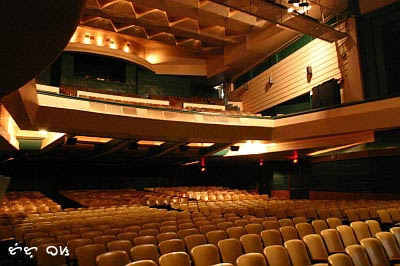
FEU auditorium
 Mural by Antonio Dumlao
 Noticed the letters looked like Baybayin (alibata), the ancient script of the ancestors of Filipinos that Tutubi uses to sign his photographs?
 Owing to the exemplary conservation work done by the university, UNESCO awarded the university the UNESCO Asia-Pacific Heritage Award in 2005.
During World War 2, the campus was used as a concentration camp by the Kempeitai and where Josefa Llanes Escoda, the founder of the Girl Scouts of the Philippines, was executed.
After the FEU tour, Tutubi suggested visiting the nearby Gota de Leche building on S.H. Loyola St (formerly Lepanto), a request acquiesed by the gracious guide.
The university produced many outstanding graduates in it's existence but the greatest of them all, according to Tutubi graduated in 1967 with a degree in accounting.
~~~~~~~~~~~~~~~~~~~~~~~~~~~~~~~~~~~~~~~~~~~~~~~~~~~~
Tutubi's own eyes saw these other Art Deco Structures in Manila and other parts of the Philippines:
1.Jai Alai Fronton on Taft Avenue (Welton Becket, demolished 2004)
2.Avenue Theater (Juan Nakpil, demolished 2006)
3. Metropolitan Theater (The Met)(Juan Arellano, undergoing renovation)
4. Perez-Samanillo Building on Escolta (Andres Luna de San Pedro, good condition)
5. Rizal Memorial Stadium (Juan Nakpil, extant but neglected)
6. Capitol Theater on Escolta (Juan Nakpil, forlorn)
7. Quezon Bridge
8. Meralco Building on San Marcelino St
9. St. Cecilia Hall of St. Scholastica College (Andres Luna de San Pedro, excellent)
10. Sariaya, Quezon Municipal Hall (Juan Arellano, in use)
11. Nielson Tower now Filipinas Heritage Library
12. Orchid Garden Suites on Vito Cruz (Pablo Ocampo) in Malate, Manila
Note that most of Manila's art deco structures were reduced to rubble by the howitzers of Gen. MacArthur during the Liberation of Manila, by the order of the former Manila Mayor Lito Atienza in the case of Jai Alai or by demolition by the owners unable to find adaptive re-use of the edifices.
This time, Tutubi joined a tour of the sprawling campus of FEU: its art deco gems, works of various national artists and a bonus trip to nearby Gota de Leche.
Tutubi arrived at FEU with J, and RM (of Project Manila) in J's black altis but their guide for the day, Ivan ManDy, didn't notice Tutubi and waited for him to arrive even if he's already inside taking some pictures.
The tour started with Ivan becoming "historical" again narrating various events that led to the introduction of Art Deco architecture in the Philippines in the roaring 20s.
 One of four bas relief by noted Italian sculptor Francesco Monti. Other works include Quezon Memorial, Metropolitan Theater, Sto Domingo, Bonifacio Monument, Manila Central Post Office and University of Visayas
FEU campus is a complex of art deco buildings by Pablo Antonio with Nicanor Reyes Hall, the Girls High School (now called the FEU-East Asia College) and Boys High School (now called Law Building).
 Nicanor Reyes Hall, with the baybayin-looking letters


 Statues by National Artist Vicente Manansala
Merriam and Webster defines art deco as "a popular design style of the 1920s and 1930s characterized especially by bold outlines, geometric and zigzag forms, and the use of new materials (as plastic)." (Etymology: French Art Déco, from Exposition Internationale des Arts Décoratifs et Industriels Modernes, an exposition of modern decorative and industrial arts held in Paris, France, in 1925)


Chapel designed by Felipe Mendoza

Stations of the Cross inside the FEU chapel by National Artist Carlos "Botong" Francisco

FEU auditorium
 Mural by Antonio Dumlao
 Noticed the letters looked like Baybayin (alibata), the ancient script of the ancestors of Filipinos that Tutubi uses to sign his photographs?
 Owing to the exemplary conservation work done by the university, UNESCO awarded the university the UNESCO Asia-Pacific Heritage Award in 2005.
During World War 2, the campus was used as a concentration camp by the Kempeitai and where Josefa Llanes Escoda, the founder of the Girl Scouts of the Philippines, was executed.
After the FEU tour, Tutubi suggested visiting the nearby Gota de Leche building on S.H. Loyola St (formerly Lepanto), a request acquiesed by the gracious guide.
The university produced many outstanding graduates in it's existence but the greatest of them all, according to Tutubi graduated in 1967 with a degree in accounting.
~~~~~~~~~~~~~~~~~~~~~~~~~~~~~~~~~~~~~~~~~~~~~~~~~~~~
Tutubi's own eyes saw these other Art Deco Structures in Manila and other parts of the Philippines:
1.
2.
3. Metropolitan Theater (The Met)(Juan Arellano, undergoing renovation)
4. Perez-Samanillo Building on Escolta (Andres Luna de San Pedro, good condition)
5. Rizal Memorial Stadium (Juan Nakpil, extant but neglected)
6. Capitol Theater on Escolta (Juan Nakpil, forlorn)
7. Quezon Bridge
8. Meralco Building on San Marcelino St
9. St. Cecilia Hall of St. Scholastica College (Andres Luna de San Pedro, excellent)
10. Sariaya, Quezon Municipal Hall (Juan Arellano, in use)
11. Nielson Tower now Filipinas Heritage Library
12. Orchid Garden Suites on Vito Cruz (Pablo Ocampo) in Malate, Manila
Note that most of Manila's art deco structures were reduced to rubble by the howitzers of Gen. MacArthur during the Liberation of Manila, by the order of the former Manila Mayor Lito Atienza in the case of Jai Alai or by demolition by the owners unable to find adaptive re-use of the edifices.
Labels: Architecture, Manila, Metro Manila, National Artists, National Capital Region, UNESCO, Universities
posted by GingGoy @ 1:23 PM,
,