Ifugao: How to get to Banaue Rice Terraces: Bus Fare, Commute, Directions
07 September 2012
Recently, another friend of his visited Banaue and gave Tutubi an updated information on "how to get to Banaue, Ifugao" via public transportation for the Banaue Rice Terraces and experience the living traditions that made it to the exclusive list of UNESCO World Heritage Sites.
 Banaue Rice terraces featured on the old one thousand peso bill
How to Get to Banaue, Ifugao
Tutubi was able to visit Banaue Rice Terraces years ago in a trip with Ironwulf but only for a very, very limited time.
How to Commute to Banaue by bus from Manila:
UPDATE: Autobus and Florida Bus Lines no longer serve the Manila to Banaue route
Ohayami Trans bus to Banaue now serves the route with the same
travel time of 8-9 hours
Bus fare to Banaue: PhP450.00
Trip Schedules: daily, First trip at 9pm, second (last regular trip) at 10pm. Extra trips during peak periods
Bus terminal is at the corner of J. Fajardo and Lacson (formerly Gov. Forbes) in Sampaloc, Manila (near UST)
You can reserve your bus ticket seat at their official website or calling
Ohayami Trans contact number
Manila: +63.927.649.3055; +63.2.516.0501
Ifugao: +63.917.561.7344
Email address: ohayami@ohayamitrans.com
How to Get to Banaue from Baguio City
just hop on a bus to Baguio (e.g. Victory Liner) take a taxi to Ohayami Trans terminal then ride a bus to Banaue.
How to get to Banaue via Solano, Nueva Vizcaya:
Ride a bus to Solano, Nueva Vizcaya with buses of Victory Liner, GV Florida, Baliwag Transit or any bus going to Tuguegarao or Isabela.
via Solano, Nueva Vizcaya
Alight in Solano town of Nueva Vizcaya near a gas station where the jeepneys wait for passengers. Board a jeepney with signboard Lagawe (Ifugao). In Lagawe, ride another jeep to Banaue. Total travel time by 2 jeepney rides is 4-5 hours
via Bagabag, Nueva Vizcaya
Victory Liner bus fare from EDSA, Kamias bus terminal is PhP349.00. At Bagabag junction you can ride the jeepney to banawe rice terraces
For driving directions to Banaue if you have your own car, you're really adventurous if you want this but it's not recommended at night if it's also your first time to go there and also for SUVs and pick-ups, not sedans.
You can try this Manila - Banaue route:
Manila -NLEX -SCTEX - right Tarlac - La Paz road - Cabanatuan - Talavera - Munoz - San Jose - Sta. Fe - Aritao - Bambang - Bayombong - Solano - turn left to the road going to Banaue before you reach Bagabag - Lamut - Lagawe - Banaue (Ifugao)
you may also be looking for
Bus to banaue rice terraces, driving directions to Banaue, route to banaue rice terraces, how to get to banaue rice terraces
Labels: Banaue, Cordillera Administrative Region, Ifugao, UNESCO
posted by GingGoy @ 8:16 PM,
,


Palawan: How to Get to Puerto Princesa Underground River: Map, Fare, Tour Rates/Entrance Fee
07 February 2012
UPDATED: April 2013
how to get to Puerto Princesa Underground River in Palawan:
Getting there is really not easy the backpacking way, as there's still unreliable public transportation to get there but there were and are many foreigners who tried.
1. Book a flight to Puerto Princesa (via Philippine Airlines, PAL Express, Cebu Pacific or ZestAir, or slow ferry to Puerto Princesa via 2Go Travel SuperFerry if you have the the time but not the moolah) or a RORO bus to Puerto Princesa
2. Book your access to Puerto Princesa Underground River Online or visit the Booking office near PP Airport:
2.1 Book online by visit the official online booking website here
or visit the booking office:
2.2 From Puerto Princesa Airport, ride a tricycle to Underground River Booking Office. Don't forget this step, you can't just show up in Sabang as they limit tourists to about 600 per day.
Email: reservation@puerto-undergroundriver.com
Call Contact Number: +63.48.434.2509; +63.48.723.0904; +63.48.723.2563
Park Rates and Other Fees Local International
Underground River Entrance Fee
Adult P 100.00 P 150.00
Minor P 75.00 P 100.00
Underground River Tour Rate (Boat Ride Price):
Adult P 175.00 P 250.00
Minor P 100.00 P 150.00
Commercial Video Fee P 3,000.00
3. From your hotel, ride a tricycle to New Market terminal (fare: around PhP15.00)
4. At San Jose New Market Transportation terminal, ride jeepneys going to Sabang, Puerto Princesa (it's still part of mayor Hagedorn's city, not another town of Palawan). Fare: PhP125.00 (first trip at 7am, last trip at 3pm, travel time: 2 hours). Return trip from Sabang to Puerto Princesa last trip is at 2pm daily.
5. In Sabang, proceed to the Tourism office to book your boat to Puerto Princesa Underground River cave entrance
6. Near the cave entrance, enlist for another boat, good for 6 people, to ferry you inside and out of the longest navigable underwater river in the world.
7. Enjoy one of the New 7 Wonders of Nature! :P

Note that the Puerto Princesa public transportation terminal is at San Jose New Market, a jeepney ride (signboard: New Market, fare PhP12.00) or tricycle ride from Puerto Princesa Airport (fare: around PhP15.00)
How to Get to Sabang from El Nido:
Follow this post on How to get to El Nido from Sabang to get an idea as it's just the reverse.
Note: Prices, costs, rates and fares may change without prior notice, mainly due to skyrocketing gasoline prices. Expect fare hikes anytime soon. Tutubi will update this from time to time by calling his friend in Palawan (sorry, can't post his contact number here for privacy)
Related posts on Palawan:
Puerto Princesa Airport
How to get to El Nido from Sabang
Palawan Underground River
Jungle Trek to Puerto Princesa Underground River
Palawan Accommodations in Sabang, Puerto Princesa, Cheap Palawan Package Tours
posted by GingGoy @ 9:14 PM,
,
UNESCO World Heritage Site: Palawan Underground River Tour
02 April 2011
On his return trip, however, he made the Palawan Underground River tour that started with a visit to the Palawan Underground River Booking Office on Rizal Avenue right after visiting a resort on Honda Bay to reserve his slot.
The day, his group left their "hideout" in Puerto Princesa and went to Sabang, Puerto Princesa and scheduled a boat trip to the world-famous Palawan Underground River (also called Puerto Princesa Subterranean River).
Pictures of Palawan Underground River Tour:
 Tutubi's boat that took his group to Palawan Undergroung River. trip only took about 15 minutes
 a boat ride at Palawan Underground River consists of 7 people, including the driver. life vests and hardhats required for the cave tour for the usual safety precautions (you don't need them but just to be safe)
 the dark and dingy interiors of Palawan Underground River is really not scary. Just don't create much movement so your boat won't tip over.
 The boatman doubles as tour guide who narrates funny stories to brighten up the dark (and scary to some) underground river and cave. Stalactites (limestone formations from the cave ceiling going down), stalagmites (formations on the ground going up) and columns (formations joining the ground and ceiling) were given descriptive names and stories.
 Palawan underground river tour allows you to see amazing formations called stalactites, stalagmites and columns
 an interesting stalactite formation called Sharon Stone
The 45 minutes tour of the longest navigable river in the world was a pleasant experience that Tutubi vowed to return there again probably with Tutubi Jr. and his grandparents, if Tutubi's budget can accommodate them all.
Palawan Underground River is one of Palawan's pride inscribed in UNESCO World Heritage sites, the other one being Tubbataha Reef. Recent news also trumpeted an amazing discovery in some unexplored chambers of the cave where fossils of extinct animals that existed at least 20 million years ago before civilization came on earth were unearthed by a team of Italian scientists who condected the scientific survey, as revealed by Puerto Princesa City Mayor Edward Hagedorn.
Coming Up: Palawan Underground River Tour Tips for the "cheapest Palawan Underground River package tour" you can have with the latest Palawan Underground River rates and bus, jeepney fares from Puerto Princesa.
Related posts on Palawan:
Puerto Princesa Airport
How to get to El Nido from Sabang
How to Get to Puerto Princesa Underground River
Labels: Caves, Mimaropa, Palawan, Rivers, Southern Tagalog, UNESCO
posted by GingGoy @ 8:14 PM,
,
The UNESCO World Heritage Church of Sta. Maria Ilocos Sur
02 February 2011
 no lens wide enough for Tutubi to take a full frontal photo of Sta. Maria Church's facade so this one would do. tip: visit it in the early morning as the church is facing east or late afternoon
 the interi0r of the church is unmistakeably baroque with the usual four gospel writers, pulpit and gold-leaf decorated retablo (tableau)
Original church structure by Augustinians as a chapel in 1769 with patron Our Lady of Assumption (Nuestra Señora de la Asuncion). The present stone and brick church was built in 1810 as stated on the NHI marker on the church facade. It's presently undergoing restoration and structural support repair to make it last for posterity.
 massive buttresses line the church walls to support it in case of earthquakes
 the church bell tower a few feet away from the main church structure
What makes Sta. Maria Church unique is that it is a UNESCO World Heritage site, one of the four Baroque Churches of the Philippines (the three others are San Agustin Church Manila, Miag-ao Church in Iloilo and San Agustin Church (Paoay Church) in Ilocos Norte). The church has remarkable universal value that should be preserved for the benefit of mankind.
Sporting the earthquake baroque architecture distinguished by it's massive buttresses to withstand earthquakes common in the Philippines and a belfry separate from the main church so as not to "bang heads" with each other during temblors.
Tutubi intends to visit the other two UNESCO World Heritage Baroque Churches someday. He missed Paoay Church during his Ilocos tour in 2003 but will surely won't the next time
Labels: Architecture, Churches, Ilocos Region, Ilocos Sur, UNESCO
posted by GingGoy @ 8:01 PM,
,
Manila: Gota De Leche Buillding: Another UNESCO Awardee
06 August 2007
After the FEU tour, the group went, on Tutubi's suggestion, to Gota de Leche by crossing Nicanor Reyes St (formerly Morayta) passed by FEU gym and right turn to SH Loyola.
Gota de Leche, which means "drop of milk," was modeled after the Ospedale degli Innocenti, an orphanage in Florence created by Brunelleschi, a renowned Renaissance architect. Constructed in 1917, the building has been the home of La Proteccion de la Infancia, a charitable organization providing free pediatric care and food to poor "people in the neighborhood" of which Manila has so many of.


The building has an adjacent arcade with windows that shields the windows, with capiz (mother of pearl) shells, the hot tropical sun. Its architects, Arcadio and Juan Arellano, thus successfully adapted a Italian Renaissance architecture to a tropical setting.(The use of capiz was preferred then to allow light to enter the room, glass was hard and expensive to acquire that time, while the Japanese used paper for the same purpose.)
On the facade of the building are two relief carvings of angels and the words Salus Populi Supremo Lex, familiar Latin words from Cicero's De Legibus meaning "the health of the people is the supreme law"

 this says "charitable prject of La Proteccion de la Infancia giving milk to babies. Inaugurated on San Pedro St., now Evangelista in Quiapo, 1907. Built a new building in Sampaloc, 1914. Designed by Arcadio and Juan Areallano based on Ospedale Degli Innocenti by Brunelleschi in Florence, Italy. Opened, 1915. Restored, 2002"

It's for this outstanding work of restoration and adaptive re-use that UNESCO awarded Gota de Leche the prestigious Asia-Pacific Heritage Conservation award in 2003. Other winners of this award were Far Eastern University and Nielson Tower (now Filipinas Heritage Library).
Gota De Leche
Address: 859 S. H. Loyola Street, Sampaloc, Manila
(ask the canteen people beside the place for assistance)
Tutubi's Note:
* unlike present modern buildings in Makati and Ortigas that look like transplanted buildings from New York, made of glass and steel, but not designed for tropical Philippines. Those buildings suffer from high power consumption due to the amount of air-conditioning required. Most buildings here were designed by foreigners not used to designing buildings for hot countries; contracted by Filipinos afflicted either with "National Inferiority Complex" or the debilitating disease called colonial mentality)
Labels: Architecture, Manila, Metro Manila, National Capital Region, UNESCO
posted by GingGoy @ 8:12 PM,
,
Manila: Fabulous FEU Art Deco Walking Tour
03 August 2007
This time, Tutubi joined a tour of the sprawling campus of FEU: its art deco gems, works of various national artists and a bonus trip to nearby Gota de Leche.
Tutubi arrived at FEU with J, and RM (of Project Manila) in J's black altis but their guide for the day, Ivan ManDy, didn't notice Tutubi and waited for him to arrive even if he's already inside taking some pictures.
The tour started with Ivan becoming "historical" again narrating various events that led to the introduction of Art Deco architecture in the Philippines in the roaring 20s.
 One of four bas relief by noted Italian sculptor Francesco Monti. Other works include Quezon Memorial, Metropolitan Theater, Sto Domingo, Bonifacio Monument, Manila Central Post Office and University of Visayas
FEU campus is a complex of art deco buildings by Pablo Antonio with Nicanor Reyes Hall, the Girls High School (now called the FEU-East Asia College) and Boys High School (now called Law Building).
 Nicanor Reyes Hall, with the baybayin-looking letters

 Statues by National Artist Vicente Manansala
Merriam and Webster defines art deco as "a popular design style of the 1920s and 1930s characterized especially by bold outlines, geometric and zigzag forms, and the use of new materials (as plastic)." (Etymology: French Art Déco, from Exposition Internationale des Arts Décoratifs et Industriels Modernes, an exposition of modern decorative and industrial arts held in Paris, France, in 1925)


Chapel designed by Felipe Mendoza

Stations of the Cross inside the FEU chapel by National Artist Carlos "Botong" Francisco

FEU auditorium
 Mural by Antonio Dumlao
 Noticed the letters looked like Baybayin (alibata), the ancient script of the ancestors of Filipinos that Tutubi uses to sign his photographs?
 Owing to the exemplary conservation work done by the university, UNESCO awarded the university the UNESCO Asia-Pacific Heritage Award in 2005.
During World War 2, the campus was used as a concentration camp by the Kempeitai and where Josefa Llanes Escoda, the founder of the Girl Scouts of the Philippines, was executed.
After the FEU tour, Tutubi suggested visiting the nearby Gota de Leche building on S.H. Loyola St (formerly Lepanto), a request acquiesed by the gracious guide.
The university produced many outstanding graduates in it's existence but the greatest of them all, according to Tutubi graduated in 1967 with a degree in accounting.
~~~~~~~~~~~~~~~~~~~~~~~~~~~~~~~~~~~~~~~~~~~~~~~~~~~~
Tutubi's own eyes saw these other Art Deco Structures in Manila and other parts of the Philippines:
1.
2.
3. Metropolitan Theater (The Met)(Juan Arellano, undergoing renovation)
4. Perez-Samanillo Building on Escolta (Andres Luna de San Pedro, good condition)
5. Rizal Memorial Stadium (Juan Nakpil, extant but neglected)
6. Capitol Theater on Escolta (Juan Nakpil, forlorn)
7. Quezon Bridge
8. Meralco Building on San Marcelino St
9. St. Cecilia Hall of St. Scholastica College (Andres Luna de San Pedro, excellent)
10. Sariaya, Quezon Municipal Hall (Juan Arellano, in use)
11. Nielson Tower now Filipinas Heritage Library
12. Orchid Garden Suites on Vito Cruz (Pablo Ocampo) in Malate, Manila
Note that most of Manila's art deco structures were reduced to rubble by the howitzers of Gen. MacArthur during the Liberation of Manila, by the order of the former Manila Mayor Lito Atienza in the case of Jai Alai or by demolition by the owners unable to find adaptive re-use of the edifices.
Labels: Architecture, Manila, Metro Manila, National Artists, National Capital Region, UNESCO, Universities
posted by GingGoy @ 1:23 PM,
,
Nielson Tower: Makati CBD Was an Airport
11 March 2007
While the United States' economy traversed the economic downward spiral due to the Great Depression, the Philippine economy rode high with unprecedented growth. Along with this came economic prosperity that made many foreigners coming to our shores dubbed then as the Pearl of the Orient.
One of those who came to the Philippines was Laurie Reuben Nielson, by way of New Zealand, quickly made successes in businesses. He later became involved in building an airport and aviation school in Manila, badly needed at that time, due to the booming needs of the economy. He was able to convince several investors in the airport project and secured a lease from Ayala y Cia for several hectares of land carved out of the vast Hacienda San Pedro de Makati.
The new airport, baptized Nielson Airport, was completed in 1937 and touted as the largest and most modern airport in Asia. It became the home of the country's first airline: Philippine Air Taxi Company (PATCO) and where Philippine Airlines made her maiden flight on March 15, 1941 to Baguio. (Philippine Airlines is the oldest operating airline in Asia, established by a group of businessmen led by Andres Soriano in February 1941)
When war spilled into the country in December 1941 and soldiers of the Land of the Rising Sun overran the archipelago, Laurie Nielson, due to his British citizenship, was taken to Hong Kong while his family brought to the University of Sto. Tomas then converted into an internment camp.
Laurie was never seen nor heard from again and his family moved to the United States after the war.
When airport subsequently transferred to a new location in Paranaque in 1948, Ayala y Cia, reborn Ayala Corporation in 1968, developed Makati into the present modern city while Nielson Tower, with its art deco-inspired architecture that resemble an airplane if viewed from above, was saved from demolition, converted into a library called Filipinas Heritage Library in 1996.

In 2001, UNESCO, recognizing the Nielson Tower for the impressive conversion from airport tower to library, renovation and adaptive reuse, conferred to it the prestigious annual UNESCO Asia-Pacific Cultural Heritage Award,
The same award was given to Gota de Leche building in 2003 and Far Eastern University campus in 2005.
Nielson Tower still stands in an area known as Ayala Triangle while the airport's two major runways are the present day Ayala Avenue and Paseo de Roxas.

bird's eyeview of Ayala avenue corner Makati avenue taken through dirty glasswindow of my new office with Nielson Tower in view
 I happened to organize a seminar for my company, the freelance events organizer that I am, shopped around Makati for a suitable venue to accommodate about a hundred seminar participants and this nearby building came to mind: Filipinas Heritage Library and gave me the chance to take pictures of the structure using my reliable point-and-shoot camera. The seminar turned out success to the enjoyment of the attendees and satisfaction of my various sponsors. Maybe I should change career into events management! :)
Labels: Architecture, History, Makati, Metro Manila, National Capital Region, UNESCO
posted by GingGoy @ 8:23 PM,
,
Once Upon a Time in Manila (Tour of Intramuros and Nilad Tree)
24 June 2006
It's Manila's birthday!
It was on this day 435 years ago that Miguel Lopez de Legazpi forged a pact with Rajahs Suliman, Matanda and Lakandula founding the city of Manila.
I celebrated this day by heading to the old business district of Manila- Binondo. 'Twas here where the Christianized Sangleys, as the Spaniards called Chinese at the time, settled outside the walls of Intramuros.
Last July 5, 2005, while meandering through Ongpin St, we passed by Eng Bee Tin, every hopia lover's haven and the fabled Estero "fun" dining. While looking for the traditional chocolate factory, I blitzed through Nueva, renamed Yuchengco in honor of the chinese taipan.
La calle anterior de Nueva ahora es calle de Yuchengco!
On discovery of the name change, I sent an email (July 15, 2005) to rant about it to the hcs-youth yahoogroups. Aside from Nueva, Gandara was also named Padilla St.
Two weeks later, the streetwalker, Ivan ManDy, campaigned to petition to restore the old name to Nueva but fell on deaf ears.
Manila folks are truly apathetic.
Manila government really is doing a very good job of renaming historic streets at the same time demolishing historic landmarks and architectural sites that should've been preserved for posterity.
Back to the present, after brief Chinatown tryst, I proceeded to Intramuros to join Ivan's walking tour of the old walled city, a visit to Bahay Tsinoy (my second time there actually) and San Agustin Church and adjoining museum
San Agustin Church and Museum
Upong entering San Agustin Church, with its redolent "historic" smell and listed as one of the four UNESCO World Heritage churches in the Philippines, I again marvelled at the magnificent walls and ceilings painted, though appearing to be carvings using a style known as Trompe l'oeil. The choir loft floors were made of Philippine molave (though Ivan wasn't sure what kind of wood it was). It's huge buttresses used as altars double as structural support during earthquakes.
The adjacent museum houses and protects a sizeable collection of religious icons and images numerous ones trace provenance from my hometown Paete in Laguna. This structure also houses the tomb of Juan Luna and was the site of the surrender of the Spaniards to the Americans after a mock battle.
Ivan, our guide, is chatty tour guide though he prefers not be called as one. He's one of the best guides we have. Visit his site here.
The Monument to King Charles IV of Spain (in silhouette)in gratitude for sending smallpox vaccine to Manila located at Plaza de Roma in front of Manila Cathedral

Al Rey de Carlos IV en gratito al non beneficio de la vacuna los habitantes de Filipinas.
Manila Cathedral
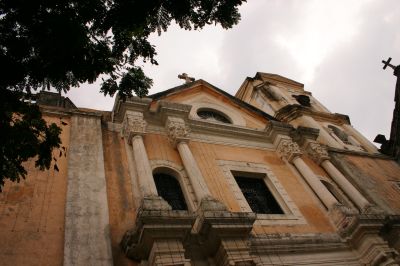
The Manila War marker at the back of Manila Cathedral

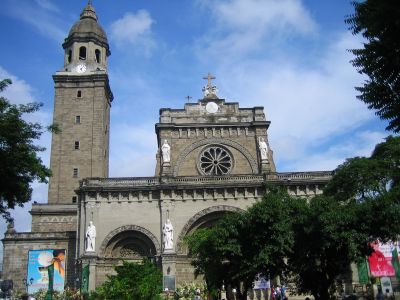
San Agustin Church
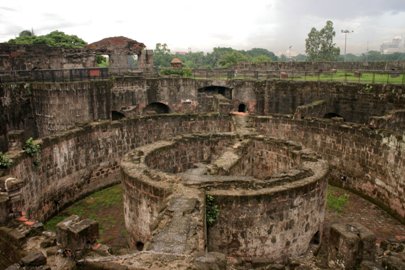
Baluarte De San Diego
the kalesa along the ruins

tee off at Intramuros

coconut country

Casa Manila showing fusion of Spanish and Filipino Architecture

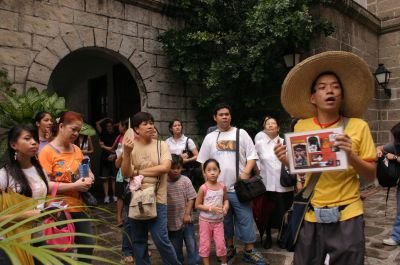
"klasmeyts" with Ivan
Finally, for those who still don't know how a Nilad tree, from where Manila got its name, looks like:
original Nilad photo found here.

UPDATE: Ambeth Ocampo in one of his columns remarked there is not such thing as Nilad tree and that Manila was already named Maynila even before the Spaniards came.
All photos except the Nilad are all property of the author.
Labels: Churches, History, Intramuros, Manila, Metro Manila, National Capital Region, UNESCO
posted by GingGoy @ 10:02 PM,
Of National Artists and Their Legacies
12 June 2006
After scouring various shops for various finds, we decided to proceed to people "infested" and traffic-burdened street formely called Azcarraga. We passed by the pedestrianized part of Avenida Rizal to our left while the soon-to-be-demolished Galaxy Theater to our right.It's ironic that such building considered exquisite in its time and the work of National Artist Pablo Antonio will soon face the wrath of a demolition ball. Nearby is the now demolished Avenue Theater which is the work of another national artist Juan Nakpil. The two buildings are to be converted into parking lots.
My country honors National Artists but doesn't make an effort to preserve their work for posterity's sake!
We were caught in heavy traffic and when we realized the futility if squirming through it, we decided instead to make a 180 degree turn towards Morayta. There we passed by the newly-restored FEU building partly designed by Pablo Antonio that won the UNESCO 2005 Asia-Pacific Cultural Heritage Awards.
Previous winnersof this prestigious award were Gota de Leche in Sampaloc and Nielsen Tower in Makati.
Manila, mostly decaying, and most of it destroyed by Japanese demolition and American carpet bombing seem unmindful of the fast disappearing heritage.Notable of these are the Jai Alai building and San Lazaro Hippodrome,now an SM mall aggravated by a mayor that value modernityand not heritage conservation.
How can we as a nation move forward if we treat the past with apathy? We can't even remember our history written by Filipinos and not by our conquerors.
The media only reported mostly and sensationalized FPJ's family's refusal to attend the awards ceremony for national artists and not the more important news of the meritorius achievements of the other awardees.
With this attitude, does it look like the works of the new national awardees will also suffer the same fate as that of the earlier awardees?
I can't imagine BenCab's Tam-awan village in Baguio being converted to another parking lot or subdivision.
btw, did you notice I don't have pictures? My goodness, I didn't bring my EOS 300D while my Ixus 30 bled dry after a few clicks :-(
Labels: Manila Bay, National Artists, Quiapo, UNESCO
posted by GingGoy @ 8:40 PM,
,
Travel Guide Vigan, Ilocos Sur: UNESCO World Heritage Site
14 December 2002
The city is the most preserved example of a Spanish colonial town in Asia, with its cobblestone streets and a unique architecture showcasing fusion of Asian building design and construction with European colonial architecture and planning. This has earned listing as a UNESCO World Heritage Site.
 Calle Crisologo, Vigan's main street with nostalgic cobblestone
 key to preservation of the place is a strict building code that even modern restaurants need to adhere to
Places of Interest in Vigan, Ilocos Sur:
here's a list of places to see in Vigan:
St. Paul’s Metropolitan Cathedral (Vigan Cathedral)- an earthquake baroque style church built in 1574
Syquia Mansion Museum the the ancestral home / museum of a former president of the Philippines Elpidio Quirino (entrace fee: P10)
Padre Burgos Museum
Nueva Segovia Museum
Pottery Making (Burnay) Pagburnayan where traditional Vigan jars, called burnay, are made.
Baluarte home and mini-zoo of Chavit Singson (a tricycle ride away from Vigan city center. no entrance fee)
Vigan Delicacies and Pasalubong:
Vigan empanada, vigan royal bibingka, tinubong, sinanglao, vigan longganiza
How to get to Vigan, Ilocos Sur:
Commute by Bus to Vigan is easy via Philippine Rabbit Bus Line, Dominion Bus Corp., Partas Trans. Co.
Baguio to Vigan by bus travel time is around 3 hours
Driving Directions to Vigan, Ilocos Sur:
follow this route: NLEX, SCTEX, then follow highway up to Vigan, it's just a straight drive
Updated: April 2013
Labels: Ilocos Region, Ilocos Sur, UNESCO, Vigan
posted by GingGoy @ 8:10 PM,
,