Andres Bonifacio Monument in Tondo, Manila
30 November 2009
In front of Tutuban Center mall on C.M. Recto Avenue, Tondo, Manila, situated in a small public park, is a monument in honor of the founder of the secret society of Katipunan on this day marking his coming into this world.
 Andres Bonifacio depicted not in the usual (and false) bolo and red trousers
 Tutuban Primeblock fronting C.M. Recto and facing the street going to 168 Shopping Mall. Also visible is the Andres Bonifacio Monument
 National Historical Institute (NHI) marker in Tagalog
another marker has these Spanish inscriptions:
"Los hijos del pueblo Filipino erigen este monumento para eterna consagrados del sitio en que nacio el 30 de noviembre de 1863 El heroe popular
Andres Bonifacio
Padre del Katipunan y
Brazo del Movimiento Libertador de 1896
Andres Bonifacio 1863 - 1897"
It's mentioned above the Andres Bonifacio is always falsely featured wearing red trousers, said to be uniform of Katipuneros, but actually not true-- Katipuneros were not stupid to wear red trousers as uniforms for they're easy targets of Spanish mausers in battle.
Related Posts:
How to commute to Divisoria
Andres Bonifacio Shrines
How to get to Divisoria
 Andres Bonifacio depicted not in the usual (and false) bolo and red trousers
 Tutuban Primeblock fronting C.M. Recto and facing the street going to 168 Shopping Mall. Also visible is the Andres Bonifacio Monument
 National Historical Institute (NHI) marker in Tagalog
another marker has these Spanish inscriptions:
"Los hijos del pueblo Filipino erigen este monumento para eterna consagrados del sitio en que nacio el 30 de noviembre de 1863 El heroe popular
Andres Bonifacio
Padre del Katipunan y
Brazo del Movimiento Libertador de 1896
Andres Bonifacio 1863 - 1897"
It's mentioned above the Andres Bonifacio is always falsely featured wearing red trousers, said to be uniform of Katipuneros, but actually not true-- Katipuneros were not stupid to wear red trousers as uniforms for they're easy targets of Spanish mausers in battle.
Related Posts:
How to commute to Divisoria
Andres Bonifacio Shrines
How to get to Divisoria
Labels: Andres Bonifacio, Manila, Metro Manila
posted by GingGoy @ 9:06 PM,
,


A Short Sightseeing Tour of Dipolog City
25 November 2009
Formerly part of Dapitan City and now the capital of the province of Zamboanga del Norte, is the gateway to the Shrine City of Dapitan where Rizal Shrine, Dakak Beach Resort and the new Gloria de Dapitan theme park is located.
A brief tour of Dipolog City materialized on the way from Dapitan City to Dipolog Airport to catch Tutubi's flight back to Manila.
At the intersection of Estaka and Turno road, there's Dipolog Fountain (sometimes called Estaka-Turno Y junction Fountain), according to the official website of Dipolog City, "located at Estaka-Turno road junction is the Fountain of Blessings. The statutes represent the tri-people of Mindanao, which symbolize the diverse cultures prevailing in Dipolog. The bowl raised to heavens is a gesture of thanksgiving and offering to God Almighty for the generous outpouring of graces and blessings, bountiful harvests and sustained peace and prosperity."
 a photo of Dipolog Fountain taken inside a moving van. This fountain would surely look great at night with water and lights but no time to even stop and take a better snapshot
Just outside Holy Rosary Cathedral (Dipolog Church), in front of the historic Dipolog Hall is the Monument of Three Prominent Dipolognons: namely "Hon. Pascual T. Martinez, the first appointed Mayor of Dipolog in 1913-1918), Rev. Fr. Nicasio Y. Patangan, the first Filipino Diocesan Priest of Mindanao and Eugenio R. Margate, a farmer for 25 years who introduced the MARGATE SYSTEM OF PLANTING RICE."
Onwards you'll come across the "Sta. Cruz Marker (Punta Corro) which is the spot where migrating Boholanos from the Visayas landed on and planted the cross for Christianity on May 3, 1905."
 The historic landing spot of Boholano settlers in Dipolog City's marked by a huge cross facing the sea and Dipolog Boulevard
Dipolog has three major shopping malls: Dipolog Shopping Center and Lee Plaza Mall (LP) Mall and Dipolog City Mall
 Dipolog Shopping Center
Dipolog Boulevard is a development of coastal park now a favorite haunt of promenaders and fitness enthusiasts.

Other places to see in Dipolog that Tutubi wasn't able to visit due to lack of time: Sungkilaw falls, Subanen Village in Cogon Eco Park, Organization of International Spiritual and Cultural Advancement or OISCA Forest Park for trekkers and nature trippers being a mountrain trail and bird sanctuary, the 3003 Steps to Linabo Peak (a holy week trek destination). No information yet on why the local government of Dipolog is marketing the city as Orchid City of the Philippines.
Other tourism activities in Dipolog include the annual Sinulog sa Dipolog every 3rd Saturday of January with the usual street dancing for the Sto. Niño, Katkat Sakripisyo at Linabo Peak in April, and the Pagsalabuk Festival in May marked by harvest rituals of the Subanens, Feast of St. Vincent Ferrer during 3rd Saturday of May, Araw ng Dipolog marked July 1 to 6, Feast of the Lady of the Holy Rosary in October, and the nightly shows during Pasko sa Dipolog in December. Take note also of Araw ng Zamboanga del Norte.
Coming up...Dipolog pasalubong shopping :P
How to get there:
Dipolog can be reached by plane from Manila via Dipolog Airport and by ferry via the Dapitan Seaport. Buses from other parts of Mindanao e.g. Davao City (via Butuan City), Cagayan de Oro City (CDO) and Zamboanga City are available.
drive-by Photos of Dipolog City taken inside a cruising van and may appear a tad blurry or color-skewed.
Sources: Official Website of Dipolog City and Dipolog City locals who are now friends of Tutubi :P
Related Posts and Nearby Places in Dipolog:
Dakak Beach Resort
Jose Rizal Shrine
Holy Rosary Cathedral
A brief tour of Dipolog City materialized on the way from Dapitan City to Dipolog Airport to catch Tutubi's flight back to Manila.
At the intersection of Estaka and Turno road, there's Dipolog Fountain (sometimes called Estaka-Turno Y junction Fountain), according to the official website of Dipolog City, "located at Estaka-Turno road junction is the Fountain of Blessings. The statutes represent the tri-people of Mindanao, which symbolize the diverse cultures prevailing in Dipolog. The bowl raised to heavens is a gesture of thanksgiving and offering to God Almighty for the generous outpouring of graces and blessings, bountiful harvests and sustained peace and prosperity."
 a photo of Dipolog Fountain taken inside a moving van. This fountain would surely look great at night with water and lights but no time to even stop and take a better snapshot
Just outside Holy Rosary Cathedral (Dipolog Church), in front of the historic Dipolog Hall is the Monument of Three Prominent Dipolognons: namely "Hon. Pascual T. Martinez, the first appointed Mayor of Dipolog in 1913-1918), Rev. Fr. Nicasio Y. Patangan, the first Filipino Diocesan Priest of Mindanao and Eugenio R. Margate, a farmer for 25 years who introduced the MARGATE SYSTEM OF PLANTING RICE."
Onwards you'll come across the "Sta. Cruz Marker (Punta Corro) which is the spot where migrating Boholanos from the Visayas landed on and planted the cross for Christianity on May 3, 1905."
 The historic landing spot of Boholano settlers in Dipolog City's marked by a huge cross facing the sea and Dipolog Boulevard
Dipolog has three major shopping malls: Dipolog Shopping Center and Lee Plaza Mall (LP) Mall and Dipolog City Mall
 Dipolog Shopping Center
Dipolog Boulevard is a development of coastal park now a favorite haunt of promenaders and fitness enthusiasts.

Other places to see in Dipolog that Tutubi wasn't able to visit due to lack of time: Sungkilaw falls, Subanen Village in Cogon Eco Park, Organization of International Spiritual and Cultural Advancement or OISCA Forest Park for trekkers and nature trippers being a mountrain trail and bird sanctuary, the 3003 Steps to Linabo Peak (a holy week trek destination). No information yet on why the local government of Dipolog is marketing the city as Orchid City of the Philippines.
Other tourism activities in Dipolog include the annual Sinulog sa Dipolog every 3rd Saturday of January with the usual street dancing for the Sto. Niño, Katkat Sakripisyo at Linabo Peak in April, and the Pagsalabuk Festival in May marked by harvest rituals of the Subanens, Feast of St. Vincent Ferrer during 3rd Saturday of May, Araw ng Dipolog marked July 1 to 6, Feast of the Lady of the Holy Rosary in October, and the nightly shows during Pasko sa Dipolog in December. Take note also of Araw ng Zamboanga del Norte.
Coming up...Dipolog pasalubong shopping :P
How to get there:
Dipolog can be reached by plane from Manila via Dipolog Airport and by ferry via the Dapitan Seaport. Buses from other parts of Mindanao e.g. Davao City (via Butuan City), Cagayan de Oro City (CDO) and Zamboanga City are available.
drive-by Photos of Dipolog City taken inside a cruising van and may appear a tad blurry or color-skewed.
Sources: Official Website of Dipolog City and Dipolog City locals who are now friends of Tutubi :P
Related Posts and Nearby Places in Dipolog:
Dakak Beach Resort
Jose Rizal Shrine
Holy Rosary Cathedral
Labels: Dipolog, Zamboanga del Norte, Zamboanga Peninsula
posted by GingGoy @ 10:20 PM,
,
Stopover at Dipolog Cathedral, Zamboanga del Norte
22 November 2009
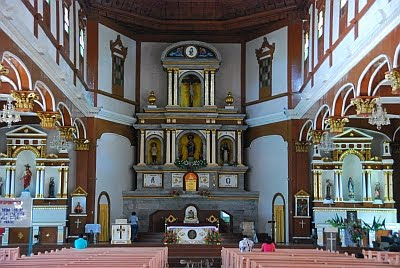
Prior to leaving Dipolog City, the twin city of Dapitan, Tutubi and his friendly hosts took him on a short tour of Dipolog City that began with a few minutes stop at Holy Rosary Cathedral, Dipolog's church reportedly built by the Spaniards near the end of the 19th century.
It's actually disappointing that the more than a century old church no longer has the looks of its age and was undergoing renovation when Tutubi visited.
 Dipolog Cathedral's interiors doesn't have the looks of an old church.
 the four evangelists adorn the roof of the church. in typical baroque style churches, the four evangelists can be seen on the four columns supporting the apse (the big dome of churches near the altar)
Dipolog Cathedral's claim to fame and history is that Jose Rizal designed the main altar during his exile in Dapitan.
Coming...a brief tour of Dipolog City
It's actually disappointing that the more than a century old church no longer has the looks of its age and was undergoing renovation when Tutubi visited.
 Dipolog Cathedral's interiors doesn't have the looks of an old church.
 the four evangelists adorn the roof of the church. in typical baroque style churches, the four evangelists can be seen on the four columns supporting the apse (the big dome of churches near the altar)
Dipolog Cathedral's claim to fame and history is that Jose Rizal designed the main altar during his exile in Dapitan.
Coming...a brief tour of Dipolog City
Labels: Churches, Dipolog, Jose, Zamboanga del Norte, Zamboanga Peninsula
posted by GingGoy @ 9:10 PM,
,
A Visit to Tutuban Center Mall, Divisoria, Manila
15 November 2009
A shopping mall built on historic ground and in the middle of a sprawling shopping mecca that is Divisoria, Tutuban Center is an air-conditioned version of stalls selling cheap goods particularly clothes (RTWs et al) and textiles.
Tutuban Primeblock fronting C.M. Recto and facing the street going to 168 Shopping Mall. Also visible is the Andres Bonifacio Monument
 Tutuban Centermall sporting a bahay-na-bato architecture
 inside Tutuban Center are lines and lines of stalls selling almost everything under sun but with the convenience of escalators and air-conditioning
History of Tutuban (origin of the name):
Located in the district of Tondo, Manila, Tutuban was named as such because it used to be a production center of tuba, a fermented drink made from coconut or nipa palm.
Tutuban is the historic birthplace of Katipunan founder and national hero Andres Bonifacio of which a monument dedicated to him can be found in front of Tutuban Centermall plus a small park where people can rest (and also the best spot to flag a taxi in Divisoria)
ATM in Tutuban Center:
Banco de Oro (BDO) ATM at Tutuban Center Primeblock ground floor
Security bank at Tutuban Center Mall
How to get there:
please refer to this post on How to get to Divisoria for directions and commuting guides to Tutuban Mall
Related Links:
Manila Shopping Guide
Philippine National Railways
168 Shopping Mall
How to get to Divisoria
Tutuban Primeblock fronting C.M. Recto and facing the street going to 168 Shopping Mall. Also visible is the Andres Bonifacio Monument Tutuban Centermall sporting a bahay-na-bato architecture
 inside Tutuban Center are lines and lines of stalls selling almost everything under sun but with the convenience of escalators and air-conditioning
History of Tutuban (origin of the name):
Located in the district of Tondo, Manila, Tutuban was named as such because it used to be a production center of tuba, a fermented drink made from coconut or nipa palm.
Tutuban is the historic birthplace of Katipunan founder and national hero Andres Bonifacio of which a monument dedicated to him can be found in front of Tutuban Centermall plus a small park where people can rest (and also the best spot to flag a taxi in Divisoria)
ATM in Tutuban Center:
Banco de Oro (BDO) ATM at Tutuban Center Primeblock ground floor
Security bank at Tutuban Center Mall
How to get there:
please refer to this post on How to get to Divisoria for directions and commuting guides to Tutuban Mall
Related Links:
Manila Shopping Guide
Philippine National Railways
168 Shopping Mall
How to get to Divisoria
Labels: Divisoria, Malls, Manila, Metro Manila, Shopping
posted by GingGoy @ 9:30 PM,
,
How to Commute to Divisoria: Jeepney, Bus, LRT, MRT and PNR
Due to the looming shopping season that's called Christmas, many people will flock to the sprawling Divisoria "Shopping Complex" in Manila to buy gifts and clothes and what-have-yous at bargain prices
This is a guide for first-timers for Directions to Divisoria as well as answer the oft-asked question: How to Commute to Divisoria:
Commuting to Divisoria? You have lots of options of Divisoria Jeepney Routes (as recalled by Tutubi, there may be other routes available, please feel free to leave a comment)
Navotas to Divisoria jeepney via Gasak
MCU- Divisoria (Terminal on A. Rivera St.) Route: Manila Central University, Monumento, Rizal Avenue, Abad Santos, C.M. Recto
Blumentritt - Divisoria (Terminal on A. Rivera St.) Leonor Rivera, right New Antipolo, left Felix Huertas [SM San Lazaro], right Quericada [Rizal Avenue, San Lazaro Hospital] left Abad Santos, right Mayhaligue, left Antonio Rivera [Seng Guan Temple]
Quiapo - Divisoria - North Harbor
Baclaran - Divisoria (via Taft Avenue) Baclaran Taft Avenue, pass Manila City Hall, Jones Bridge, Paredes St, pass Binondo Church, Juan Luna St (then walk to C.M. Recto Avenue)
Cubao to Divisoria (via Aurora Blvd., Ramon Magsaysay, Legarda, and CM Recto Avenue)
Gastambide to Divisoria (via Morayta, CM Recto and Soler)
Balut to Divisoria
Gasak to Divisoria
Sangandaan to Divisoria (via Abad Santos)
Marikina to Divisoria bus route operated by Marikina Auto Line by the SSS Village - Divisoria Route
How to get to Divisoria via LRT, LRT2 and MRT
From LRT Doroteo Jose Station, walk towards C.M. Recto and board Divisoria-bound jeeps
via LRT 2: Alight at the end of the LRT line i.e. Recto Station then board Divisoria-bound jeeps. This is the fastest way to get there from people from Rizal province and Marikina.
via MRT: at Taft Avenue Station, board jeepneys bound for Divisoria on Taft Avenue.
From Makati: board a jeepney on Buendia/Gil Puyat going (a bus if you're on Ayala Avenue) to Cartimar/LRT/Taft Avenue then transfer to a Divisoria-bound jeepney or FX
Divisoria via Pasig River Ferry: board the Pasig River Ferry at your own convenient terminal and get off at Escolta Station. Transfer to a Divisoria-bound jeepney at the foot of Jones Bridge, get off on Juan Luna St. then walk towards CM. Recto
Divisoria via Philippine National Railways (PNR) can be reached from any PNR train station as far as Binan, Laguna or Alabang Muntinlupa where the last station in Tutuban is just behind Tutuban Center Mall
From Manila Airport (NAIA) to Divisoria:
1. The fastest and easiest is to flag an airport taxi (if you can get one)
2. From NAIA Termina 1 and 2, board the buses or jeepneys going to Baclaran then transfer to jeepneys going to Divisoria
3. from NAIA Terminal 3: board the shuttle bus to LRT Taft Avenue then transfer to a jeepney bound for Divisoria on Taft Avenue.
Related Links:
Manila Shopping Guide
Philippine National Railways
168 Shopping Mall
Pasig River Ferry
How to get to Divisoria
This is a guide for first-timers for Directions to Divisoria as well as answer the oft-asked question: How to Commute to Divisoria:
Commuting to Divisoria? You have lots of options of Divisoria Jeepney Routes (as recalled by Tutubi, there may be other routes available, please feel free to leave a comment)
Navotas to Divisoria jeepney via Gasak
MCU- Divisoria (Terminal on A. Rivera St.) Route: Manila Central University, Monumento, Rizal Avenue, Abad Santos, C.M. Recto
Blumentritt - Divisoria (Terminal on A. Rivera St.) Leonor Rivera, right New Antipolo, left Felix Huertas [SM San Lazaro], right Quericada [Rizal Avenue, San Lazaro Hospital] left Abad Santos, right Mayhaligue, left Antonio Rivera [Seng Guan Temple]
Quiapo - Divisoria - North Harbor
Baclaran - Divisoria (via Taft Avenue) Baclaran Taft Avenue, pass Manila City Hall, Jones Bridge, Paredes St, pass Binondo Church, Juan Luna St (then walk to C.M. Recto Avenue)
Cubao to Divisoria (via Aurora Blvd., Ramon Magsaysay, Legarda, and CM Recto Avenue)
Gastambide to Divisoria (via Morayta, CM Recto and Soler)
Balut to Divisoria
Gasak to Divisoria
Sangandaan to Divisoria (via Abad Santos)
Marikina to Divisoria bus route operated by Marikina Auto Line by the SSS Village - Divisoria Route
How to get to Divisoria via LRT, LRT2 and MRT
From LRT Doroteo Jose Station, walk towards C.M. Recto and board Divisoria-bound jeeps
via LRT 2: Alight at the end of the LRT line i.e. Recto Station then board Divisoria-bound jeeps. This is the fastest way to get there from people from Rizal province and Marikina.
via MRT: at Taft Avenue Station, board jeepneys bound for Divisoria on Taft Avenue.
From Makati: board a jeepney on Buendia/Gil Puyat going (a bus if you're on Ayala Avenue) to Cartimar/LRT/Taft Avenue then transfer to a Divisoria-bound jeepney or FX
Divisoria via Pasig River Ferry: board the Pasig River Ferry at your own convenient terminal and get off at Escolta Station. Transfer to a Divisoria-bound jeepney at the foot of Jones Bridge, get off on Juan Luna St. then walk towards CM. Recto
Divisoria via Philippine National Railways (PNR) can be reached from any PNR train station as far as Binan, Laguna or Alabang Muntinlupa where the last station in Tutuban is just behind Tutuban Center Mall
From Manila Airport (NAIA) to Divisoria:
1. The fastest and easiest is to flag an airport taxi (if you can get one)
2. From NAIA Termina 1 and 2, board the buses or jeepneys going to Baclaran then transfer to jeepneys going to Divisoria
3. from NAIA Terminal 3: board the shuttle bus to LRT Taft Avenue then transfer to a jeepney bound for Divisoria on Taft Avenue.
Related Links:
Manila Shopping Guide
Philippine National Railways
168 Shopping Mall
Pasig River Ferry
How to get to Divisoria
Labels: Divisoria
posted by GingGoy @ 7:58 PM,
,
P499 Cebu Pacific Sale Fare on Bus and Ferry Routes
Good news for those for people still taking the slow bus and slower ferries to get to their home province, latest Cebu Pacific's sale on popular bus routes gives you a choice to fly to get there faster at about the same price as bus and ferry commuting.
Cebu Paficic Sale period: Now until November 16, 2009
Travel Period: December 1, 2009 to February 28, 2010
Bus and ferry routes covered include the following flights:
Manila to Cauayan (Isabela)
Manila to Laoag (Ilocos Norte)
Manila to Legazpi (Albay)
Manila to Tuguegarao,
Manila to Naga (Camarines Sur)
Manila to Virac (Catanduanes)
Manila to San Jose (Romblon)
The P499 ‘Go Lite’ seats are also available for flights for these routes:
Cebu to Dumaguete,
Cebu to Butuan,
Cebu to Cagayan de Oro,
Cebu to Legazpi,
Cebu to Bacolod,
Cebu to Cotabato,
Cebu to Roxas,
Cebu to Iloilo
Cebu to Tacloban
Davao to Cagayan de Oro
Davao to Iloilo.
Travellers with check-in luggage need to add P100 on booking.
Note that the bus is still recommended for people with lots of baggage in tow (to avoid excess baggage charges of course) as well as shelling out PhP200 for airport terminal fees and sometimes taxi fare to the airport.
November 15, 2009
Cebu Paficic Sale period: Now until November 16, 2009
Travel Period: December 1, 2009 to February 28, 2010
Bus and ferry routes covered include the following flights:
Manila to Cauayan (Isabela)
Manila to Laoag (Ilocos Norte)
Manila to Legazpi (Albay)
Manila to Tuguegarao,
Manila to Naga (Camarines Sur)
Manila to Virac (Catanduanes)
Manila to San Jose (Romblon)
The P499 ‘Go Lite’ seats are also available for flights for these routes:
Cebu to Dumaguete,
Cebu to Butuan,
Cebu to Cagayan de Oro,
Cebu to Legazpi,
Cebu to Bacolod,
Cebu to Cotabato,
Cebu to Roxas,
Cebu to Iloilo
Cebu to Tacloban
Davao to Cagayan de Oro
Davao to Iloilo.
Travellers with check-in luggage need to add P100 on booking.
Note that the bus is still recommended for people with lots of baggage in tow (to avoid excess baggage charges of course) as well as shelling out PhP200 for airport terminal fees and sometimes taxi fare to the airport.
November 15, 2009
Labels: Promo Fares
posted by GingGoy @ 8:54 AM,
,
The US Flag Raising on Hill 120, Dulag, Leyte
11 November 2009
One of World War II's most iconic images was taken on Iwo Jima with the US Marines planting the American flag on the blood-drenched island of Iwo Jima in southern Japan after a hard-fought and costly battle.
In the Philippines, the first raising of the American flag on Philippine soil after the fall of Bataan was made on top of Hill 120 in Dulag Leyte facing Red Beach, a few hours after Gen. Douglas macArthur waded ashore nearby on Red Beach, Palo, Leyte, area now called Leyte Landing Memorial
 the not so noticeable depiction of the flag-raising on Hill 120 where a US soldier climbing a coconut tree
Facing the main highway of Dulag is a historical marker narrating the historic significance of the place and reads:"Atop the height of this hill 120, Blue beach, Dulag Leyte, Philippines at 10:42 a.m. 20 October 1944, only 42 minutes had elapsed since the first assault troops of the 3rd BN of 382D Infantry, 96th Division of the American forces of liberation had landed 1st Lt. Clifford W. Mills raised the American flag in Philippine soil after it had been lowered at Bataan on 9 April 1942. Floating high and proud was tangible proof that the Americans had made good their promise to the Filipinos."
 "In grateful memory of the unknown American soldiers who with untold magnanimity and valiance fought and paid the supreme sacrifice on this foreign shore to liberate a people foreign to them."
 Japanese Memorial and Cenotaph of the bloody encounter
"Cenotaph
Dedicated to console all souls of Filipinos, Japanese, American who
passed away in Leyte during World War II.
Sworn that the same tragedy and mistake should never be repeated. Prayer
for the true world peace and friendship forever"
There's a trail of concrete steps up to the top of Hill 120 require a five minute trek upwards.
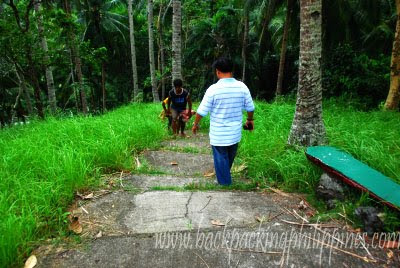
On top of the hill, the view is obstructed by tall trees mostly coconuts plus a limited view of what seemed to be a construction or cement factory. Badges and logos of 96th Infantry Division who stormed the hill, the Deadeyes, are displayed on the memorial.

World War II monuments are regularly featured on this blog, not to glorify a war but to remind people of the lives lost and folly of a senseless war.
---
How to get to Dulag, Leyte:
the town of Dulag can be reached by two jeepney rides from Tacloban Airport, first the jeep from San Jose to Tacloban City transport terminal then another jeep to Dulag, Leyte about an hour away.
In the Philippines, the first raising of the American flag on Philippine soil after the fall of Bataan was made on top of Hill 120 in Dulag Leyte facing Red Beach, a few hours after Gen. Douglas macArthur waded ashore nearby on Red Beach, Palo, Leyte, area now called Leyte Landing Memorial
 the not so noticeable depiction of the flag-raising on Hill 120 where a US soldier climbing a coconut tree
Facing the main highway of Dulag is a historical marker narrating the historic significance of the place and reads:"Atop the height of this hill 120, Blue beach, Dulag Leyte, Philippines at 10:42 a.m. 20 October 1944, only 42 minutes had elapsed since the first assault troops of the 3rd BN of 382D Infantry, 96th Division of the American forces of liberation had landed 1st Lt. Clifford W. Mills raised the American flag in Philippine soil after it had been lowered at Bataan on 9 April 1942. Floating high and proud was tangible proof that the Americans had made good their promise to the Filipinos."
 "In grateful memory of the unknown American soldiers who with untold magnanimity and valiance fought and paid the supreme sacrifice on this foreign shore to liberate a people foreign to them."
 Japanese Memorial and Cenotaph of the bloody encounter
"Cenotaph
Dedicated to console all souls of Filipinos, Japanese, American who
passed away in Leyte during World War II.
Sworn that the same tragedy and mistake should never be repeated. Prayer
for the true world peace and friendship forever"
There's a trail of concrete steps up to the top of Hill 120 require a five minute trek upwards.

On top of the hill, the view is obstructed by tall trees mostly coconuts plus a limited view of what seemed to be a construction or cement factory. Badges and logos of 96th Infantry Division who stormed the hill, the Deadeyes, are displayed on the memorial.

World War II monuments are regularly featured on this blog, not to glorify a war but to remind people of the lives lost and folly of a senseless war.
---
How to get to Dulag, Leyte:
the town of Dulag can be reached by two jeepney rides from Tacloban Airport, first the jeep from San Jose to Tacloban City transport terminal then another jeep to Dulag, Leyte about an hour away.
Labels: Eastern Visayas, Leyte, World War II
posted by GingGoy @ 9:09 PM,
,
Burial Customs, Traditions, Superstitions at the Funeral Wake
07 November 2009
Ever been constrained by superstitious people, particularly old folks in an important family event?
Here's a list of do's and don't, traditions and superstitions on death, wake and funerals in the Philippines compiled by Tutubi based on his own observations and experiences.
Bawal ang pulang damit: No wearing of red-colored dresses and shirts at the wake/funeral
Bawal Maghatid ng Bisita: During the funeral wake, never see your visitors off at the door of the chapel or funeral parlor
Bawal Maglinis: Sweep/clean the house only after the burial. But you're excused if the wake is held in a chapel/funeral home.
Bawal umuwi diretso sa bahay: After the visiting a wake or funeral, do not go home directly, instead visit a "happy place" so that the spirit of the dead will not follow you home (hmmm, isn't it ok for your love one to come and visit you to say goodbye, say a few words particularly those "I love you" that was only said on the deathbed or coffin and not when your dear one's still alive?)
Bawal mag-uwi ng pagkain: No "take home" of food and drinks served at the wake. Probably more of a practical prohibition, Tutubi at one time unknowingly took home a cupcake from a wake he attended. No bad consequence happened to him.
Babies and children are made to cross over the coffin of the dead and back again lest the dead departed will come to "haunt" them. Talk about a good man turned evil when dead. Tutubi prefers his baby to be visited by his dead grandfather for them to bond, spend time together and watch over Tutubi, Jr.
 Tutubi, Jr. passed over his grandfather's coffin. Note that Tutubi has only two memories of his paternal grandfather and one of them was the time he was lifted over the casket of his dead grandpa when he was four years old. Sadly, 6 month old Tutubi, Jr. will not have a memory imprint of his grandpa.
Walang libing ng Byernes (No burial on Friday): this is new to Tutubi, he only knew about the no burial on Monday simply because it's the priests' day-off but not this one. This was the main reason why his daddy's interment was moved from Friday to Saturday.
Politicians at each and every wake:
In Makati, incumbent Mayor Jejomar Binay, with his "army of alalay," makes sure he personally visits each and every wake in the "Republic of Makati." This is also the practice almost everywhere (except in Quezon City, the largest city in Metro Manila. Mayor Sonny Belmonte won't find the time to visit all of them due to the sheer number of wakes there. Expected only district councilors and barangay officials)
Expect flowers from politicians with huge ribbons emblazoned with their names. Funerals are visited by many people and so make them effective marketing campaign exercise besides their usual waste-of-public-funds street signs and tarpaulins hanging here and there. Expect also the politicians' names written in large, noticeable writing on the visitor logbook for added "pogi points" to whoseoever care and dare to review the visitor log.
Since next elections are nearing, a city councilor from district 4 visited the wake at St. Peter Chapels, located in QC District 1. It's because she's reportedly eyeing the vice-mayoralty of Quezon City.
Hagad or police escorts will direct/halt traffic flow on the funeral route from the funeral home/chapel, pass by the home of the departed, then proceed to the resting place (Manila Memorial Park Holy Cross near Quirino Highway, Novaliches, Quezon City). The police escorts are, again, courtesy of a politician in addition to providing a van/vehicle to be used by the family.
Burial Traditions:
How do Filipinos bury their dead? The most common you can find in cemeteries are above-ground niches with white crosses with letters SLN or RIP inscribed on them plus the name, birth and date of death of the departed. Epitaphs are not popular. Burying 6 feet underground is uncommon except in pricey cemeteries. Columbariums to hold ashes of cremated dead are also gaining popularity.
Herewith are some observations of Tutubi on the present traditions and thhe emerging ones:
During the funeral, what used to be black attire of family and friends is now white.
In Tutubi's hometown in Paete, Laguna, he witnessed a handful of soil placed inside his grandmother's coffin for reasons unknown to him.
Flowers, usually roses are thrown at the casket being lowered or before the niche is sealed.
White balloons are sometimes released after the burial by family and friends of the departed.
 white balloons as if to signal release
Pasiyam (Nine days): traditional nine days of prayers offered for the departed. This is confusing. Tutubi knows the counting starts on the death death, some people offering the prayers aver the day is reckoned from the first day when mass was offered; others say counting starts the day after the death occurred and still other people argue counting should start on the date of interment/cremation.
40 days traditional mourning observed forty days after the death of loved one. This is not really confusing as the pasiyam since everyone agrees with the date. But why observe the pa-siyam reckoned from a different day?
If you were in Tutubi's shoes, what would you do: would you oppose other people imposing their own beliefs on your family of just go with the flow?
Here's a list of do's and don't, traditions and superstitions on death, wake and funerals in the Philippines compiled by Tutubi based on his own observations and experiences.
Bawal ang pulang damit: No wearing of red-colored dresses and shirts at the wake/funeral
Bawal Maghatid ng Bisita: During the funeral wake, never see your visitors off at the door of the chapel or funeral parlor
Bawal Maglinis: Sweep/clean the house only after the burial. But you're excused if the wake is held in a chapel/funeral home.
Bawal umuwi diretso sa bahay: After the visiting a wake or funeral, do not go home directly, instead visit a "happy place" so that the spirit of the dead will not follow you home (hmmm, isn't it ok for your love one to come and visit you to say goodbye, say a few words particularly those "I love you" that was only said on the deathbed or coffin and not when your dear one's still alive?)
Bawal mag-uwi ng pagkain: No "take home" of food and drinks served at the wake. Probably more of a practical prohibition, Tutubi at one time unknowingly took home a cupcake from a wake he attended. No bad consequence happened to him.
Babies and children are made to cross over the coffin of the dead and back again lest the dead departed will come to "haunt" them. Talk about a good man turned evil when dead. Tutubi prefers his baby to be visited by his dead grandfather for them to bond, spend time together and watch over Tutubi, Jr.
 Tutubi, Jr. passed over his grandfather's coffin. Note that Tutubi has only two memories of his paternal grandfather and one of them was the time he was lifted over the casket of his dead grandpa when he was four years old. Sadly, 6 month old Tutubi, Jr. will not have a memory imprint of his grandpa.
Walang libing ng Byernes (No burial on Friday): this is new to Tutubi, he only knew about the no burial on Monday simply because it's the priests' day-off but not this one. This was the main reason why his daddy's interment was moved from Friday to Saturday.
Politicians at each and every wake:
In Makati, incumbent Mayor Jejomar Binay, with his "army of alalay," makes sure he personally visits each and every wake in the "Republic of Makati." This is also the practice almost everywhere (except in Quezon City, the largest city in Metro Manila. Mayor Sonny Belmonte won't find the time to visit all of them due to the sheer number of wakes there. Expected only district councilors and barangay officials)
Expect flowers from politicians with huge ribbons emblazoned with their names. Funerals are visited by many people and so make them effective marketing campaign exercise besides their usual waste-of-public-funds street signs and tarpaulins hanging here and there. Expect also the politicians' names written in large, noticeable writing on the visitor logbook for added "pogi points" to whoseoever care and dare to review the visitor log.
Since next elections are nearing, a city councilor from district 4 visited the wake at St. Peter Chapels, located in QC District 1. It's because she's reportedly eyeing the vice-mayoralty of Quezon City.
Hagad or police escorts will direct/halt traffic flow on the funeral route from the funeral home/chapel, pass by the home of the departed, then proceed to the resting place (Manila Memorial Park Holy Cross near Quirino Highway, Novaliches, Quezon City). The police escorts are, again, courtesy of a politician in addition to providing a van/vehicle to be used by the family.
Burial Traditions:
How do Filipinos bury their dead? The most common you can find in cemeteries are above-ground niches with white crosses with letters SLN or RIP inscribed on them plus the name, birth and date of death of the departed. Epitaphs are not popular. Burying 6 feet underground is uncommon except in pricey cemeteries. Columbariums to hold ashes of cremated dead are also gaining popularity.
Herewith are some observations of Tutubi on the present traditions and thhe emerging ones:
During the funeral, what used to be black attire of family and friends is now white.
In Tutubi's hometown in Paete, Laguna, he witnessed a handful of soil placed inside his grandmother's coffin for reasons unknown to him.
Flowers, usually roses are thrown at the casket being lowered or before the niche is sealed.
White balloons are sometimes released after the burial by family and friends of the departed.
 white balloons as if to signal release
Pasiyam (Nine days): traditional nine days of prayers offered for the departed. This is confusing. Tutubi knows the counting starts on the death death, some people offering the prayers aver the day is reckoned from the first day when mass was offered; others say counting starts the day after the death occurred and still other people argue counting should start on the date of interment/cremation.
40 days traditional mourning observed forty days after the death of loved one. This is not really confusing as the pasiyam since everyone agrees with the date. But why observe the pa-siyam reckoned from a different day?
If you were in Tutubi's shoes, what would you do: would you oppose other people imposing their own beliefs on your family of just go with the flow?
Labels: Culture
posted by GingGoy @ 9:48 PM,
,
Nothing is Certain but Death and Taxes
03 November 2009
"Nothing is certain but death and taxes" a very popular phrase that simply states that inevitability of death and taxes in life.
As sure as everyone will meet his/her death someday, one member of Tutubi's family met his on Halloween
It happened so fast, he just complained of difficulty in breathing, was rushed to the hospital, suffered two successive cardiac arrests, resuscitated twice but the third one sent him into coma and the fourth one made him expire.
No posts will be made here in the coming days as Tutubi and his family tries to cope and adjust to the lost and humongous expenses.
Tutubi spent All Saints Day and All Souls Day at the wake of his dear daddy...an in-law that he loves to be around with unlike the popular notion that in-laws are hard to deal with...
As sure as everyone will meet his/her death someday, one member of Tutubi's family met his on Halloween
It happened so fast, he just complained of difficulty in breathing, was rushed to the hospital, suffered two successive cardiac arrests, resuscitated twice but the third one sent him into coma and the fourth one made him expire.
No posts will be made here in the coming days as Tutubi and his family tries to cope and adjust to the lost and humongous expenses.
Tutubi spent All Saints Day and All Souls Day at the wake of his dear daddy...an in-law that he loves to be around with unlike the popular notion that in-laws are hard to deal with...
Labels: Floobydust
posted by GingGoy @ 9:48 PM,
,